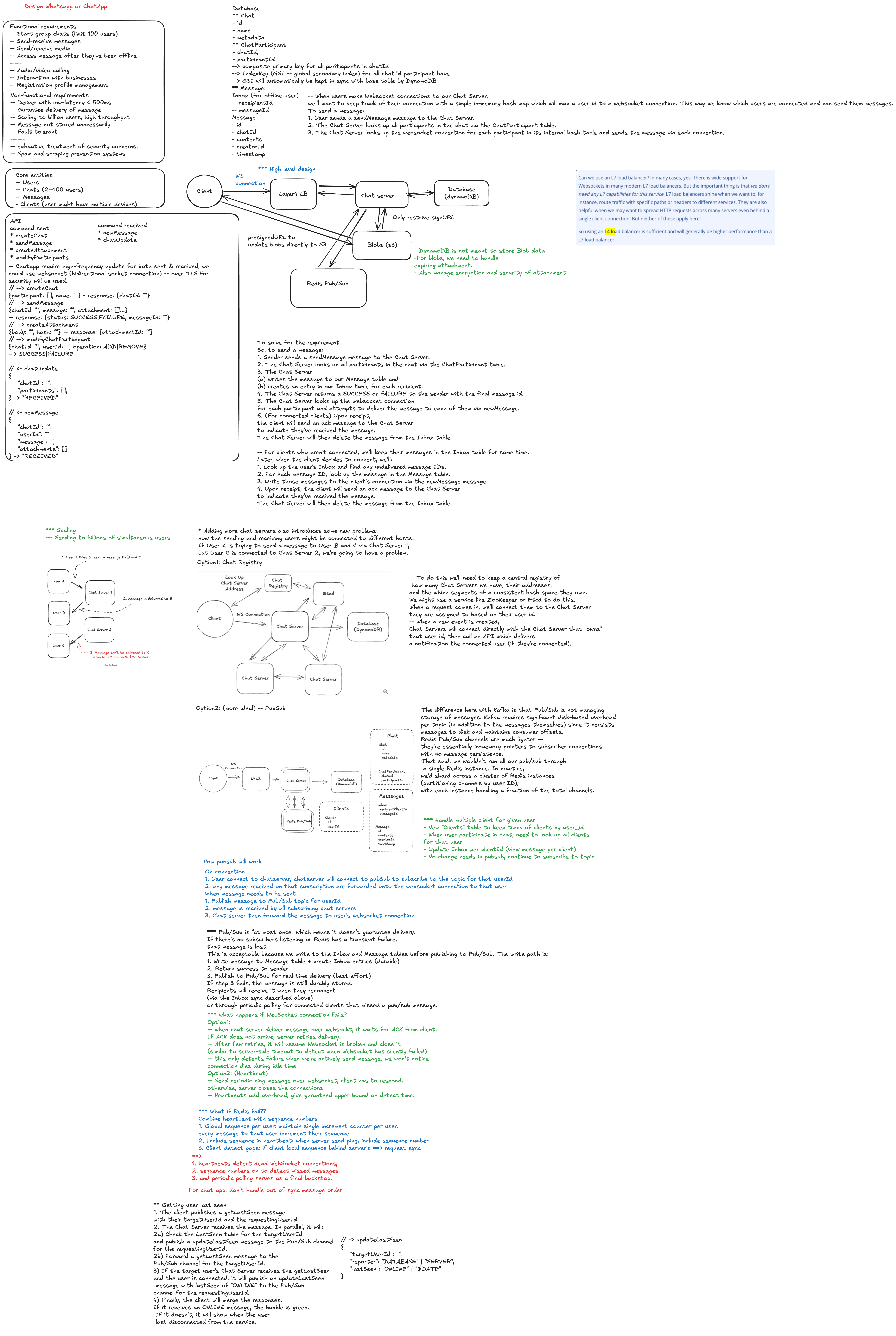
WhatsApp-Style Chat Application System Design
Interview Goal
Design a private messaging product supporting one-to-one conversations, group chat, media attachments, delivery receipts, presence, offline delivery, and multiple devices.
At staff level, connect frontend and backend decisions to product outcomes:
- Messages should feel immediate.
- Accepted messages should not silently disappear.
- Retries should not create duplicates.
- Conversation ordering should be understandable.
- Offline and weak-network behavior should be intentional.
- Private content should remain protected.
- Optional features should not make core messaging unavailable.
This is a conceptual design for a WhatsApp-style product, not a description of any company's private implementation.
Staff-Level Checklist
Frontend
- Conversation list, message timeline, composer, and media flows.
- Optimistic sending and explicit message state.
- WebSocket lifecycle, reconnect, resume, and deduplication.
- Offline outbox and local persistence.
- Pagination, virtualization, scroll anchoring, and unread markers.
- Multi-device synchronization and conflict handling.
- Accessibility, localization, and weak-device performance.
Backend
- Connection gateway and session management.
- Durable message acceptance and idempotency.
- Conversation sequencing and delivery fan-out.
- Offline inboxes, push notifications, and receipts.
- Group membership and authorization.
- Media upload and download pipeline.
- Multi-region routing, storage, and disaster recovery.
- End-to-end encryption and metadata minimization.
- Abuse controls, observability, and capacity planning.
Product
- Define what sent, delivered, and read actually mean.
- Prioritize messaging over presence, typing, and analytics.
- Design graceful behavior for poor networks and low-end devices.
- Provide transparent privacy and safety controls.
- Protect users from spam without weakening private communication.
- Roll out protocol changes without abandoning older clients.
1. Clarify Requirements
Functional requirements
- Register and authenticate users.
- Start one-to-one and group conversations.
- Send text, emoji, reactions, replies, and edits when supported.
- Upload images, video, audio, and documents.
- Show sent, delivered, and read states.
- Show typing and online presence when privacy settings allow it.
- Deliver messages to temporarily offline users.
- Synchronize history across a user's linked devices.
- Send push notifications to backgrounded or disconnected devices.
- Search local or server-visible metadata according to the privacy model.
- Block and report abusive users.
Non-functional requirements
- Low perceived send latency.
- Durable acceptance of messages.
- At-least-once transport with effective exactly-once user experience.
- Deterministic ordering within a conversation.
- High availability under regional or dependency failures.
- Efficient operation on weak networks and low-memory devices.
- Strong tenant and user isolation.
- Privacy-preserving content and metadata handling.
- Horizontal scale for connections, messages, groups, and media.
Questions to ask
- Is end-to-end encryption required?
- What does delivery mean: server accepted, recipient device received, or all devices received?
- How many users and concurrent connections should we support?
- What is the maximum group size?
- How many linked devices can one user have?
- Is full cross-device history required?
- Are message edits and deletion supported?
- What media types and maximum file sizes are required?
- Is global multi-region operation required?
- Are presence, read receipts, and search configurable for privacy?
2. Define Product Semantics First
Ambiguous product semantics create inconsistent implementations.
Message states
draft
  -> queued locally
  -> sending
  -> accepted by server
  -> delivered to recipient device
  -> read

Any transient state may become failed or retrying.
Possible definitions:
- Queued: stored in the sender's local outbox.
- Sent: durably accepted by the messaging service.
- Delivered: at least one recipient device acknowledged receipt.
- Read: the recipient opened the conversation and acknowledged a read position.
For groups, decide whether delivery and read status are per member, aggregated, or omitted above a size threshold.
Ordering
Do not promise a meaningful global order across all conversations. A practical contract is:
- The server assigns a monotonic sequence within each conversation.
- The client preserves local optimistic order before acknowledgement.
- Messages with the same timestamp are ordered by sequence or stable ID.
- Late messages are inserted by server sequence without surprising scroll jumps.
Delivery guarantee
Exactly-once transport is unrealistic across retries and failures. Build:
- At-least-once delivery.
- Stable client-generated message IDs.
- Idempotent server acceptance.
- Client and server deduplication.
This produces an effectively exactly-once experience for users.
3. Critical User Flows
Send a message
- Client creates a stable message ID.
- Message is written to the local outbox.
- UI renders it optimistically as queued or sending.
- Client sends it over WebSocket or an HTTP fallback.
- Gateway authenticates the device and validates the envelope.
- Messaging service verifies conversation membership.
- Message is durably stored and assigned a conversation sequence.
- Server acknowledges the sender.
- Fan-out delivers the message to recipient devices or offline inboxes.
- Recipient acknowledgements update delivery state.
- Push notifications are scheduled when necessary.
Receive after reconnecting
- Client reconnects with device ID and last acknowledged cursor.
- Server authenticates the session.
- Missing messages are fetched from the durable inbox or sync service.
- Client deduplicates by message ID.
- Client persists messages before advancing its acknowledgement cursor.
- Live delivery resumes after catch-up.
Upload media
- Client requests an upload session.
- Backend returns a short-lived signed upload URL.
- Client uploads directly to object storage.
- Media pipeline scans, validates, and creates derivatives.
- Client sends a message containing the encrypted media reference and metadata.
- Recipients download through a CDN using authorized URLs.
4. High-Level Architecture
Web / Mobile / Desktop Clients
  |
  +-- WebSocket: messages, receipts, presence, typing
  +-- HTTPS: history, media sessions, account and group management
  |
Global Edge / Load Balancer
  |
  +-- Connection Gateway
  +-- Authentication and Device Session Service
  |
Messaging Platform
  |
  +-- Message Acceptance Service
  +-- Conversation Sequencer
  +-- Delivery and Fan-out Service
  +-- Offline Inbox / Sync Service
  +-- Group and Membership Service
  +-- Receipt Service
  +-- Presence Service
  +-- Push Notification Service
  |
Media Platform
  |
  +-- Upload Service
  +-- Object Storage
  +-- Scan / Transcode / Thumbnail Workers
  +-- CDN
  |
Data Platform
  |
  +-- Message Store
  +-- Conversation Metadata Store
  +-- Device and Membership Store
  +-- Event Stream
  +-- Analytics and Abuse Systems
Separate durable messaging from ephemeral presence and typing. Messaging should continue if presence, analytics, media processing, or push notification systems are degraded.
5. Frontend Architecture
Main modules
| Module | Responsibility |
|---|---|
| Conversation list | Recent conversations, unread counts, and pagination |
| Message timeline | Rendering, grouping, receipts, unread boundary, and virtualization |
| Composer | Drafts, attachments, replies, and send actions |
| Connection manager | WebSocket lifecycle, heartbeat, reconnect, and resume |
| Outbox | Durable pending messages and retries |
| Sync engine | History catch-up, deduplication, and cursor management |
| Local database | Conversations, messages, drafts, and media metadata |
| Media manager | Uploads, downloads, thumbnails, and progress |
| Notification manager | Foreground notifications and deep-link behavior |
State ownership
Keep durable message state in a normalized local database rather than only in component state.
conversationsById
messagesById
messageIdsByConversation
outboxByMessageId
syncCursorByConversation
draftByConversation
uploadByAttachmentId
React or the UI framework should subscribe to focused queries. Replacing a large message array on every receipt or token update causes unnecessary rendering.
Optimistic sending
- Generate the message ID before network submission.
- Persist the message and outbox entry atomically.
- Render immediately with a queued state.
- Reuse the same ID on every retry.
- Replace temporary metadata with server sequence and timestamps after acknowledgement.
- Expose manual retry for terminal failures.
- Never silently remove a failed message.
Connection management
The client should:
- Authenticate the connection with a short-lived device token.
- Send heartbeats and detect half-open connections.
- Reconnect with exponential backoff and jitter.
- Pause aggressive reconnecting when offline or backgrounded.
- Resume from the last durable acknowledgement cursor.
- Detect sequence gaps and request catch-up.
- Refresh credentials without losing the local outbox.
- Fall back to HTTPS submission when appropriate.
Message timeline performance
- Load recent messages first and paginate backward.
- Virtualize long conversations.
- Preserve scroll position when older messages are prepended.
- Anchor scrolling to stable message IDs.
- Avoid auto-scrolling when the user reads older messages.
- Show a new-message indicator instead.
- Reserve media dimensions to prevent layout shift.
- Lazy-load media and expensive message types.
Offline behavior
- Store drafts and queued messages locally.
- Allow text composition without connectivity.
- Clearly distinguish queued, retrying, and failed states.
- Resume uploads when feasible.
- Reconcile acknowledgements and remote messages after reconnecting.
- Bound storage and provide predictable cleanup behavior.
6. Backend Message Acceptance
The write path should be short and durable:
1. Authenticate user and device.
2. Validate message size and schema.
3. Verify active conversation membership.
4. Check idempotency by sender device and message ID.
5. Assign conversation sequence.
6. Persist the message and acceptance result.
7. Acknowledge the sender.
8. Publish a durable delivery event.
Avoid acknowledging a message before it reaches durable storage or a replicated log that can recover the write.
Use an outbox pattern, transactional log, or change-data capture so persistence and delivery publication cannot diverge silently.
7. Message Data Model
Message
  conversation_id
  sequence
  message_id
  sender_user_id
  sender_device_id
  client_created_at
  server_accepted_at
  type
  encrypted_payload
  attachment_refs[]
  reply_to_message_id
  status
Conversation
  conversation_id
  type: direct | group
  created_at
  latest_sequence
  membership_version
DeviceCursor
  device_id
  conversation_id
  last_delivered_sequence
  last_read_sequence
Partition messages by conversation ID, with sequence as the clustering key. This supports ordered range reads and pagination within a conversation.
Very large groups may require additional partitioning to prevent one hot conversation from overwhelming a shard.
8. Fan-Out Strategy
Fan-out on write
Create delivery entries for every recipient device when a message is accepted.
Advantages:
- Fast recipient reads.
- Simple offline inbox consumption.
Disadvantages:
- Expensive for large groups.
- Membership and device fan-out can amplify writes significantly.
Fan-out on read
Store one conversation message and let recipients query new sequences.
Advantages:
- Lower write amplification.
- Better for very large groups or channels.
Disadvantages:
- More expensive reads.
- Requires efficient membership and cursor queries.
Hybrid approach
- Fan out direct messages and small groups on write.
- Use shared logs and per-user cursors for large groups.
- Select strategy by group size and activity.
9. Group Membership
Group operations need a clear versioned membership model:
- Add and remove members.
- Promote and demote administrators.
- Leave a group.
- Change group metadata.
- Enforce maximum size.
Every message should be authorized against the relevant membership version. Define whether a removed member can receive messages accepted concurrently with removal and whether a newly added member receives prior history.
Under end-to-end encryption, membership changes may require encryption-key rotation and distribution to remaining devices.
10. Multi-Device Synchronization
Treat each linked device as an independent delivery endpoint:
- Each device has authentication credentials and delivery cursors.
- Sender messages are synchronized to the sender's other devices.
- New devices require an explicit history-transfer or server-sync policy.
- Device revocation should stop future delivery quickly.
- Receipts should identify device or aggregate to user-level product semantics.
Avoid assuming one user's devices are always online simultaneously.
11. Presence and Typing
Presence and typing are ephemeral:
- Keep them in memory or a short-lived distributed store.
- Use leases and heartbeats.
- Throttle and coalesce updates.
- Drop stale events rather than queueing them indefinitely.
- Enforce privacy settings before subscription.
- Degrade silently when the presence service is unavailable.
Do not put presence updates into the durable message log.
12. Receipts
Model receipts as monotonic cursors when possible:
recipient device D has delivered through sequence 428
recipient user U has read through sequence 421
This is more compact than storing one receipt row per message.
Requirements:
- Receipt updates must never move backward.
- Duplicate updates should be harmless.
- Privacy settings may disable read receipts.
- Group receipt detail may be bounded or summarized.
- Receipt failure must not block message delivery.
13. Media Pipeline
- Upload directly to object storage with short-lived signed URLs.
- Validate size, type, and checksums.
- Scan content according to product policy.
- Generate thumbnails and compatible derivatives asynchronously.
- Encrypt media with per-object keys for end-to-end encrypted products.
- Deliver through a CDN.
- Use resumable and chunked uploads for large files.
- Allow text messages to send even when attachments fail.
- Expire abandoned uploads.
Do not route large media bytes through WebSocket messaging servers.
14. End-to-End Encryption
With end-to-end encryption:
- Clients encrypt message content before upload.
- Servers route ciphertext and cannot inspect plaintext.
- Devices manage identity keys and session keys.
- Group membership changes require secure key updates.
- New-device linking requires a trusted verification flow.
- Backups need a separate encryption and recovery design.
Product trade-offs:
- Server-side full-text search becomes unavailable or limited.
- Content moderation relies more on metadata, user reports, and client-side signals.
- Lost keys may mean unrecoverable history.
- Multi-device synchronization and backup restoration become more complex.
Be precise: transport encryption protects network traffic, while end-to-end encryption prevents intermediaries, including the service, from reading content.
15. Multi-Region Design
Possible routing model:
- Assign each conversation or user a home region.
- Route message writes to the authoritative region.
- Maintain connections at nearby edges.
- Forward accepted messages through the backbone to recipient regions.
- Replicate durable logs for disaster recovery.
Trade-offs:
- A single conversation authority simplifies ordering.
- Cross-region writes increase latency.
- Active-active sequencing is more complex.
- Regional failover must prevent conflicting sequence assignments.
During a home-region outage, choose explicitly between:
- Temporarily delaying writes to preserve ordering.
- Failing over with a consensus or lease transfer.
- Accepting limited local writes that require later reconciliation.
16. Push Notifications
Push is a wake-up hint, not the source of truth:
- Trigger push after durable message acceptance.
- Suppress it when the target device is actively connected to the conversation.
- Avoid including sensitive plaintext on locked screens by default.
- Collapse notifications when providers support it.
- Retry provider failures asynchronously.
- Fetch authoritative messages from the sync service after wake-up.
Messaging must still work when APNs, FCM, or another push provider is delayed.
17. Reliability and Failure Handling
| Failure | Expected behavior |
|---|---|
| Sender loses connection after sending | Retry with the same message ID |
| Duplicate submission arrives | Return the original acceptance result |
| Recipient is offline | Persist delivery state and notify later |
| WebSocket sequence gap appears | Pause live application and fetch missing messages |
| Presence service fails | Continue messaging without presence |
| Push provider fails | Queue or retry notification; message remains available |
| Media processing fails | Preserve text and show attachment failure |
| One region fails | Route according to the conversation failover policy |
| Receipt is duplicated | Apply monotonic cursor update idempotently |
| Analytics pipeline fails | Buffer or drop by policy; never block messages |
Retries should be bounded and jittered. Backpressure should protect overloaded gateways, brokers, stores, and recipient devices.
18. Security, Privacy, and Abuse
- Authenticate users and individual devices.
- Authorize every conversation and group action.
- Rotate and revoke device credentials.
- Rate-limit registration, messaging, group invitations, and media uploads.
- Detect spam campaigns and automated abuse using privacy-aware metadata.
- Support block, report, leave, and invitation controls.
- Protect contact discovery from enumeration.
- Minimize retention of IP addresses and unnecessary social-graph metadata.
- Keep administrative access auditable.
- Design legal and safety workflows that match the encryption model.
User reports should contain only the information users intentionally submit, especially in an end-to-end encrypted product.
19. Capacity Planning
Estimate:
- Daily and peak active users.
- Concurrent connections.
- Messages per user per day.
- Peak messages per second.
- Average message-envelope size.
- Average devices per user.
- Direct versus group-message ratio.
- Fan-out amplification.
- Media uploads and CDN bandwidth.
- Offline retention duration.
- Receipt, presence, and typing-event volume.
Connection capacity and message throughput are different dimensions. A gateway may hold millions of mostly idle connections but process far fewer messages per second.
20. Observability
Product quality metrics
- Send success rate.
- Time from local send to server acceptance.
- Time from acceptance to recipient delivery.
- Offline catch-up latency.
- Duplicate-message and ordering anomaly rates.
- Failed and retried message rate.
- Media upload success and completion time.
- Crash-free and reconnect-success rates.
Service metrics
- Concurrent connections and reconnect storms.
- Gateway CPU, memory, and outbound buffer depth.
- Message-store write and read latency.
- Broker lag and fan-out queue depth.
- Hot conversations and partitions.
- Push-provider latency and failures.
- Regional replication lag.
Trace with message, conversation, device, and request IDs while avoiding plaintext content and sensitive relationship data.
21. Accessibility and Inclusive Product Design
- Make the conversation list and timeline keyboard navigable.
- Announce new messages without overwhelming screen-reader users.
- Provide accessible names for media and icon controls.
- Support text scaling and large touch targets.
- Do not rely only on color for delivery state.
- Respect reduced-motion preferences.
- Design for right-to-left languages and locale-specific timestamps.
- Provide captions or transcripts for supported media where possible.
- Test on low-memory devices and poor networks.
22. Testing Strategy
- Unit-test message state transitions and outbox retry behavior.
- Contract-test WebSocket events and version compatibility.
- Test duplicate, delayed, missing, and out-of-order messages.
- Test disconnect immediately before and after acknowledgement.
- Test offline sending followed by reconnect and catch-up.
- Test group membership races.
- Test multi-device delivery and device revocation.
- Load-test reconnect storms and hot groups.
- Chaos-test gateways, brokers, stores, regions, and push providers.
- Verify encryption-key rotation and device-linking flows.
- Test accessibility, localization, and weak-device performance.
23. Staff-Level Product Care
A staff-level design should make user trust visible in technical choices.
Protect the core promise
- Message delivery is more important than presence or analytics.
- Never show a sent state before durable acceptance.
- Never discard failed messages without telling the sender.
- Keep retries idempotent and understandable.
Design for real-world networks
- Assume mobile clients move between Wi-Fi and cellular networks.
- Expect suspended apps, expired credentials, and clock drift.
- Preserve drafts and outbox entries through crashes.
- Make recovery automatic without hiding terminal failures.
Respect privacy
- Make read receipts, presence, and previews configurable.
- Minimize metadata collection and retention.
- Explain security boundaries accurately.
- Provide clear device and session management.
Manage product complexity
- Version protocols so older clients continue to function.
- Roll out receipts, edits, reactions, and media independently.
- Use feature flags and capability negotiation.
- Degrade optional features before core messaging.
- Define ownership across client, messaging, media, identity, privacy, and safety teams.
Set meaningful objectives
Establish service-level objectives for:
- Durable message acceptance.
- End-to-end delivery latency.
- Offline catch-up.
- Reconnect success.
- Duplicate and ordering correctness.
- Media reliability.
- Privacy and security incident response.
24. Important Trade-offs
- Strong ordering versus multi-region write latency.
- Fan-out on write versus fan-out on read.
- At-least-once delivery versus duplicate handling.
- Rich presence versus privacy and infrastructure cost.
- Server-side search versus end-to-end encryption.
- Full history sync versus storage and key-management complexity.
- Exact group receipts versus write amplification.
- Immediate failover versus sequence consistency.
- Long offline retention versus storage cost.
- Aggressive spam detection versus false positives and privacy.
Interview Closing Summary
Start with product semantics: what sent, delivered, read, ordered, and deleted mean. Then design a durable message-acceptance path with stable IDs, conversation sequencing, idempotent retries, fan-out, offline inboxes, and multi-device cursors.
On the frontend, emphasize optimistic sending backed by a durable outbox, reconnect and resume behavior, timeline performance, media handling, and clear failure states.
The staff-level difference is care for the whole product: protect user trust, make optional systems degradable, respect privacy, support poor networks, measure user-visible delivery quality, and evolve protocols safely across many client versions and engineering teams.