I would design this as a distributed token-bucket rate limiter integrated into the API gateway. Each request is identified by API key, org, project, endpoint, and model. The gateway asks a rate limiter service whether the request can proceed. For the first version, I would store bucket state in Redis and use Lua scripts to atomically refill and deduct tokens. For OpenAI APIs, I would enforce both request-per-minute and token-per-minute limits. Since output tokens are unknown before generation, I would reserve based on estimated input plus max output tokens, then reconcile after the response using actual token usage. At larger scale, I would move from a centralized Redis model to regional quota leasing, where each region receives a portion of global quota and enforces locally, while usage events are streamed for reconciliation, billing, and abuse detection. This gives low latency, high availability, and bounded quota error across regions.
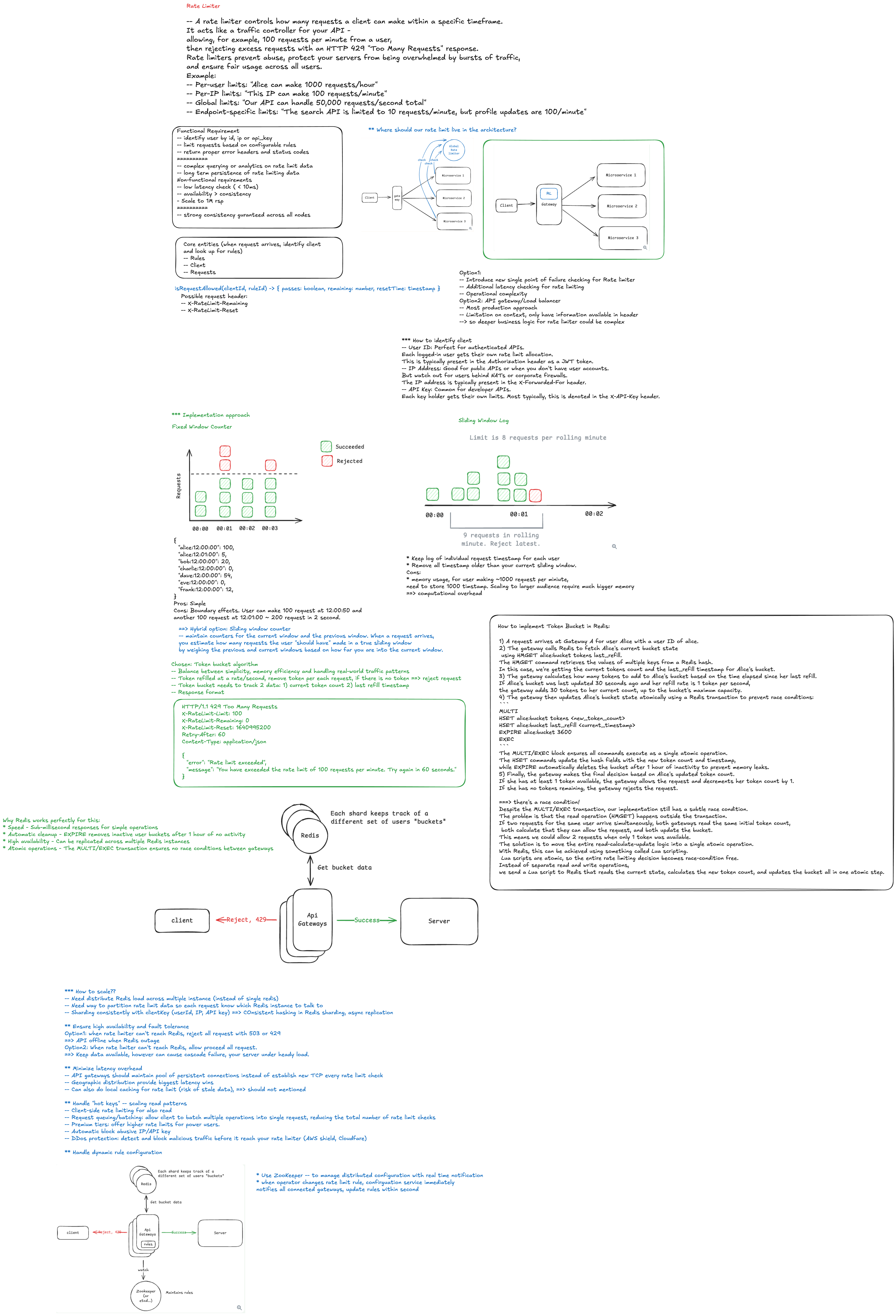
Rate Limiter System Design
Interview Goal
Design a rate limiter that protects APIs and backend systems from abusive, buggy, or unexpectedly high traffic while keeping legitimate users productive.
At staff level, do more than name token bucket or Redis. Clarify the product policy, fairness model, consistency requirements, placement in the stack, failure behavior, operational controls, and how teams safely change limits over time.
Staff-Level Checklist
- Clarify who or what is being limited: user, IP, tenant, API key, endpoint, or device.
- Define hard limits, soft limits, burst limits, and quotas.
- Choose algorithm by product behavior, not by memorized popularity.
- Decide where rate limiting runs: client, edge, gateway, service, or background worker.
- Design distributed counters and consistency trade-offs.
- Define behavior during cache, Redis, region, or config failures.
- Return useful response headers and retry guidance.
- Protect high-value resources such as login, search, LLM inference, media upload, and writes.
- Support tiered plans, overrides, allowlists, and emergency blocks.
- Add observability for denied traffic, near-limit users, and false positives.
- Make config changes safe through versioning, audit logs, canaries, and rollback.
1. Clarify Requirements
Functional requirements
- Allow or reject a request according to configured limits.
- Support multiple dimensions such as user ID, API key, tenant ID, IP, route, and region.
- Support different limits by endpoint and customer tier.
- Allow short bursts while controlling long-term average rate.
- Return retry information when a request is rejected.
- Expose administrative controls for overrides, blocks, and emergency changes.
- Emit metrics and audit logs for accepted and rejected decisions.
Non-functional requirements
- Low decision latency, usually single-digit milliseconds at the gateway.
- Highly available and safe under dependency failures.
- Horizontally scalable across gateways and regions.
- Resistant to key explosion and high-cardinality attacks.
- Predictable behavior for legitimate users near the limit.
- Configurable without deploying application code.
- Auditable because rate limits directly affect customer access.
Questions to ask
- Are we protecting a public API, internal API, login flow, or expensive compute resource?
- Should limits be strict or approximate?
- What is the request volume and peak QPS?
- Is traffic global and multi-region?
- Are limits per user, tenant, IP, API key, route, or a combination?
- Do paid tiers get different limits?
- What should happen if the limiter store is unavailable?
- Is it acceptable to temporarily over-allow during outages?
- Do we need monthly quota, per-minute rate, and burst control?
- Are denied requests billable or visible in analytics?
2. Product Policy Comes First
Rate limiting is product policy expressed as infrastructure.
Examples:
Free user:
  60 requests per minute
  burst up to 10 requests
  10,000 requests per month

Enterprise tenant:
  5,000 requests per minute
  burst up to 500 requests
  custom monthly quota

Login endpoint:
  5 attempts per minute per account
  20 attempts per hour per IP block
Define:
- What entity is being protected.
- What entity is being limited.
- What time window matters.
- Whether burst traffic is allowed.
- Whether the decision must be globally strict.
- Whether legitimate traffic should degrade or be blocked.
3. Common Algorithms
Fixed window counter
Counts requests in a fixed interval, such as one minute.
key = user:123:/search:2026-06-19T10:42
count <= limit
Advantages:
- Simple and cheap.
- Easy to implement with atomic increment and TTL.
- Works well for coarse quotas.
Disadvantages:
- Boundary burst problem: a user can send limit requests at the end of one window and limit requests at the start of the next.
Use for:
- Daily or monthly quotas.
- Simple low-risk endpoints.
- Internal systems where precision is not critical.
Sliding window log
Stores timestamps for each request and removes expired entries.
Advantages:
- Accurate rolling-window behavior.
- Easy to reason about.
Disadvantages:
- Memory grows with request volume.
- Expensive for high-QPS users.
Use for:
- Low-volume but high-value actions such as password reset or account creation.
- Interview clarity when exact behavior matters.
Sliding window counter
Approximates a rolling window by weighting the previous fixed window.
estimated = currentWindowCount + previousWindowCount * overlapRatio
Advantages:
- Lower memory than timestamp logs.
- Smoother than fixed windows.
Disadvantages:
- Approximate.
- More complex than fixed windows.
Use for:
- API gateway limits where small approximation is acceptable.
Token bucket
Tokens refill at a configured rate up to a maximum capacity. Each request consumes one or more tokens.
Advantages:
- Supports bursts naturally.
- Controls long-term average rate.
- Common fit for APIs.
Disadvantages:
- Requires careful distributed state management.
- Users may experience bursty accept/reject behavior near empty bucket.
Use for:
- General API limits.
- Expensive operations with weighted costs.
- User or tenant traffic shaping.
Leaky bucket
Requests enter a queue and drain at a fixed rate.
Advantages:
- Smooths traffic.
- Useful when downstream systems prefer steady load.
Disadvantages:
- Adds queueing latency.
- Requires queue length, timeout, and backpressure decisions.
Use for:
- Background jobs.
- Webhook delivery.
- Systems where smoothing is better than immediate rejection.
4. Where to Apply Rate Limits
Client-side hints
- Useful for reducing accidental traffic.
- Cannot be trusted for enforcement.
Edge or CDN
- Best for IP-based abuse, bots, and volumetric traffic.
- Very low latency and protects origin.
- Has limited user context unless tokens are inspected.
API gateway
- Good default for authenticated API limits.
- Centralizes policy across services.
- Can return consistent headers and error formats.
Service-level limiter
- Required for resource-specific limits.
- Knows domain context, such as model type, upload size, or account risk.
- Should complement, not replace, gateway protection.
Background workers
- Useful for queues and asynchronous workloads.
- Can smooth downstream calls and third-party API usage.
Staff-level answer: apply layered limits. A login endpoint, for example, may need IP, account, device, and tenant-level protections at different layers.
5. High-Level Architecture
Client
  |
Edge / CDN
  |  IP and bot protection
  v
API Gateway
  |  user, API key, tenant, route limits
  v
Service
  |  domain-specific limits and weighted costs
  v
Backend dependency
Shared components:
Rate Limit Config Service
  -> versioned policies
  -> rollout and override controls

Decision Engine
  -> parses identity and route
  -> builds limit keys
  -> evaluates algorithm
  -> returns allow, deny, or degrade

Counter Store
  -> Redis, distributed cache, local memory, or durable quota store

Telemetry Pipeline
  -> metrics, audit logs, abuse signals, billing events
6. Data Model and Keys
Example rate-limit key:
tenant:{tenantId}:user:{userId}:route:{routeGroup}:minute
Avoid raw unbounded values in keys without normalization. Attackers can create many unique keys and exhaust memory.
Key dimensions:
- Tenant ID.
- User ID.
- API key.
- IP or IP prefix.
- Device ID.
- Route group.
- HTTP method.
- Region.
- Model or resource class.
Use route groups instead of exact URLs when URLs contain IDs or query strings.
7. Distributed Counter Design
Centralized store
Use Redis or another low-latency atomic counter store.
Advantages:
- Simple mental model.
- Stronger cross-gateway consistency.
- Easy to inspect and reset.
Disadvantages:
- Adds network latency to every decision.
- Store outage can affect all traffic.
- Hot keys can overload one shard.
Local counters with periodic sync
Each gateway keeps local counters and syncs periodically.
Advantages:
- Very fast and highly available.
- Survives remote store latency.
Disadvantages:
- Approximate global limits.
- Can over-allow under high concurrency or outages.
Sharded quotas
Pre-allocate part of a global limit to each region or gateway.
Advantages:
- Lower coordination cost.
- Bounds over-allowing.
Disadvantages:
- Unused quota in one shard may not help another shard.
- Requires rebalancing.
Hybrid approach
- Use local in-memory buckets for low-latency burst decisions.
- Reconcile against a shared store for stronger long-term limits.
- Use strict central checks for high-risk actions.
This is often the staff-level answer: match consistency cost to risk.
8. Multi-Region Behavior
Questions:
- Is a user's limit global or region-local?
- Can requests from the same user hit multiple regions at once?
- Is temporary overage acceptable?
- How quickly must config changes propagate?
Options:
- Route each user or tenant to a home region.
- Use globally replicated counters with higher latency.
- Allocate regional quota slices.
- Accept approximate regional limits and enforce strict monthly quota later.
For public APIs, approximate per-minute regional enforcement plus strict billing/quota reconciliation is often reasonable. For login abuse or financial actions, stricter coordination may be required.
9. Failure Modes
| Failure | Possible behavior |
|---|---|
| Counter store unavailable | Fail open, fail closed, or use local fallback |
| Config service unavailable | Continue using last known good config |
| Redis shard hot | Split keys, add local cache, or shard by subkey |
| Gateway restarts | Recover from shared store or accept local counter loss |
| Region partition | Enforce regional limits and reconcile later |
| Clock skew | Use store-side time or monotonic server time |
| Telemetry pipeline down | Continue decisions and buffer/drop logs by policy |
Fail open versus fail closed
Fail open:
- Better user availability.
- Risk of abuse and downstream overload.
Fail closed:
- Protects infrastructure and sensitive endpoints.
- Can cause broad customer-facing outage.
Use risk-based behavior:
- Fail closed for login brute force, payments, and dangerous mutations.
- Fail open or degrade for low-risk read endpoints.
- Use stale/local fallback for core product flows.
10. Response Contract
When rejecting a request:
HTTP/1.1 429 Too Many Requests
Retry-After: 12
X-RateLimit-Limit: 60
X-RateLimit-Remaining: 0
X-RateLimit-Reset: 1718820020
Response body:
{
  "error": "rate_limited",
  "message": "Too many requests. Try again in 12 seconds.",
  "retryAfterSeconds": 12
}
Staff-level detail:
- Do not expose sensitive internal policy names.
- Provide actionable retry information.
- Make error formats consistent across APIs.
- For streaming APIs, define whether limits are checked at start, per token, or by weighted cost.
11. Weighted Limits
Not all requests cost the same.
Examples:
GET /profile: 1 token.POST /search: 5 tokens.POST /upload: based on file size.- LLM request: based on input tokens, output tokens, model, and tools.
Weighted token buckets are useful when protecting expensive resources. The limiter can reserve estimated cost upfront and adjust after completion if exact cost is only known later.
12. Abuse and Fairness
Rate limiting should separate:
- accidental client bugs,
- normal bursty use,
- scraping,
- credential stuffing,
- spam,
- denial-of-service traffic.
Controls:
- Per-IP and per-account limits.
- Tenant-level aggregate limits.
- Device or session limits.
- Progressive challenges such as CAPTCHA.
- Temporary blocks and risk scoring.
- Allowlist for trusted internal systems.
- Customer-specific overrides with expiration.
Fairness questions:
- Can one user consume all tenant quota?
- Should background tasks be lower priority than interactive requests?
- Should paid users get reserved capacity?
- Should retries count against the limit?
13. Observability
Track:
- Allowed and denied decisions by key type, route, tenant, and region.
- Near-limit users and tenants.
- Store latency and error rate.
- Config version used for each decision.
- Hot keys and key cardinality.
- Estimated over-allow during fallback mode.
- False-positive reports and customer escalations.
- Downstream saturation despite accepted traffic.
- 429 rate correlated with product conversion or task success.
Logs should include decision metadata but avoid sensitive raw identifiers when possible. Hash or tokenize keys where appropriate.
14. Configuration and Operations
Rate-limit configuration should be:
- Versioned.
- Audited.
- Validated before rollout.
- Tested in shadow mode.
- Rollable by region, tenant, route, and percentage.
- Revertible quickly.
Support:
- Dry-run mode that logs would-be denies without blocking.
- Emergency global blocks.
- Temporary customer overrides.
- Expiring allowlist entries.
- Policy simulation from production traces.
This is a staff-level operational point: the limiter will be changed often during incidents, launches, abuse events, and customer escalations.
15. Testing Strategy
- Unit-test each algorithm and boundary condition.
- Test distributed concurrency and duplicate requests.
- Test burst behavior at window boundaries.
- Test config rollout and rollback.
- Test hot-key and high-cardinality attacks.
- Test Redis or counter-store outages.
- Test multi-region partitions.
- Load-test gateway decision latency.
- Validate
Retry-Afterand rate-limit headers. - Shadow-test policies before enforcement.
- Chaos-test fallback behavior.
16. Important Trade-offs
- Strict global limits versus latency and availability.
- Fail open versus fail closed.
- Token bucket burstiness versus leaky bucket smoothing.
- Centralized counters versus local approximations.
- Per-user fairness versus tenant-level simplicity.
- Low cardinality keys versus precise policy.
- Exact analytics versus low decision latency.
- Dynamic configuration versus operational risk.
- Customer experience versus infrastructure protection.
- Blocking abuse versus avoiding false positives.
Interview Closing Summary
Start by defining the policy: who is limited, what resource is protected, and what behavior is acceptable near or above the limit. Then choose the algorithm and placement.
A strong staff-level design uses layered enforcement, low-latency counters,
safe configuration, risk-based failure modes, clear 429 responses, and
observability that detects both abuse and false positives. The best answer
shows care for product experience as much as infrastructure protection.