Yelp — Local Business Search & Reviews
Editable diagram: Open in Excalidraw
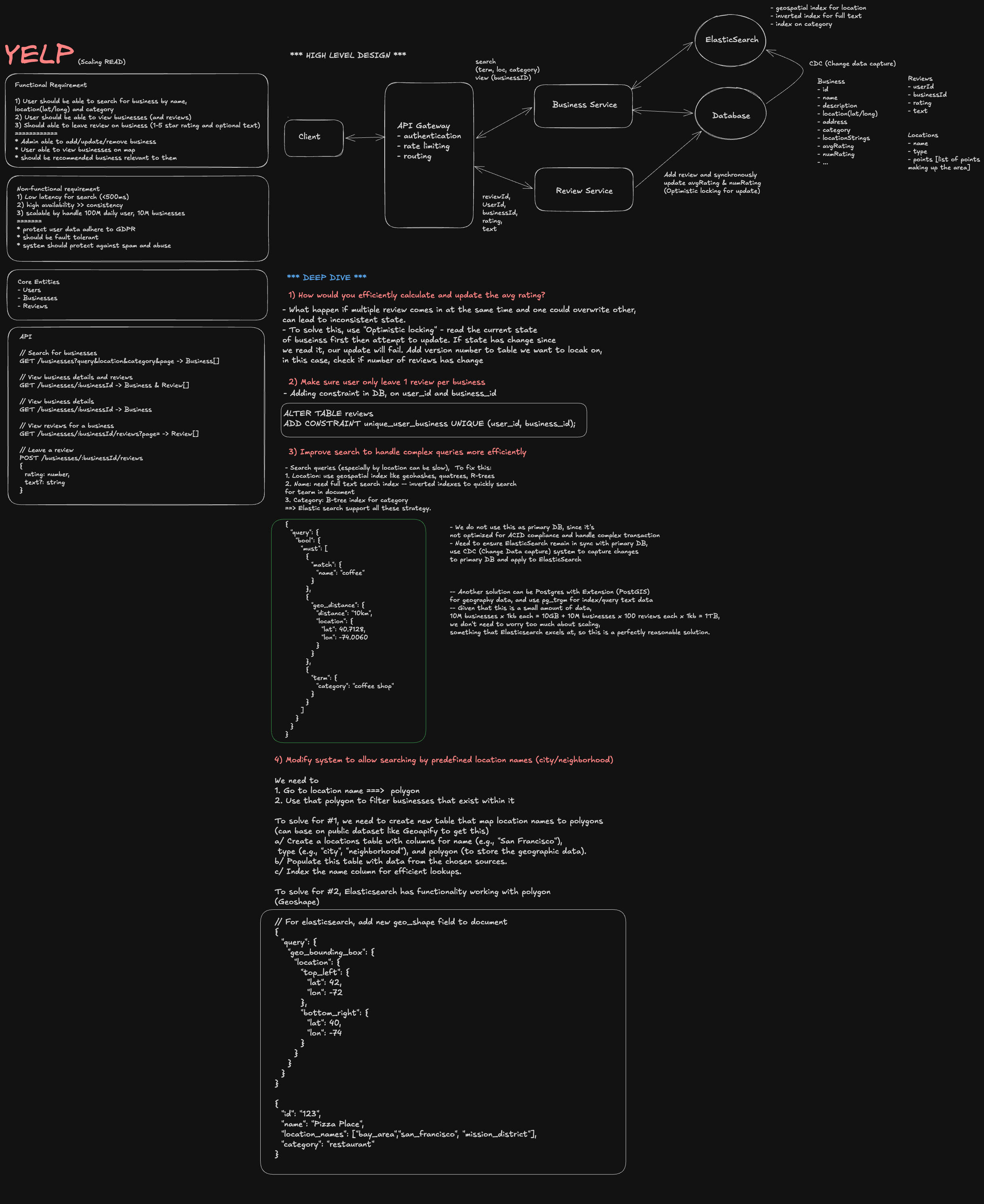
Problem Statement
Design a system like Yelp that allows users to discover local businesses, read and write reviews, and search by location, category, and rating. This is a geo-spatial search, content management, and social platform problem combined.
Scale & Requirements
Functional
- Business owners can register and manage their business listing (name, address, category, hours, photos)
- Users can search for businesses by location + keyword + filters (category, rating, price range, open now)
- Users can write reviews (text + star rating 1–5) and upload photos
- Users can view a business profile: info, aggregate rating, paginated reviews, photos
- Personalized recommendations (nearby trending, similar to past visits)
Non-Functional
- Search: p99 latency <200ms for geo+keyword queries
- Reviews: Eventual consistency acceptable; reviews visible within seconds
- Scale: 100M businesses globally, 200M monthly active users, 50M reviews/day reads, 500K reviews/day writes
- Availability: 99.99% for search and business profiles
- Geo precision: Support radius search (1km–50km), bounding box, city-level
Scale Estimates
- Businesses: 100M × 1KB metadata = 100GB — fits in memory for a hot index
- Reviews: 500K writes/day × 365 = ~180M/year; avg 500 bytes = 90GB/year
- Photos: 2 photos/review avg, 250KB each → 1M photos/day → 3.5TB/month (object storage)
- Search QPS: 200M MAU × 10 searches/day / 86400 ≈ 23K QPS peak
High-Level Architecture
┌──────────────────────────────────────────────────────────────────────┐
│                          Write Path                                  │
│  Business Registration / Review Submit                               │
│  → API Gateway → Write Service → DB (Postgres)                      │
│                              → Event (Kafka)                         │
│                              → Search Index Updater → Elasticsearch  │
│                              → Photo Upload → S3 → CDN               │
└──────────────────────────────────────────────────────────────────────┘

┌──────────────────────────────────────────────────────────────────────┐
│                          Read Path                                   │
│  Search Query (lat/lng + keyword + filters)                          │
│  → API Gateway → Search Service → Elasticsearch (geo+text)          │
│                                → Redis (hot business cache)          │
│  Business Profile                                                    │
│  → API Gateway → Profile Service → Postgres + Redis                 │
│                                  → Review Service → Cassandra        │
└──────────────────────────────────────────────────────────────────────┘
Data Model
Business Table (Postgres — source of truth for metadata)
CREATE TABLE businesses (
  id              UUID PRIMARY KEY DEFAULT gen_random_uuid(),
  owner_id        BIGINT REFERENCES users(id),
  name            TEXT NOT NULL,
  description     TEXT,
  category        TEXT NOT NULL,             -- 'restaurant', 'spa', 'plumber'
  subcategories   TEXT[],
  phone           TEXT,
  website         TEXT,
  price_range     SMALLINT CHECK (price_range BETWEEN 1 AND 4),   -- $ $$ $$$ $$$$
  address_line    TEXT NOT NULL,
  city            TEXT NOT NULL,
  state           TEXT,
  country         TEXT NOT NULL,
  zip             TEXT,
  lat             DOUBLE PRECISION NOT NULL,
  lng             DOUBLE PRECISION NOT NULL,
  hours           JSONB,                     -- { "mon": ["09:00","21:00"], ... }
  attributes      JSONB,                     -- { "wifi": true, "parking": "lot" }
  status          TEXT DEFAULT 'active',     -- active | closed | pending
  total_reviews   INT DEFAULT 0,
  avg_rating      NUMERIC(3,2) DEFAULT 0,    -- denormalized aggregate
  created_at      TIMESTAMPTZ DEFAULT now()
);

CREATE INDEX idx_businesses_geo ON businesses USING GIST (
  ll_to_earth(lat, lng)        -- PostGIS earth_distance extension
);
CREATE INDEX idx_businesses_category ON businesses(category, status);
Reviews (Cassandra — high write throughput, time-ordered reads)
Table: reviews
Partition key: business_id
Clustering key: created_at DESC, review_id

Columns: review_id, user_id, rating, text, photos[], helpful_votes,
         owner_response, flagged, created_at
Why Cassandra for reviews?
- Reviews are append-only → LSM tree is ideal
- Query pattern is always
WHERE business_id = ? ORDER BY created_at DESC LIMIT 20→ perfect for partition + clustering key - Write throughput is high (500K/day); Cassandra handles this better than Postgres under write load
- Reviews older than N months move to cold storage (S3 + Athena for analytics)
Users Table (Postgres)
CREATE TABLE users (
  id              BIGSERIAL PRIMARY KEY,
  username        TEXT UNIQUE NOT NULL,
  email           TEXT UNIQUE NOT NULL,
  location        TEXT,
  elite_status    BOOLEAN DEFAULT false,
  review_count    INT DEFAULT 0,
  created_at      TIMESTAMPTZ DEFAULT now()
);
Geo-Spatial Search Deep Dive
This is the hardest part of Yelp. Naively querying WHERE lat BETWEEN x1 AND x2 AND lng BETWEEN y1 AND y2 doesn't use indexes efficiently on a spherical earth.
Geohash (Recommended Primary Approach)
Geohash encodes a (lat, lng) pair into a string prefix where shared prefix = geographic proximity.
lat=37.7749, lng=-122.4194 (San Francisco)
→ Geohash: "9q8yy" (precision 5 = ~5km cell)
→ Geohash: "9q8yy1" (precision 6 = ~1km cell)

Search radius = "find all geohash cells that overlap the search circle"
  1. Compute center geohash at appropriate precision
  2. Find 8 neighboring geohash cells + center = 9 cells
  3. Query: WHERE geohash LIKE '9q8yy%'
  4. Post-filter: precise distance check on candidates
ALTER TABLE businesses ADD COLUMN geohash TEXT GENERATED ALWAYS AS (
  ST_GeoHash(ST_SetSRID(ST_Point(lng, lat), 4326), 6)
) STORED;

CREATE INDEX idx_businesses_geohash ON businesses(geohash, category, status);

-- Range query: all businesses within geohash prefix
SELECT * FROM businesses
WHERE geohash LIKE '9q8yy%'
  AND category = 'restaurant'
  AND status = 'active'
  AND earth_distance(ll_to_earth(lat, lng), ll_to_earth(37.7749, -122.4194)) < 5000
ORDER BY avg_rating DESC
LIMIT 20;
Geohash precision guide:
| Precision | Cell Size | Use Case |
|---|---|---|
| 4 | ~40km | City-level search |
| 5 | ~5km | Neighborhood search |
| 6 | ~1km | Walking distance |
| 7 | ~150m | Precise location |
Elasticsearch for Production Geo Search
At 23K QPS with combined text + geo + filter queries, Elasticsearch is the right tool.
{
  "query": {
    "bool": {
      "must": {
        "multi_match": {
          "query": "sushi",
          "fields": ["name^3", "description", "subcategories"]
        }
      },
      "filter": [
        {
          "geo_distance": {
            "distance": "5km",
            "location": { "lat": 37.7749, "lon": -122.4194 }
          }
        },
        { "term": { "category": "restaurant" } },
        { "term": { "status": "active" } },
        { "range": { "avg_rating": { "gte": 3.5 } } }
      ]
    }
  },
  "sort": [{ "_score": { "order": "desc" } }, { "avg_rating": { "order": "desc" } }]
}
Index mapping stores location as geo_point type — Elasticsearch internally uses quadtree/BKD-tree for efficient geo filtering.
Sync strategy: Postgres is the source of truth. Kafka events trigger an Elasticsearch indexer that updates the index asynchronously within <1s of a business create/update. Full re-index runs weekly as a background job.
Search Ranking
Yelp doesn't just sort by distance or rating — it uses a learned ranking model:
Score = f(
  text_relevance_score,         // BM25 tf-idf from Elasticsearch
  avg_rating,                   // aggregate of all reviews
  review_count,                 // more reviews = more confidence
  recency_of_reviews,           // recent activity signals quality
  distance_decay,               // closer = higher score (but not linear)
  price_range_match,            // user preference match
  photo_count,                  // richer profiles rank higher
  elite_review_ratio,           // Yelp Elite reviewer reviews weighted more
  business_completeness_score   // complete profiles rank higher
)
For MVP: use Elasticsearch's function_score query with Gaussian decay on distance. For production: train a gradient-boosted model (XGBoost/LightGBM) on click-through rate and booking conversion.
Review System Deep Dive
Write Path
User submits review
  → POST /api/businesses/{id}/reviews { rating, text, photos[] }
  → Rate limiting: 1 review per user per business (Redis SET check)
  → Spam/quality filter: ML model scores text (async, doesn't block submission)
  → Write to Cassandra: reviews table
  → Publish ReviewCreated event to Kafka
      ↓
  Aggregate Worker (consumes ReviewCreated):
    UPDATE businesses SET
      total_reviews = total_reviews + 1,
      avg_rating = ((avg_rating * total_reviews) + new_rating) / (total_reviews + 1)
    WHERE id = ?

    UPDATE users SET review_count = review_count + 1 WHERE id = ?
    Invalidate Redis cache for business profile
Why not update avg_rating atomically? High-volume concurrent reviews would cause lock contention. Instead, use an async consumer that processes in batches. Eventual consistency on the aggregate (seconds of lag) is acceptable.
Review Quality & Fraud Detection
ReviewCreated event → ML Scoring Pipeline
  Features:
    - Account age at review time
    - Review velocity (N reviews in last 24h)
    - IP geolocation vs business location
    - Text similarity to previous reviews (copy-paste detection)
    - Friend network (are reviewer and owner connected?)
    - Review language patterns (template detection)

  Output:
    - score: 0.0–1.0 (higher = more likely spam/fake)
    - action: PUBLISH | HOLD_FOR_REVIEW | REJECT | NOT_RECOMMENDED

  "Not Recommended" reviews:
    - Still stored, not counted in aggregate
    - Visible under a collapsed section ("X not recommended reviews")
    - Yelp's controversial but effective spam filter
Helpful Votes
POST /api/reviews/{reviewId}/vote { type: 'useful' | 'funny' | 'cool' }
→ Write to votes table (Postgres): { review_id, user_id, type, created_at }
→ Unique constraint prevents double-voting
→ Async job updates reviews.helpful_count in Cassandra
→ Vote counts used in ranking: highly-voted reviews surfaced first
Photo Storage
Client → POST /api/photos/upload
  → Server validates auth, checks quota (max 10 photos/review, 30/business)
  → Generates presigned S3 URL for direct upload
  → Client uploads directly to S3 (no bytes through app server)
  → S3 event → Lambda → resize to multiple sizes:
      thumbnail: 100×100
      medium:    400×300
      large:     1024×768
  → Store all sizes in S3: photos/{businessId}/{photoId}/{size}.jpg
  → CDN (CloudFront) serves all photo URLs
  → Write photo metadata to Postgres: { id, business_id, user_id, s3_key, caption, status }
Moderation: Photos go through content moderation (AWS Rekognition or custom model) before being marked status = 'approved'. Rejected photos are quarantined. Business owners can flag user photos; users can flag business photos.
Business Profile API
The profile page aggregates: business metadata + recent reviews + photos + hours + similar businesses.
GET /api/businesses/{id}

Response assembled from:
  1. Business metadata      → Redis cache (TTL 5min) → Postgres fallback
  2. Recent reviews (page 1)→ Cassandra (first 20, sorted by date)
  3. Review summary         → Redis (aggregate: rating dist, top keywords)
  4. Cover photos (5)       → Postgres + CDN URLs
  5. Similar businesses     → Elasticsearch (same category, nearby, high rating)
  6. Owner response         → Cassandra (latest owner comment on each review)

All assembled in parallel → <50ms server time
Cache strategy:
Key: business:{id}:profile
TTL: 5 minutes
Invalidation: on review write, business update, new photo approval
Recommendations & Personalization
Offline (batch, nightly):
  Collaborative filtering: users who visited A also visited B
  → Stored as: user:{id}:recommendations → [businessId, score][]

Online (real-time per request):
  "Near you" feed: Elasticsearch geo query + trending weight
  "Trending in {city}": Redis sorted set, updated by review/view velocity
  "You might like": served from offline model output in Redis

Trending sorted set (Redis):
  ZINCRBY trending:{city}:{category}:{date} 1 {businessId}
  ZREVRANGE trending:sf:restaurant:2026-08-02 0 9  → top 10 trending restaurants in SF today
  Expire key at midnight
Open / Closed in Real-Time
"Open now" is a filter users commonly apply. Business hours are stored in JSONB:
{ "mon": ["09:00","21:00"], "tue": ["09:00","21:00"], ..., "sun": null }
At query time:
def is_open_now(hours: dict, tz: str) -> bool:
    local_time = datetime.now(pytz.timezone(tz))
    day = local_time.strftime('%a').lower()  # 'mon', 'tue', ...
    if not hours.get(day):
        return False
    open_t, close_t = hours[day]
    current = local_time.strftime('%H:%M')
    return open_t <= current <= close_t
This runs in the application layer, not the DB. Elasticsearch indexes a precomputed is_open_now boolean updated hourly via a background job (avoids per-request timezone math at 23K QPS).
Infrastructure & Capacity
| Component | Technology | Why |
|---|---|---|
| Business metadata | Postgres | ACID, complex queries, PostGIS for geo |
| Reviews | Cassandra | High write throughput, time-ordered reads |
| Search | Elasticsearch | Geo+text+filter combined queries |
| Cache | Redis | Hot business profiles, trending sets |
| Photos | S3 + CloudFront | Blob storage, CDN delivery |
| Events | Kafka | Async fanout: index updates, aggregates, ML pipeline |
| Recommendations | Redis + offline batch | Low-latency serving |
Failure Scenarios & Mitigations
| Failure | Impact | Mitigation |
|---|---|---|
| Elasticsearch down | Search unavailable | Fallback to Postgres geo query (slower but correct); circuit breaker |
| Cassandra node failure | Partial review reads | Replication factor 3 + QUORUM reads; remaining nodes serve requests |
| Review aggregate consumer lag | Stale avg_rating | Acceptable — <30s lag; display "ratings updating" if lag detected |
| Photo upload S3 failure | User sees error | Retry with exponential backoff; queue upload for background retry |
| Spam filter outage | Spam reviews published | Buffer reviews in Kafka; process once filter recovers; manual review queue |
| Redis eviction under memory pressure | Cache misses spike | DB handles load; auto-scaling; LFU eviction to keep hottest data |
Key Design Decisions & Trade-offs
| Decision | Rationale | Trade-off |
|---|---|---|
| Cassandra for reviews | Write throughput, time-ordered reads | No complex queries; must denormalize for other access patterns |
| Elasticsearch for search | Geo+text+filter in one query, 23K QPS | Eventual consistency with Postgres (seconds lag); infra cost |
| Geohash prefix search | Simple, fast, works at scale | Boundary artifacts (cells near geohash boundary need neighbor cells) |
| Async aggregate updates | Avoids write contention on avg_rating | Seconds of lag; acceptable for review aggregates |
| "Not Recommended" instead of delete | Preserves data, auditable | Controversial; reduces trust if over-applied |
| Denormalized avg_rating in business row | Fast reads; no join needed | Must keep in sync with reviews; eventual consistency |
Staff Interview Follow-ups
"How do you handle the 'open now' filter at 23K QPS?"
Pre-compute is_open_now boolean in Elasticsearch indexed field, updated by a background job every hour (or triggered on hour boundaries). At query time, simply filter "term": \{"is_open": true\}. Avoids per-request timezone arithmetic. Accuracy: worst case 59-minute stale for a business that changed hours — acceptable.
"How do you prevent fake reviews?" Multi-layer defense: rate limiting (1 review per user per business), account age gate (accounts <7 days old flagged), IP/device fingerprinting, ML text analysis (template detection, sentiment anomalies), graph analysis (reviewer-owner relationship), behavioral signals (reviewing only 1-star or only 5-star). "Not Recommended" bucket instead of delete — keeps data for model training.
"How would you scale the search to handle global traffic spikes?" Elasticsearch cluster with dedicated data nodes per region (US, EU, APAC). Route search queries to nearest regional cluster via GeoDNS. Each region maintains a full replica of its regional data + a partial replica of global popular businesses. Index sharding: shard by geohash prefix so geo queries hit minimal shards. Auto-scaling data nodes on CPU and heap pressure.
"What's your strategy for photo storage at 1M uploads/day?"
Client-direct S3 multipart upload (no bytes through app servers). Lambda-triggered resizing pipeline generates 3 sizes. Content moderation before CDN publication. Storage tiering: recent photos in S3 Standard; photos older than 1 year move to S3 Infrequent Access; very old/rarely accessed photos to Glacier. CDN cache-control: public, max-age=31536000, immutable (content-addressed keys never change). Total monthly cost at 3.5TB/month ingestion: ~$80/month S3 + CloudFront egress.
"How do you handle business owners disputing a review?" Flag → enters manual review queue (staffed moderation team). Automated escalation: if business has >10 flags on a single review, auto-hold pending human review. Owner can post a public "owner response" visible below the review (most effective resolution). If review violates ToS (personal info, off-topic) → remove. If review is legitimate negative opinion → keep, owner can respond publicly. Track flag abuse: owners who over-flag get their flag weight reduced.