Editable diagram: Open in Excalidraw
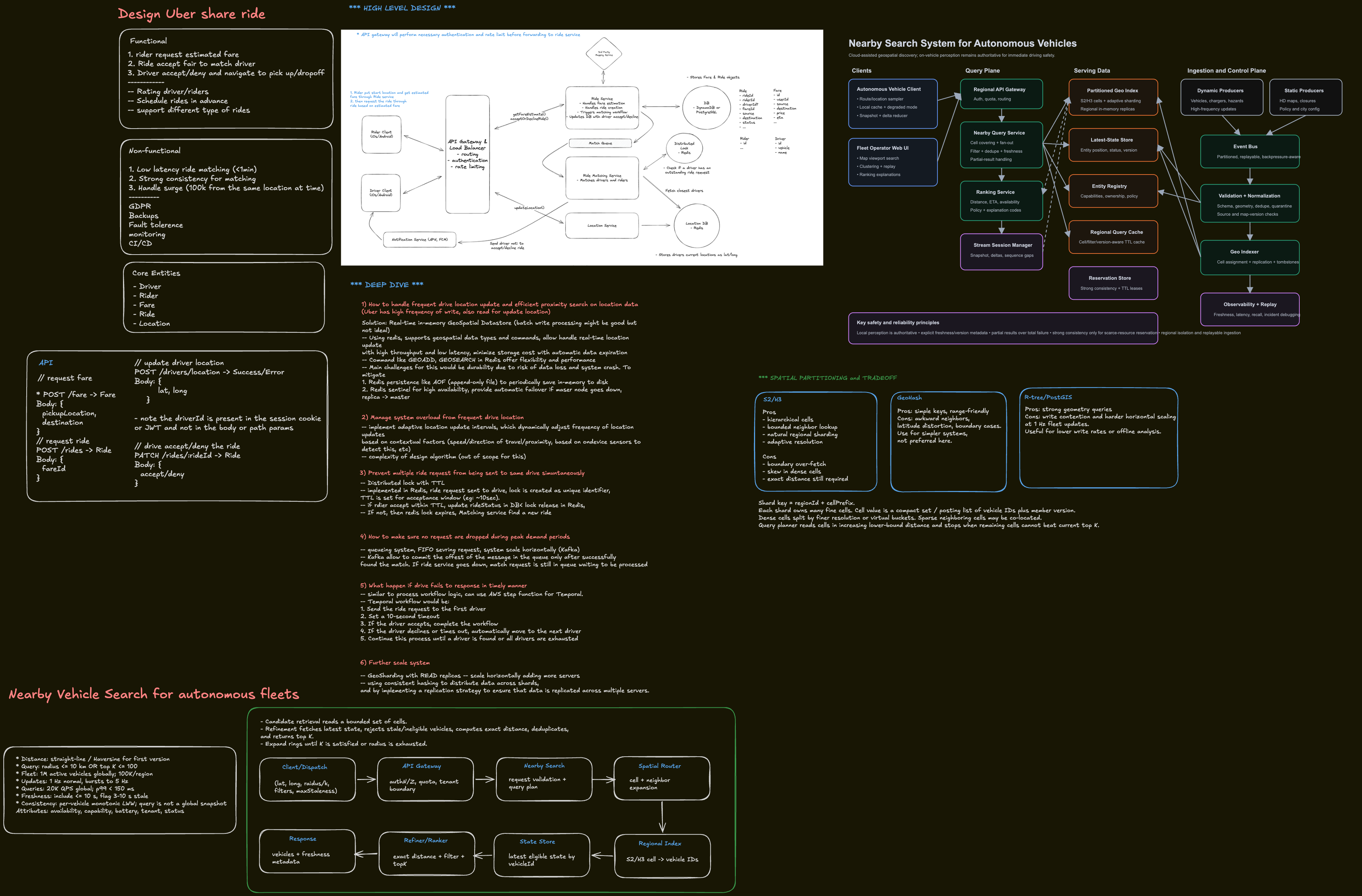
Uber System Design
Design a ride-hailing platform: rider requests a car, system matches a nearby driver, both parties track each other in real-time, driver accepts and completes the trip, and payment is settled automatically.
Functional Requirements
- Request a ride — rider specifies pickup/dropoff, gets fare estimate + ETA
- Match a driver — system finds and assigns the best available nearby driver
- Accept/reject — driver has a short window to accept; on timeout/reject, re-dispatch
- Real-time tracking — rider sees driver's live location en route to pickup, then during the trip
- Payment — fare calculated, charged automatically at trip end, receipt issued
- Trip lifecycle — requested → matched → driver en route → arrived → in progress → completed/cancelled
Non-Functional Requirements
| Concern | Target |
|---|---|
| Matching latency | Driver found & notified within 2–5s |
| Location update frequency | Every 3–4s per active driver (battery/bandwidth trade-off) |
| Tracking fan-out latency | Rider sees driver position within ~1s of update |
| Payment | Exactly-once charge, idempotent, PCI compliant |
| Scale | Millions of concurrent trips globally, 100M+ location pings/minute in dense cities |
| Availability | Matching & tracking must degrade gracefully; payment must never double-charge |
High-Level Architecture
Core services:
- Trip Service — owns trip state machine, source of truth (Postgres, strongly consistent)
- Matching Service — stateless, queries geospatial index for nearby drivers, scores candidates
- Location Ingestion — high write-throughput endpoint absorbing driver GPS pings
- Geospatial Index — Redis with geohash/H3 cells, or dedicated in-memory grid, holds current driver positions only
- Dispatch/Notification — pushes ride offers to driver devices, manages accept/reject timers
- Tracking/Fan-out — subscribes to location stream, pushes filtered updates to the specific rider/driver watching a trip
- Payment Service — fare calculation, charge orchestration, idempotency, ledger
Deep Dive 1: Requesting a Ride
Flow:
- Rider app sends pickup/dropoff coordinates to Trip Service
- Trip Service creates a trip record in state
REQUESTED, computes a fare estimate (base fare + distance/time model + surge multiplier) - Trip Service asynchronously calls Matching Service to begin driver search
- Rider app polls/subscribes (WebSocket) for trip status updates
Fare estimation:
fare = base_fare + (distance * per_km_rate) + (duration * per_min_rate) * surge_multiplier- Surge multiplier computed per geo-cell from a real-time demand/supply ratio (requests vs. available drivers in last N minutes), recalculated every 30–60s and cached
- Estimate shown to rider is a range, not a guarantee — final fare is computed from actual GPS trace at trip end
Why async matching instead of synchronous?
- Matching can take a few seconds (retries across candidates); blocking the request would hurt UX and time out clients
- Trip Service returns immediately with
trip_id+ statusSEARCHING; rider app subscribes to status changes
Idempotency: rider can double-tap "Request Ride" — client sends an idempotency key (e.g., UUID generated on tap) so Trip Service dedupes duplicate trip creation.
Deep Dive 2: Driver Matching
Candidate retrieval — geospatial index:
- Divide the map into cells using H3 (hexagonal hierarchical index) or geohash
- Each driver's last-known location is written to Redis keyed by cell:
SADD drivers:cell:\{cellId\} \{driverId\}, plus a hash storing lat/lng, heading, status (available/en_route/on_trip) - On ride request, look up the rider's cell + ring of neighboring cells (expanding radius search: try radius 1, if <3 candidates expand to radius 2, etc.)
- This bounds candidate lookup to O(cells) instead of scanning all drivers
Scoring & ranking candidates: Once you have ~10-20 nearby available drivers, score each by:
- ETA to pickup (via routing engine — road distance, not straight-line, adjusted for real-time traffic)
- Driver acceptance rate (deprioritize drivers who habitually reject/cancel)
- Idle time (fairness — drivers waiting longest get priority among near-equal ETAs)
- Driver rating (optional weighting)
Weighted score, e.g.: score = w1 * (1/eta) + w2 * acceptance_rate + w3 * idle_time_norm
Dispatch strategy — sequential vs. batch:
- Sequential (Uber's original approach): offer to best candidate, wait for accept/timeout (~10-15s), on reject/timeout move to next candidate. Simple, but slow if top candidates keep rejecting.
- Batch/broadcast: offer to top-K candidates simultaneously, first to accept wins, notify others "ride taken." Faster overall matching time, but requires atomic assignment to avoid double-booking.
Preventing double-assignment (race condition):
- Use a distributed lock or conditional write when a driver accepts:
SET trip:\{tripId\}:assigned_driver \{driverId\} NX— only the first accept wins - Once assigned, immediately update driver status to
en_routein the geo-index so they're excluded from other searches - Rejected/late drivers receive a "ride no longer available" push
Matching at scale — sharding:
- Geo-index sharded by region (e.g., city or larger metro cluster) since matching is inherently local — a driver in NYC will never match a rider in SF
- Each shard runs independent matching; no cross-shard coordination needed
Deep Dive 3: Accepting the Ride (Driver Side)
Offer/accept protocol:
- Dispatch service pushes a ride offer to the driver's app (via push notification + persistent WebSocket/long-poll)
- Driver has a short window (~10-15s) to accept or reject
- On accept: atomic compare-and-swap on trip assignment (see above), trip transitions to
DRIVER_ASSIGNED, rider notified with driver info (name, photo, plate, ETA) - On reject or timeout: driver marked temporarily deprioritized for this trip, offer cascades to next candidate (or next batch)
Handling flaky connectivity:
- If driver app doesn't ACK within timeout, treat as implicit reject — don't block the rider indefinitely
- Use push notification + WebSocket redundancy: push wakes the app, WebSocket carries the real-time offer payload
Trip state machine:
REQUESTED → SEARCHING → DRIVER_ASSIGNED → DRIVER_ARRIVING → DRIVER_ARRIVED
  → IN_PROGRESS → COMPLETED
                → CANCELLED (rider or driver, at various stages, different penalty rules)
- Each transition is a Trip Service write (Postgres, single source of truth) — this must be strongly consistent since billing/support/disputes depend on accurate state history
- Cancellation windows/fees depend on which state the trip was in (e.g., free cancellation before driver assigned, fee after driver has been en route N minutes)
Re-matching on driver cancellation:
- If a driver cancels after accepting (e.g., car trouble), trip reverts to
SEARCHING, matching re-runs excluding that driver, rider is notified with minimal disruption (ideally auto re-matched without rider re-requesting)
Deep Dive 4: Real-Time Location Tracking
Ingestion:
- Driver app sends GPS ping every 3-4s (adaptive: less frequent when stationary/idle, more frequent when moving or near pickup/dropoff)
- High-throughput ingestion endpoint (e.g., gRPC or lightweight HTTP) writes to:
- Geo-index (Redis) — overwrite current position, used by Matching Service for candidate search
- Event stream (Kafka, partitioned by driver_id or trip_id) — used for real-time fan-out to riders and for historical trace (fare calc, ETA recompute, fraud/audit)
Fan-out to the rider watching a specific trip:
- Not every rider needs every driver's location — only riders with an active trip need updates for their driver
- Tracking Service maintains an in-memory map of
trip_id → subscribed rider connection(WebSocket) - Consumes the Kafka stream, filters to only trips with active subscribers, pushes the matching driver's position over the rider's WebSocket
- This avoids fanning out all driver GPS pings to all clients — filter at the server before pushing
Why not just poll?
- Polling (rider app requests location every N seconds) wastes battery/bandwidth and adds latency; a persistent WebSocket push from server is far more efficient at this update frequency and scale
ETA recomputation:
- ETA isn't static — recomputed periodically (e.g., every 10-15s or on significant route deviation) using a routing engine with live traffic data
- Sudden large ETA jumps are smoothed client-side to avoid jarring UI changes
Scaling location ingestion:
- Partition by geography (same city-based sharding as matching) so ingestion, geo-index, and fan-out all colocate per-region
- Use a lightweight, connectionless protocol (UDP-like semantics over HTTP/gRPC) since occasional dropped pings are acceptable — the next ping in 3-4s supersedes it
Deep Dive 5: Payment
Fare finalization:
- At
COMPLETED, Trip Service computes final fare from the actual GPS trace (not the original estimate): actual distance/duration + applicable surge locked in at request time (or recalculated per policy) + tolls/fees - Fare breakdown stored immutably on the trip record for dispute resolution
Charging the rider — idempotency is critical:
- Payment Service charges the rider's saved payment method using an idempotency key = trip_id (or trip_id + attempt number)
- If the charge request is retried (network blip, service restart), the payment processor (Stripe/Braintree) recognizes the duplicate idempotency key and returns the original result instead of double-charging
- Charge attempt recorded in a local payment ledger before calling the processor (write-ahead), so a crash mid-call can be reconciled via processor status lookup rather than blindly retrying
Handling failures:
- Card declined → retry with backup payment method if on file, else trip marked
PAYMENT_PENDING, rider prompted to resolve, account may be restricted from requesting new rides until resolved - Processor timeout (unknown outcome) → do not immediately retry the charge; poll processor for the idempotency key's actual status first, only retry if genuinely not charged
Split responsibilities (driver payout vs. rider charge):
- These are decoupled: rider charge happens near-real-time; driver payout is typically batched (daily/weekly) via a separate ledger and payout service — this avoids coupling payout provider outages to the rider-facing charge path
- Internal ledger double-entry: debit rider, credit "Uber clearing account," later debit clearing account, credit driver payout batch
PCI compliance:
- Uber's servers never touch raw card numbers — tokenization via payment processor SDK on the client, only tokens/payment-method-IDs stored server-side
Refunds/disputes:
- Refund also idempotent, tied to original charge ID, reverses the ledger entry, doesn't touch the (already batched) driver payout unless fraud is confirmed
Follow-up Interview Questions
- How do you prevent two drivers from being assigned the same rider simultaneously? — Atomic conditional write (CAS) on trip assignment; first accept wins, others rejected.
- How do you handle a region with very few available drivers (rural/off-peak)? — Expand search radius progressively; if none found within max radius/time, surface "no drivers available" and offer to notify when one is found.
- How would you reduce driver GPS ping cost at scale? — Adaptive ping frequency (slower when idle/stationary), delta-compression, regional partitioning to avoid cross-datacenter hops.
- What happens if the Trip Service goes down mid-trip? — Trip state persisted in Postgres before each transition; on recovery, reconcile from last known state; location tracking is independent so rider/driver apps can keep functioning with cached last-known state until Trip Service recovers.
- How do you avoid double-charging a rider? — Idempotency key per trip on the payment call, write-ahead ledger entry before calling the processor, and status-check-before-retry on ambiguous failures.
- How would you design surge pricing to be fair and gameable-resistant? — Compute per-geo-cell demand/supply ratio over a rolling window, cap multiplier, smooth changes to avoid rapid oscillation, and avoid exposing exact algorithm to prevent gaming by drivers artificially going offline to trigger surge.