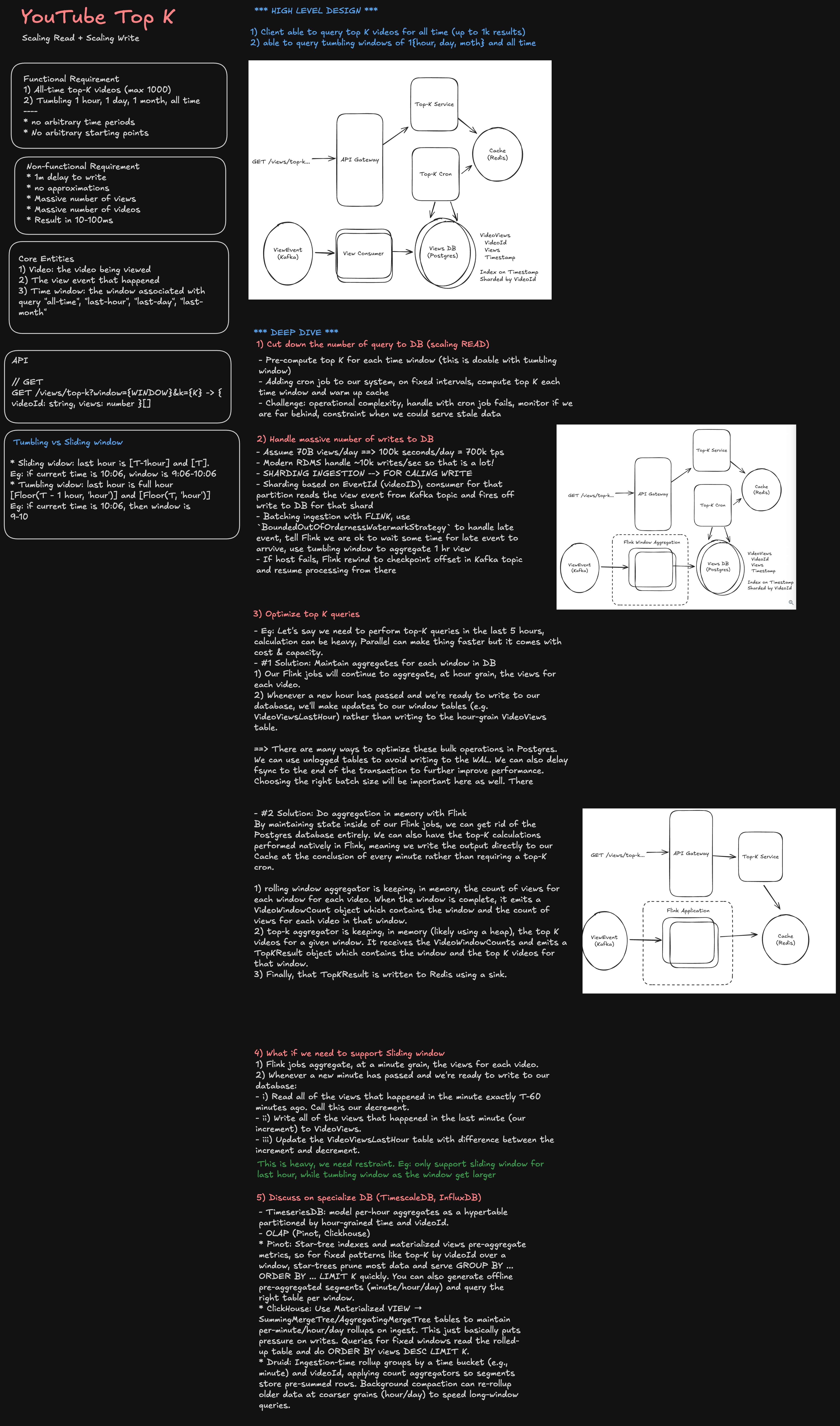
YouTube Top-K System Design
Design a system that continuously returns the top K trending videos for different scopes (global, country, language, category, channel segment) with low latency and high freshness.
At staff level, this is not just “find top K.” It is a streaming ranking system under bursty traffic, eventual consistency, anti-fraud constraints, and product rules.
Interview framing
Clarify what “top” means before discussing data structures.
- Is top-K based on views only, or a weighted score (views, watch time, completion, likes, shares, recency)?
- Is the ranking window 5 minutes, 1 hour, 24 hours, or mixed windows?
- Is this for homepage trending, search boosters, or creator dashboards?
- Do we need per-region and per-language lists?
- How stale can results be: seconds, minutes, or hours?
- Are we optimizing for strict correctness or product relevance and freshness?
Define one explicit product contract, for example:
- Return top 100 videos per region and category.
- Update every 30 seconds.
- Rank by weighted trend score over the last 60 minutes with recency decay.
- Exclude policy-violating and spam-flagged videos.
Requirements
Functional requirements
- Ingest user events: impression, click, play, watch duration, like, share, comment.
- Compute rolling per-video trend features in near real time.
- Produce top-K lists for multiple segments (global, region, category, language).
- Apply policy filters, deduplication, and anti-abuse checks.
- Serve top-K with low-latency read APIs and caching.
- Support replay/backfill when data pipeline incidents happen.
Non-functional requirements
| Requirement | Target |
|---|---|
| Read latency | P99 under 20-50 ms from cache/API |
| Freshness | 10-60 seconds for trending surfaces |
| Throughput | Millions of events per second globally |
| Availability | Degrade to last good snapshot during compute outages |
| Correctness | Deterministic ranking for same snapshot/version |
| Auditability | Explain why a video appears in top-K |
High-level architecture
Key split:
- Streaming path computes fresh metrics and candidate scores.
- Materializer writes immutable ranking snapshots and cache-friendly lists.
- Serving layer reads precomputed lists, not raw events.
Ranking score design
A typical trend score is weighted and time-decayed:
Apply recency decay and anti-spam dampening:
Staff-level points to discuss:
- Watch time is often more robust than raw views.
- New videos need exploration boosts to avoid rich-get-richer lock-in.
- Clamp suspicious spikes until abuse review completes.
- Keep scoring versioned so rankings are reproducible.
Top-K computation strategy
For each partition key (for example region:US:category:music):
- Maintain rolling aggregates per video in stream state.
- Compute incremental score deltas per event batch.
- Update candidate set and maintain a min-heap of size
Kfor fast local top-K. - Periodically emit ranked snapshots with a monotonically increasing version.
Distributed top-K merge
When multiple workers compute local top-K for the same segment:
- each worker emits local top
K_local; - aggregator performs a K-way merge to compute global top
K; - publish final ordered list with snapshot timestamp and version.
This reduces memory and network compared to shipping full candidate sets.
Windowing and freshness
Use event-time windows with lateness handling:
- Sliding window, e.g., 60 min with 1-min slide.
- Watermarks for out-of-order events.
- Allowed lateness to absorb delayed mobile uploads.
- Correction path for late-but-valid events.
Product trade-off:
- Smaller windows improve freshness but increase volatility.
- Larger windows stabilize ranking but feel stale.
Many production systems blend short and medium windows, e.g.,
- fast momentum signal: 5-15 min,
- stability signal: 1-6 hours.
Data model
video_metric_state
	segment_key
	video_id
	window_start
	window_end
	views
	watch_time_seconds
	likes
	shares
	quality_factor
	abuse_penalty
	score
	score_version
topk_snapshot
	segment_key
	snapshot_version
	generated_at
	items: [video_id, score, rank, reason_codes]
	expires_at
Reason codes help support explainability, e.g., HIGH_WATCH_TIME, REGION_TRENDING, FRESHNESS_BOOST.
Serving path
The API should serve from precomputed snapshots:
- Cache key:
topk:\{segment_key\}:\{snapshot_version\}. - Fast path: memory cache/Redis.
- Fallback: previous snapshot if newest is unavailable.
- Return metadata:
snapshot_version,generated_at,staleness_ms.
Do not compute top-K on the synchronous request path.
Abuse and integrity controls
Trending surfaces are abuse targets. Add trust boundaries:
- Bot and replay detection on event ingestion.
- Device/account trust scoring and velocity checks.
- Minimum data-quality thresholds before eligibility.
- Policy moderation gates before top-K publish.
- Delayed promotion for suspicious high-velocity spikes.
Use dual-state scoring:
- provisional score for candidates under review,
- confirmed score for publishable rankings.
Reliability and failure handling
Failures to design for
- Event bus lag or partition outage.
- Stream processor restart and state recovery.
- Clock skew and watermark misconfiguration.
- Cache invalidation bugs and stale snapshots.
- Partial region outage.
Safe behavior
- Keep last known good snapshot and serve with staleness metadata.
- Replay from durable event log to recover state.
- Version every ranking snapshot; never mutate old versions in place.
- Use idempotent writes keyed by
(segment_key, snapshot_version).
Observability and alerting
Track:
- Event ingestion QPS, lag, and drop rate.
- Stream watermark delay and state checkpoint latency.
- Snapshot generation cadence and publish latency.
- Top-K churn rate (rank instability).
- Cache hit ratio and API p95/p99 latency.
- Abuse suppression rate and false-positive review rate.
Alert on:
- missing snapshot updates per segment,
- sudden global ranking churn spikes,
- segment-level empty top-K lists,
- stream lag beyond freshness SLA,
- significant mismatch between offline and online score distributions.
Staff-level trade-offs
- Exactness vs freshness: exact global ordering at all times is expensive; bounded approximation with rapid refresh is usually better for user experience.
- Per-event updates vs micro-batching: per-event updates are freshest but costly; micro-batches reduce overhead with small freshness loss.
- Global ranking vs regional fairness: pure global top-K can suppress local relevance; segmented top-K improves relevance and creator diversity.
- Aggressive anti-abuse vs creator latency: strict filters reduce abuse but may delay legitimate breakout content.
- High churn vs stable UX: freshness increases churn; use hysteresis or rank-stability dampening for better user trust.
Practical interview summary
A strong staff-level answer should emphasize:
- clear ranking objective,
- segmented streaming aggregation,
- versioned top-K snapshot materialization,
- low-latency cached serving,
- robust abuse controls,
- deterministic replay and recovery,
- and explicit freshness/correctness trade-offs.
Top-K at YouTube scale is a ranking-and-reliability problem more than a heap problem.