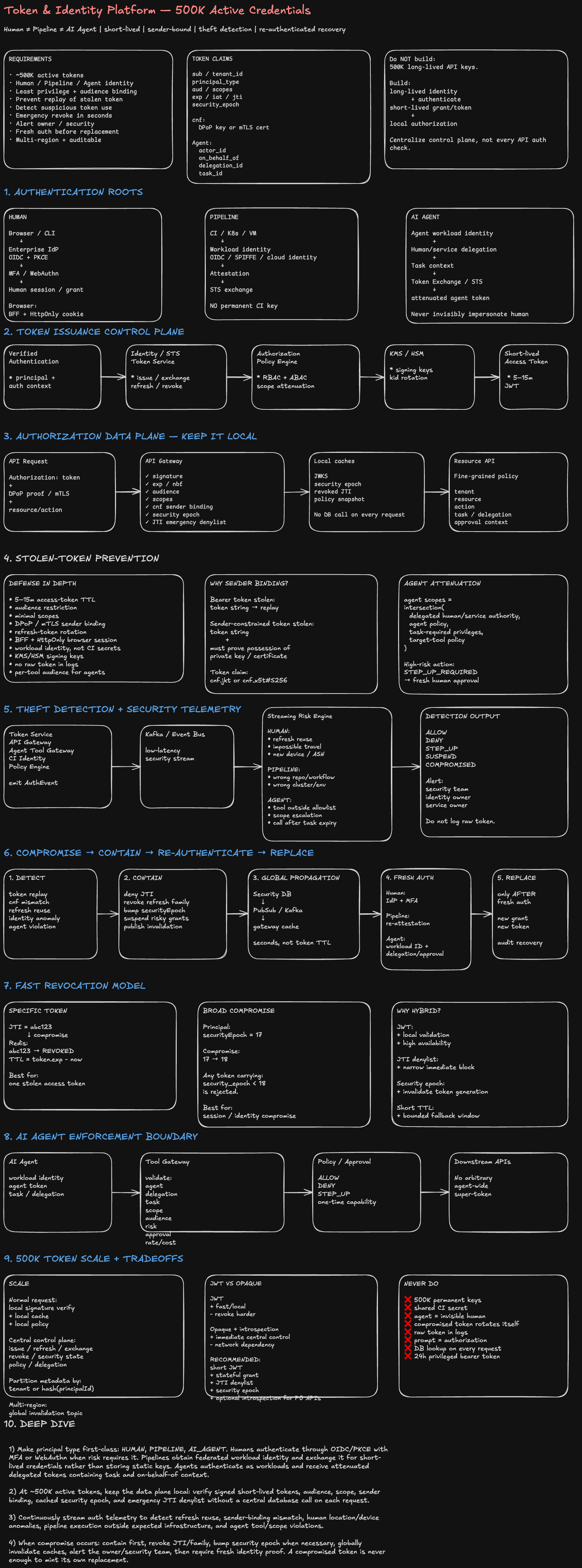
Token & Identity Platform — Humans, Pipelines, and AI Agents
0. Interview framing
We need an authentication and authorization platform that can safely support roughly 500K active credentials/tokens while clearly distinguishing:
HUMAN
PIPELINE / WORKLOAD
AI AGENT
The design must:
1. Authenticate the principal before issuing credentials.
2. Issue least-privilege, audience-bound, short-lived tokens.
3. Avoid long-lived static bearer tokens wherever possible.
4. Prevent stolen tokens from being replayed.
5. Detect suspicious token use quickly.
6. Revoke compromised access.
7. Require fresh authentication / workload attestation before issuing replacement credentials.
8. Preserve an auditable delegation chain for agents acting for users.
This is primarily an identity, token, authorization, and security telemetry platform.
1. Clarifying questions
Scale
- Does "500K tokens" mean concurrently active or total registered credentials?
- Peak issuance / refresh QPS?
- Peak API authorization QPS?
- Number of tenants / services / regions?

Humans
- Existing enterprise SSO / OIDC?
- MFA / WebAuthn available?
- Browser, CLI, and native clients?

Pipelines
- Kubernetes, VM, GitHub Actions, Jenkins, cloud CI?
- Can workloads obtain federated identity instead of stored secrets?

Agents
- Are agents autonomous workloads or always delegated by a human?
- Can an agent call external tools?
- Is human approval required for high-risk actions?

Security
- Maximum acceptable stolen-token exposure?
- How quickly must emergency revocation propagate?
- Required audit retention?
2. Working assumptions
~500K concurrently active access tokens
Millions of API authorization checks/day or more
Multi-region
Access token TTL: usually 5–15 minutes
Refresh/grant/session state is server-side
Emergency revocation propagation target: seconds
Do not interpret 500K active tokens as a reason to create 500K long-lived API secrets.
The safer architecture is:
long-lived identity
      ↓ authenticate
short-lived credential
      ↓
short-lived scoped access token
3. Principal model
Every credential and token carries an explicit principal type.
type PrincipalType = 'HUMAN' | 'PIPELINE' | 'AI_AGENT';

type Principal = {
  principalId: string;
  principalType: PrincipalType;
  tenantId: string;

  status: 'ACTIVE' | 'SUSPENDED' | 'COMPROMISED';

  // Increment to invalidate all previously issued tokens.
  securityEpoch: number;

  createdAt: string;
};
Never infer identity type from naming convention such as:
"ci-*"
"bot-*"
"agent-*"
It must be a first-class signed authorization claim.
4. Token claims
Example access-token claims:
type AccessTokenClaims = {
  iss: string;
  sub: string; // principal ID
  aud: string[]; // permitted target services
  exp: number;
  iat: number;
  nbf?: number;

  jti: string; // unique token ID

  tenant_id: string;
  principal_type: 'HUMAN' | 'PIPELINE' | 'AI_AGENT';

  scopes: string[];

  // Token invalid when older than principal.securityEpoch.
  security_epoch: number;

  // Sender-constrained token.
  cnf?: {
    jkt?: string; // DPoP key thumbprint
    'x5t#S256'?: string; // mTLS certificate thumbprint
  };

  // Agent delegation.
  actor_id?: string;
  on_behalf_of?: string;
  delegation_id?: string;
  task_id?: string;

  // Useful for authorization policy.
  auth_context?: string[];
};
Important principle:
Authentication:
"Who are you?"

Authorization:
"What may this identity do?"

Delegation:
"Who is this agent acting for, for what task, and with what authority?"
5. Identity-specific authentication
HUMAN
Preferred flow:
Browser / CLI
  ↓
Enterprise IdP / OIDC
  ↓
MFA / WebAuthn / passkey when required
  ↓
Authorization Code + PKCE
  ↓
Token Service
For browsers, prefer:
Browser
  ↓
BFF
  ↓
OAuth tokens

Browser stores:
Secure + HttpOnly + SameSite session cookie

Avoid:
long-lived bearer access token in localStorage
Human access token:
TTL: short
Scope: user role + requested resource
Audience: specific APIs
Optional DPoP binding
PIPELINE / WORKLOAD
Do not distribute static API keys to 100K CI jobs.
Preferred:
CI runner / Kubernetes workload / VM
           ↓
platform identity / OIDC / SPIFFE identity
           ↓
attestation
           ↓
Security Token Service (STS)
           ↓
short-lived workload access token
Examples of useful identity attributes:
repo
branch
workflow
environment
cluster
namespace
service account
runner identity
deployment
Policy can say:
repo=payments
workflow=deploy-prod
environment=production

may receive:

deploy:payments
aud=deployment-api
TTL=5m
No permanent secret needs to live in the pipeline configuration.
AI AGENT
An agent must have its own workload identity.
Do not pretend the agent is the human.
Use:
Human identity
      +
Agent workload identity
      +
Task / delegation grant
      ↓
Token Exchange / STS
      ↓
Agent delegated access token
Result:
sub             = agent identity
principal_type  = AI_AGENT
actor_id        = agent identity
on_behalf_of    = human identity
delegation_id   = delegation record
task_id         = current task
scopes          = attenuated subset
aud             = target tool/API
This provides:
who initiated the task
which agent executed it
which tools were permitted
what authority was delegated
6. High-level architecture
                         ┌──────────────────┐
Human ─────────────────► │ Enterprise IdP   │
                         │ OIDC + MFA       │
                         └────────┬─────────┘
                                  │
Pipeline ── Workload Identity ────┤
                                  │
Agent ───── Workload Identity ────┤
                                  ▼
                      ┌─────────────────────┐
                      │ Identity / STS      │
                      │ Token Service       │
                      └─────────┬───────────┘
                                │
                         policy evaluation
                                ▼
                    ┌────────────────────────┐
                    │ Authorization Policy   │
                    │ RBAC + ABAC + scopes  │
                    └──────────┬─────────────┘
                               │
                        short-lived token
                               ▼
                 ┌────────────────────────────┐
                 │ API Gateway / Resource API │
                 │ signature + aud + exp      │
                 │ cnf + epoch + policy       │
                 └────────────┬───────────────┘
                              │
                     auth telemetry events
                              ▼
             ┌────────────────────────────────┐
             │ Risk / Detection / SIEM        │
             │ anomaly + replay detection     │
             └───────────────┬────────────────┘
                             │
                       compromise event
                             ▼
                  ┌──────────────────────┐
                  │ Revocation Service   │
                  │ session / family /   │
                  │ epoch invalidation   │
                  └──────────────────────┘
7. Token issuance flow
Common path
1. Authenticate identity.
2. Determine principal type.
3. Load authorization policy.
4. Determine requested audience + scopes.
5. Attenuate privilege.
6. Bind token to sender when possible.
7. Sign short-lived access token.
8. Record grant/session metadata.
9. Emit issuance audit event.
Pseudo-code:
async function issueAccessToken(authentication: VerifiedAuthentication, request: TokenRequest) {
  const principal = await principalStore.get(authentication.principalId);

  if (principal.status !== 'ACTIVE') {
    throw new Error('principal_not_active');
  }

  const grant = await policyEngine.authorize({
    principal,
    requestedScopes: request.scopes,
    audience: request.audience,
    delegation: request.delegation,
  });

  const claims = {
    sub: principal.principalId,
    principal_type: principal.principalType,
    tenant_id: principal.tenantId,
    scopes: grant.scopes,
    aud: grant.audience,

    security_epoch: principal.securityEpoch,

    jti: crypto.randomUUID(),
    iat: now(),
    exp: now() + grant.ttlSeconds,

    cnf: authentication.proofOfPossession,

    ...grant.delegationClaims,
  };

  return signer.sign(claims);
}
8. Why short-lived tokens matter
Assume bearer token A is stolen at:
13:00
With a 24-hour token:
potential replay window ≈ 24 hours
With a 10-minute token:
potential replay window ≤ ~10 minutes
Then add:
sender binding
+ anomaly detection
+ emergency revocation
to reduce the practical exposure further.
9. Prevent stolen-token replay
Defense in depth:
1. Short access-token TTL.
2. Narrow audience.
3. Least-privilege scopes.
4. Sender-constrained tokens.
5. Secure browser token handling.
6. Workload identity instead of static secrets.
7. Refresh-token rotation.
8. Secrets never written to logs.
9. KMS/HSM-backed signing keys.
10. Key rotation + JWKS caching.
10. Sender-constrained tokens
A normal bearer token means:
whoever possesses token → can use token
Sender-constrained token:
token
  +
proof that caller owns specific private key/certificate
Two common mechanisms:
DPoP
or
mTLS certificate-bound access tokens
Resource server validates:
token signature
exp / nbf
aud
scope
security_epoch
cnf binding
proof signature / certificate
So merely stealing the access-token string is insufficient.
11. Human browser token storage
Prefer:
Browser
  |
  | Secure + HttpOnly cookie
  v
BFF
  |
  | access token
  v
Backend APIs
Benefits:
JavaScript cannot directly read HttpOnly cookie
token remains server-side
centralized refresh/revocation
reduced XSS token exfiltration surface
Still protect against:
CSRF
session fixation
XSS
cookie theft
12. Pipeline credential security
Bad:
env:
  API_TOKEN: 'long-lived-secret'
Better:
CI runner
   ↓
obtain signed workload identity
   ↓
STS exchange
   ↓
5-minute deployment token
Policy may bind token issuance to:
repository
workflow SHA
branch
environment
runner pool
cloud account
namespace
A stolen token from one job should not become a reusable organization-wide secret.
13. AI-agent privilege attenuation
Suppose the human can:
read:any-project
write:project-A
delete:project-A
billing:update
The agent task only needs:
read:project-A
write:draft:project-A
Issue only:
agent token scopes =
intersection(
  human delegated authority,
  agent's own policy,
  task-required scopes,
  target-tool policy
)
Never:
agent gets all scopes of delegating human
14. High-risk agent actions
Policy can require step-up approval.
Example:
Agent wants:
production:deploy

Policy:
requires fresh human WebAuthn approval
within last 5 minutes
Flow:
Agent request
   ↓
Policy engine says STEP_UP_REQUIRED
   ↓
Human authenticates / approves
   ↓
one-time or very-short-lived capability issued
   ↓
agent executes exact approved action
15. Token state model
Do not store 500K raw access-token strings.
Store:
type GrantRecord = {
  grantId: string;
  principalId: string;
  principalType: PrincipalType;

  refreshFamilyId?: string;

  status: 'ACTIVE' | 'REVOKED' | 'COMPROMISED';

  createdAt: string;
  expiresAt: string;
};

type PrincipalSecurityState = {
  principalId: string;
  securityEpoch: number;
  status: 'ACTIVE' | 'SUSPENDED' | 'COMPROMISED';
};
JWT access tokens can be verified locally.
Stateful data is primarily:
principal
grant/session
refresh-token family
security epoch
compromise/revocation state
audit events
16. Refresh-token rotation
For humans or approved long-lived clients:
refresh-1
   ↓ use
access token + refresh-2

refresh-2
   ↓ use
access token + refresh-3
If refresh-1 is seen again after it was consumed:
possible token theft / replay
Response:
revoke entire refresh-token family
require fresh authentication
Never store raw refresh tokens server-side.
Store:
hash(refresh_token)
family_id
status
rotation_counter
17. Detecting stolen credentials
Every authorization event emits metadata such as:
type AuthEvent = {
  timestamp: string;

  jti: string;
  principalId: string;
  principalType: PrincipalType;
  tenantId: string;

  audience: string;
  scopes: string[];

  sourceIp?: string;
  deviceId?: string;
  workloadId?: string;
  clusterId?: string;

  dpopThumbprint?: string;
  certThumbprint?: string;

  result: 'ALLOW' | 'DENY';
  reason?: string;
};
Do not include the raw access token.
18. Detection signals by principal type
HUMAN
new device + unusual location
impossible travel
sudden ASN / IP change
DPoP key mismatch
refresh-token reuse
access pattern far outside baseline
privileged API burst
PIPELINE
token used outside expected repo/workflow
token used outside allowed cluster/cloud account
unexpected environment
new certificate/key
production action from dev runner
token appears after workflow ended
AI AGENT
tool call outside allowlist
scope escalation attempt
high-risk API sequence
unexpected target tenant
unexpected task_id
calls after task expiration
dramatic call-volume / spend increase
attempt to bypass approval gate
19. Detection architecture
API Gateways
Token Service
Policy Engine
CI Identity
Agent Tool Gateway
       │
       │ security events
       ▼
Kafka / Event Bus
       │
       ├────► Streaming Rules
       │       replay
       │       cnf mismatch
       │       rate anomaly
       │
       ├────► Risk Engine
       │       user/workload baseline
       │
       └────► SIEM / Audit Lake
               investigation
               compliance
Critical signals should not wait for an offline batch.
20. Compromise response
When token theft is suspected:
1. Block the specific JTI immediately.
2. Revoke grant / refresh-token family.
3. Increment principal securityEpoch if broader compromise suspected.
4. Publish invalidation event globally.
5. API gateways update emergency revocation cache.
6. Suspend high-risk capabilities.
7. Alert security + identity owner.
8. Require fresh authentication / attestation.
9. Only after successful auth, issue a replacement credential.
21. Security epoch
This is useful for fast invalidation.
Principal:
{
  "principalId": "human-42",
  "securityEpoch": 18
}
Existing token:
{
  "sub": "human-42",
  "security_epoch": 17
}
Gateway compares:
if (token.security_epoch < currentSecurityEpoch) {
  deny('token_revoked');
}
Compromise:
securityEpoch: 17 → 18
All older tokens become invalid.
This avoids storing every access token in a central revocation table forever.
22. How gateways learn new security epochs
Do not query the database on every API request.
Use:
Security State DB
      │
      ├── cache
      │
      └── invalidation event
             ↓
       Kafka / PubSub
             ↓
      API gateway caches
Normal request:
JWT verification = local
epoch lookup      = local cache
On emergency revocation:
publish security_state_changed event
→ update gateway cache in seconds
23. Specific JTI emergency denylist
For a single compromised token:
jti → revoked until token.exp
Store in fast distributed cache:
Redis / equivalent
TTL:
token.exp - now
The denylist remains bounded because entries disappear when the original token would have expired anyway.
Use:
JTI denylist
for narrow revocation.
Use:
securityEpoch bump
for broader principal/session compromise.
24. Recovery MUST require fresh authentication
This is the critical requirement.
Bad recovery:
stolen token
  ↓
POST /rotate
  ↓
new token
The attacker who stole the credential can now rotate it too.
Correct:
compromise detected
      ↓
old token blocked
      ↓
fresh identity verification
      ↓
new credential issued
25. Recovery by identity type
HUMAN
Require:
fresh OIDC login
+ MFA/WebAuthn for elevated recovery
The compromised access token is not sufficient proof.
Flow:
Alert
  ↓
user starts recovery
  ↓
IdP authentication
  ↓
step-up factor
  ↓
revoke old session/refresh family
  ↓
new session
PIPELINE
Require fresh workload attestation:
runner/workload
  ↓
cloud/Kubernetes/SPIFFE identity
  ↓
STS verifies workload
  ↓
old credential revoked
  ↓
new short-lived token
Do not email an API token or ask an operator to paste a new permanent secret into CI.
AI AGENT
Require:
fresh agent workload identity
+
valid delegation/task
+
fresh human approval if policy requires it
A compromised agent token alone cannot bootstrap another agent token.
26. Recovery API
POST /v1/security/recover
The endpoint requires a fresh-authentication context, not the compromised token.
Conceptually:
async function recoverCredential(freshAuth: FreshAuthentication, incidentId: string) {
  const incident = await incidents.get(incidentId);

  assertFresh(freshAuth);
  assertMatchesPrincipal(freshAuth, incident.principalId);

  await revokeCompromisedGrant(incident.grantId);
  await bumpSecurityEpoch(incident.principalId);

  return issueReplacementCredential({
    authentication: freshAuth,
    reason: 'SECURITY_RECOVERY',
  });
}
27. APIs
Human auth
GET /oauth/authorize
POST /oauth/token
POST /oauth/revoke
Workload / agent exchange
POST /v1/token/exchange
Example:
{
  "subjectToken": "<workload-identity>",
  "audience": "deployment-api",
  "requestedScopes": ["deploy:payments"]
}
Agent delegation
POST /v1/delegations
{
  "agentId": "agent-research-7",
  "taskId": "task-991",
  "audience": "docs-api",
  "scopes": ["docs:read", "draft:write"],
  "expiresInSeconds": 600
}
Security
POST /v1/tokens/revoke
POST /v1/security/incidents
POST /v1/security/recover
GET  /v1/security/events
28. Authorization
Use both:
RBAC
+
ABAC
RBAC example:
HUMAN / admin
PIPELINE / deployment-worker
AI_AGENT / support-agent
ABAC adds:
tenant
resource owner
environment
repo
branch
cluster
task
risk level
approval context
time
device/workload attestation
Example policy:
ALLOW when:

principal_type == PIPELINE
AND repo == "payments"
AND workflow == "deploy"
AND environment == "prod"
AND audience == "deployment-api"
AND scope == "deploy:payments"
29. Authorization flow at API gateway
function authorize(token: AccessTokenClaims, request: RequestContext, state: CachedSecurityState) {
  verifySignature(token);

  assertNotExpired(token);
  assertAudience(token, request.service);
  assertScopes(token, request.requiredScopes);

  if (token.security_epoch < state.securityEpoch) {
    throw new Error('revoked');
  }

  if (state.revokedJtis.has(token.jti)) {
    throw new Error('revoked');
  }

  verifySenderConstraint(token, request);

  return policyEngine.evaluate({
    token,
    resource: request.resource,
    action: request.action,
  });
}
30. Data stores
Principal / grant store
Strongly consistent relational or distributed KV store.
Contains:
principal
principal type
tenant
status
security epoch
delegation
refresh family
credential metadata
Token access verification
Do not require central DB lookup for every request.
Use:
signed short-lived token
+
local JWKS
+
local security cache
Audit / security events
Append-only stream + warehouse/object store.
Contains:
issuance
exchange
authorization decision
revoke
recovery
policy changes
admin actions
Never log:
raw access token
raw refresh token
private key
31. Key management
Signing keys:
HSM / managed KMS
Token service:
signing operation
      ↓
KMS/HSM
Publish public keys:
JWKS
Resource services cache public keys.
Support:
key ID (kid)
overlapping old/new public keys
safe rotation window
emergency key rollover
32. Scaling to ~500K active tokens
The key design choice:
Do not centralize every authorization check.
Otherwise:
API request
  ↓
token introspection service
can become a fleet-wide bottleneck.
Prefer:
API request
   ↓
local signature verification
local audience/scope validation
local revocation/epoch cache
   ↓
policy
Control-plane operations:
token issuance
refresh
exchange
revocation
policy changes
are centralized or partitioned.
Data-plane authorization stays mostly local.
33. Token service partitioning
Partition metadata by:
tenantId
or
hash(principalId)
Do not partition by token ID alone if most operational actions are by:
principal
tenant
grant
Cache:
JWKS
principal security epoch
policy snapshot/version
JTI emergency denylist
34. Multi-region
Architecture:
Region A token endpoints
Region B token endpoints
Region C token endpoints
         │
         ▼
global signing / delegated regional signing
         │
         ▼
replicated principal/security state
Emergency revocation:
compromise detected in region A
        ↓
global invalidation topic
        ↓
A / B / C gateway caches update
Design for:
eventual normal replication
fast-path security invalidation
35. Availability vs revocation tradeoff
Self-contained JWT:
+ local validation
+ very high availability
- difficult immediate revocation
Opaque token + introspection:
+ immediate central revocation
+ central policy
- network hop
- central dependency
Recommended hybrid:
short-lived signed access tokens
+ refresh/grant state centrally
+ emergency JTI denylist
+ principal security epoch
+ invalidation events
36. Security-event severity
Example:
SEV-1
private signing key suspected compromised
large-scale token replay
cross-tenant authorization failure

SEV-2
refresh-token reuse
human impossible travel + privileged action
pipeline token from wrong runtime
agent bypassing approval gate

SEV-3
unusual but successfully sender-bound behavior
repeated authorization denial
37. Alert + automated containment
Example:
Risk engine detects refresh-token reuse
        ↓
mark family COMPROMISED
        ↓
revoke refresh family
        ↓
bump session/principal epoch
        ↓
publish invalidation
        ↓
gateways deny old access tokens
        ↓
notify human/security owner
        ↓
fresh auth required
For automation, distinguish:
detect
contain
recover
Do not automatically issue replacement credentials as part of containment.
38. Audit trail for agents
Every high-value agent action should be reconstructable.
Audit:
human initiator
agent identity
delegation ID
task ID
prompt/request reference
tool invoked
resource
scope
policy decision
approval ID
token JTI
result
timestamp
The goal is:
"Agent X deployed service Y"
is insufficient.
Need:
"Agent X, acting for Human H under Delegation D and Approval A,
used scope deploy:Y to call deployment-api at time T."
39. Agent tool gateway
For sensitive systems, do not give agents arbitrary direct network access.
Use:
Agent
  ↓
Tool Gateway
  ↓
Policy + approval
  ↓
Downstream API
Tool Gateway validates:
agent identity
delegation
task
scope
target
risk level
approval
rate/cost limit
This becomes a strong enforcement and audit boundary.
40. Threat model
Token copied from logs
Mitigation:
redaction
structured secret scanners
never log Authorization header
short TTL
sender binding
Human browser XSS
Mitigation:
BFF
HttpOnly cookie
CSP
short sessions
step-up auth
Pipeline secret leaked in repository
Mitigation:
no static secret
workload identity federation
short-lived STS exchange
secret scanner for legacy credentials
Agent token leaked through tool/plugin
Mitigation:
per-tool audiences
very narrow scope
short TTL
tool gateway
sender binding
Signing key compromised
Mitigation:
KMS/HSM
restricted signing API
kid rotation
emergency JWKS rollover
invalidate affected token generations
41. Standards-oriented choices
Use modern OAuth security principles:
Authorization Code + PKCE for interactive clients
short-lived access tokens
sender-constrained tokens where feasible
asymmetric client/workload authentication
token exchange for delegation
Useful standards:
RFC 9700 — OAuth 2.0 Security Best Current Practice
RFC 9449 — DPoP
RFC 8705 — OAuth mutual-TLS / certificate-bound tokens
RFC 8693 — OAuth 2.0 Token Exchange
NIST SP 800-207 / 800-207A — Zero Trust architecture guidance
SPIFFE/SPIRE — workload identity pattern
42. Staff-level tradeoffs
JWT vs opaque tokens
| Choice | Benefits | Costs |
|---|---|---|
| JWT | local verification, low latency, resilient | harder instant revoke |
| Opaque | immediate central state/policy | introspection dependency |
| Hybrid | performance + emergency revoke | more control-plane complexity |
Choose:
short-lived JWT + centrally managed grants + fast emergency invalidation
One token type for everything?
No.
Use common envelope semantics, but different authentication roots.
Human
root of trust = IdP + user authentication

Pipeline
root of trust = workload/cloud/CI attestation

AI Agent
root of trust = workload identity + delegation/task authority
The token format can be similar while issuance policy differs.
43. What I would NOT do
❌ 500K permanent API keys
❌ one shared CI secret
❌ let AI agent impersonate a human invisibly
❌ 24-hour bearer tokens for privileged APIs
❌ store browser bearer token in localStorage by default
❌ log Authorization headers
❌ rely only on JWT expiration for emergency response
❌ allow compromised token to rotate itself
❌ use prompt instructions as agent authorization
❌ query central DB for every API request
44. Interview deep dives
Q: Why distinguish HUMAN, PIPELINE, and AI_AGENT?
Because the trust roots and risk models differ.
Human:
interactive authentication, MFA, device/user risk

Pipeline:
non-human workload attestation, repo/workflow/environment

Agent:
non-human workload identity + delegated authority + task context
Treating them all as "service-account" destroys useful policy and audit context.
Q: Why not just use a 5-minute JWT and forget revocation?
Because five minutes may still be unacceptable for:
production deletion
payment
cross-tenant access
admin operations
Emergency revocation gives us:
JTI denylist
security epoch
invalidation events
while keeping normal authorization local.
Q: How do you rotate a stolen token?
You do not trust the stolen credential to authorize its own replacement.
Require:
human → fresh IdP + MFA/WebAuthn
pipeline → fresh workload attestation
agent → fresh workload identity + valid delegation/approval
Then revoke old grants and issue new credentials.
Q: What if revocation event propagation is delayed?
Defense in depth:
short TTL
sender binding
local denylist cache
periodic security-state refresh
risk-based denial
For extremely sensitive endpoints, require:
online introspection / fresh authorization
rather than relying solely on cached JWT state.
Q: How does this scale to 500K tokens?
500K signed access tokens do not imply 500K synchronous central checks.
The request path is:
local signature verification
+ cached security state
+ cached policy
Central systems handle issuance and security changes.
45. 2-minute staff-level answer
I would start by making principal type first-class: HUMAN, PIPELINE, or
AI_AGENT. The token format can be common, but the authentication root is
different.

Humans authenticate through the enterprise IdP using authorization code
plus PKCE and step-up MFA or WebAuthn for high-risk operations. Pipelines
do not receive permanent API keys; they obtain an attested workload
identity and exchange it through an STS for a short-lived token. Agents
also authenticate as workloads, but their access tokens include a
delegation chain identifying the human or service they act for, the task,
target audience, and attenuated scopes.

At 500K active tokens, I would keep the authorization data plane mostly
stateless. APIs verify signatures, audience, expiry, scope, sender
binding, and cached security state locally. Access tokens are short
lived and preferably sender constrained using DPoP or mTLS. Stateful
control-plane data tracks principals, grants, refresh families,
delegations, and a security epoch.

For theft detection, every issuance and authorization decision emits
security telemetry. We look for refresh-token reuse, sender-binding
mismatches, human geo/device anomalies, pipeline execution outside its
expected repo or cluster, and agents using unexpected tools or scopes.

For emergency response, I use a short-lived JTI denylist for a single
token and increment a principal or session security epoch for broader
compromise. Revocation events fan out to gateway caches globally.

Most importantly, a compromised token cannot mint its own replacement.
Recovery requires fresh proof of identity: IdP plus MFA/WebAuthn for a
human, workload re-attestation for a pipeline, and fresh agent workload
identity plus valid delegation or human approval for an agent. Only
after that authentication succeeds do we issue the replacement token.
46. One-line architecture
Authenticate principal
→ identify HUMAN / PIPELINE / AI_AGENT
→ policy + least privilege
→ short-lived sender-bound token
→ local API validation
→ security telemetry
→ detect theft
→ revoke / invalidate
→ fresh authentication
→ replacement credential