Scaling DB Read & Write
Why This Matters at Staff Level
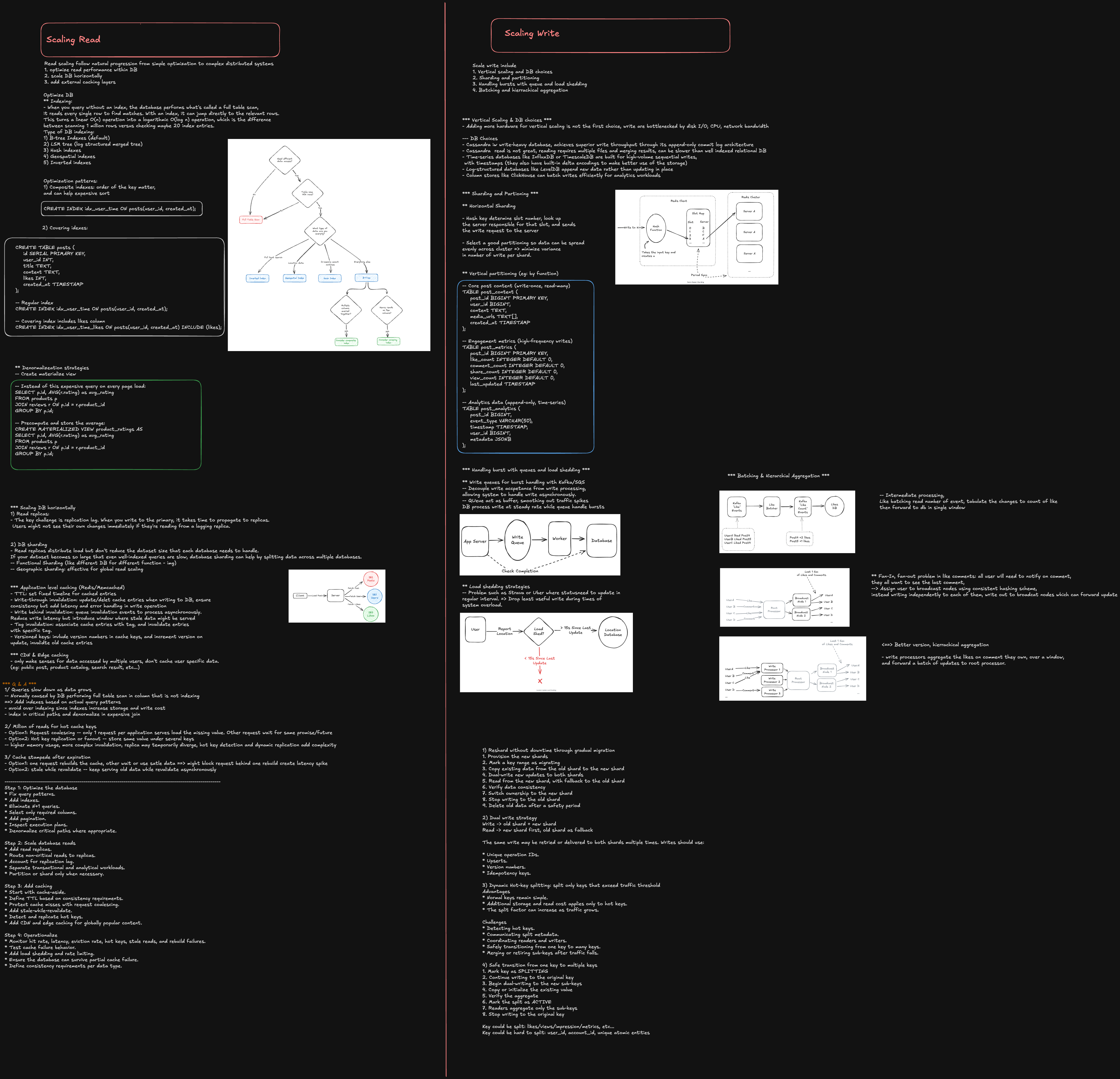
Most systems fail not because of bad code, but because the database becomes the bottleneck. A staff engineer needs to reason about which bottleneck they're solving (reads vs. writes vs. both), when each technique applies, and what trade-offs are introduced. Throwing read replicas at a write-heavy system accomplishes nothing. Blindly sharding before exhausting vertical scaling creates operational debt for years.
The framework: Diagnose → Choose the right lever → Understand the cost.
Diagnosing the Bottleneck First
Before proposing any solution, characterize the workload:
| Signal | Likely Problem |
|---|---|
High SELECT latency, low INSERT load | Read bottleneck |
High INSERT/UPDATE latency, replication lag | Write bottleneck |
| Both slow, disk I/O saturated | Storage/throughput bottleneck |
| Queries fast individually, slow under concurrency | Lock contention |
| Queries always slow | Missing indexes or schema design issue |
Tools to reach for: EXPLAIN ANALYZE, slow query log, pg_stat_activity, CloudWatch/Datadog DB metrics, replication lag dashboards.
At the staff level, you're expected to name the metric you'd look at, not just say "add a cache."
Scaling Reads
1. Read Replicas
Offload SELECT queries to one or more read-only replicas that stream changes from the primary via replication.
                 ┌─────────────┐
Writes ──────►  │   Primary   │
                 └──────┬──────┘
                        │ replication (async/sync)
            ┌───────────┼───────────┐
            ▼           ▼           ▼
         Replica 1   Replica 2   Replica 3
            ▲           ▲           ▲
Reads ──────┴───────────┴───────────┘
When to use: Read-heavy workload (>80% reads), reporting queries, analytics, search.
Trade-offs:
- Replication lag — async replicas may serve stale data. Acceptable for feeds, not for "read your own write" scenarios.
- Read-after-write consistency — route writes + the immediately following reads to the primary, or use synchronous replication (higher write latency).
- Operational cost — each replica doubles storage and increases failover complexity.
Mitigation for lag: Route session reads to primary for N seconds post-write, or use a version token / logical clock check.
2. Caching Layer
Serve reads from an in-memory cache (Redis, Memcached) in front of the DB.
Client → Cache hit? → Return cached value
               │
               └─ Cache miss → Query DB → Populate cache → Return
Patterns:
| Pattern | Description | Best For |
|---|---|---|
| Cache-aside | App checks cache, falls back to DB | General purpose, flexible TTL |
| Read-through | Cache fetches from DB on miss automatically | Simpler app code |
| Write-through | Write to cache + DB synchronously | Strong consistency, lower cache miss rate |
| Write-behind | Write to cache, async flush to DB | High write throughput, risk of data loss |
When to use: Repeated reads of the same data (hot keys), expensive aggregations, session data.
Trade-offs:
- Cache invalidation is famously hard. Stale reads happen if invalidation is delayed or missed.
- Cache stampede — many requests hit DB simultaneously on cold start or expiry. Use probabilistic early expiry or request coalescing.
- Memory cost — cache only what's hot; eviction policies (LRU, LFU) matter at scale.
3. Denormalization & Materialized Views
Pre-compute expensive joins and aggregations, store the result.
-- Instead of joining 5 tables on every read:
CREATE MATERIALIZED VIEW user_feed_summary AS
  SELECT u.id, u.name, COUNT(p.id) AS post_count, MAX(p.created_at) AS last_post
  FROM users u LEFT JOIN posts p ON p.user_id = u.id
  GROUP BY u.id, u.name;
When to use: Dashboards, leaderboards, analytics with complex aggregations that don't need real-time accuracy.
Trade-offs: Data is eventually consistent with the source. Refresh costs write I/O.
4. Indexes
Before any infrastructure change, verify indexes cover the query pattern.
-- Composite index for common filter + sort
CREATE INDEX idx_posts_user_created ON posts(user_id, created_at DESC);

-- Partial index for sparse conditions
CREATE INDEX idx_active_users ON users(email) WHERE active = true;
Staff-level nuance: Indexes speed reads but slow writes (each write updates all covering indexes). Index bloat on high-write tables is real — monitor pg_stat_user_indexes for unused indexes.
Scaling Writes
1. Vertical Scaling (Scale Up)
Increase CPU, RAM, and IOPS on the primary. Simple, no code change.
When it's the right answer: You haven't hit hardware limits yet. Many "scaling problems" at mid-size companies are solved by going from db.t3.medium to db.r6g.4xlarge. Exhaust this before sharding.
Ceiling: AWS RDS max is ~128 vCPU / 1TB RAM. Beyond that, you need a distributed strategy.
2. Write Batching & Buffering
Coalesce many small writes into fewer large writes.
User actions ──► In-memory buffer (Redis / app-level queue)
                          │
                   batch every 100ms
                          │
                          ▼
                     Single bulk INSERT
Techniques:
- Bulk INSERT —
INSERT INTO ... VALUES (...), (...), (...)— orders of magnitude faster than N individual inserts. - Async writes — acknowledge the user immediately, persist in background (acceptable for non-critical data like analytics events, view counts).
- Message queue buffer — Kafka/SQS absorbs write spikes, DB consumes at sustainable rate.
Trade-offs: Async writes risk data loss on crash. Not suitable for financial transactions.
3. Write-Optimized Storage Engines
Switch storage engines or DB types for write-heavy patterns:
| Technology | Write Optimization | Use Case |
|---|---|---|
| Cassandra / ScyllaDB | LSM tree — writes go to memtable, flushed to SSTables | Time-series, append-heavy, high write throughput |
| ClickHouse | Column-oriented, batch inserts, merge-tree | Analytics, event logs |
| PostgreSQL + BRIN index | Block Range indexes for monotonically increasing data | Timestamped event tables |
| TimescaleDB | Hypertables, automatic partitioning by time | Metrics, IoT |
4. Partitioning (Within One DB)
Split a large table into smaller physical partitions without changing the application query logic.
-- Range partition by month
CREATE TABLE events (
  id BIGSERIAL,
  user_id BIGINT,
  created_at TIMESTAMPTZ
) PARTITION BY RANGE (created_at);

CREATE TABLE events_2025_01 PARTITION OF events
  FOR VALUES FROM ('2025-01-01') TO ('2025-02-01');
Benefits: Partition pruning speeds queries, old partitions can be dropped instantly (vs. DELETE on millions of rows), maintenance operations (VACUUM, ANALYZE) run per-partition.
When to use: Time-series data, large tables with natural range keys (date, region, tenant).
5. Sharding (Horizontal Scaling)
Distribute data across multiple independent DB instances, each owning a subset of the keyspace.
Shard key: user_id % 4

user_id 0,4,8...  → Shard 0 (primary + replicas)
user_id 1,5,9...  → Shard 1 (primary + replicas)
user_id 2,6,10... → Shard 2 (primary + replicas)
user_id 3,7,11... → Shard 3 (primary + replicas)
Shard key selection — the most critical decision:
| Shard Key | Risk |
|---|---|
user_id (hash) | Hot shard if a few users have massive data |
created_at | Hot shard — all current writes go to latest shard |
tenant_id | Good for multi-tenant SaaS; uneven if tenants differ in size |
| Consistent hash | Even distribution, easier rebalancing when adding shards |
Cross-shard queries: JOINs across shards require scatter-gather (fan out to all shards, merge results in app). Avoid them by designing queries to stay within one shard — this forces you to choose the shard key based on your most common query pattern.
Resharding: Adding shards after the fact is painful. Plan capacity with 2–4x headroom.
When to use: After exhausting vertical scaling, read replicas, and caching. Sharding introduces significant operational complexity — treat it as a last resort for write scaling.
6. CQRS (Command Query Responsibility Segregation)
Maintain separate models optimized for reads and writes.
Write path:  Command → Write Model (normalized, ACID) → Event
Read path:   Event   → Async projection → Read Model (denormalized, optimized)
                                              │
                                         Client queries read model
When to use: Systems where read and write patterns are fundamentally different and at odds (e.g., an order management system where writes need strict ACID, reads need aggregated summaries across joins).
Trade-offs: Eventual consistency between write and read models. Additional infrastructure to maintain projections.
Decision Framework
Common Interview Follow-ups
"How do you handle read-after-write consistency with replicas?" Route writes and the user's subsequent reads to the primary for a short window (sticky primary reads), or use synchronous replication for critical paths while keeping async for everything else.
"How do you avoid a hot shard?" Use consistent hashing with virtual nodes so load distributes evenly. Add a salt/secondary key if a small number of entities are disproportionately large.
"What's the difference between partitioning and sharding?" Partitioning splits a table within a single DB instance — the DB engine manages it, queries are transparent. Sharding splits data across multiple DB instances — the application (or a proxy like Vitess/Citus) routes queries. Partitioning is a schema optimization; sharding is a distributed systems problem.
"When would you NOT add a cache?" Write-heavy data that changes on every read (real-time counters, live leaderboards). The invalidation overhead exceeds the cache benefit. Use atomic DB counters or a purpose-built store (Redis sorted sets) instead.
"How do you monitor if your scaling strategy is working?" Track: DB CPU %, I/O wait %, replication lag, slow query rate, p99 query latency, connection pool saturation, cache hit rate. Alert thresholds, not just averages.