Handling Multi-Step Processes
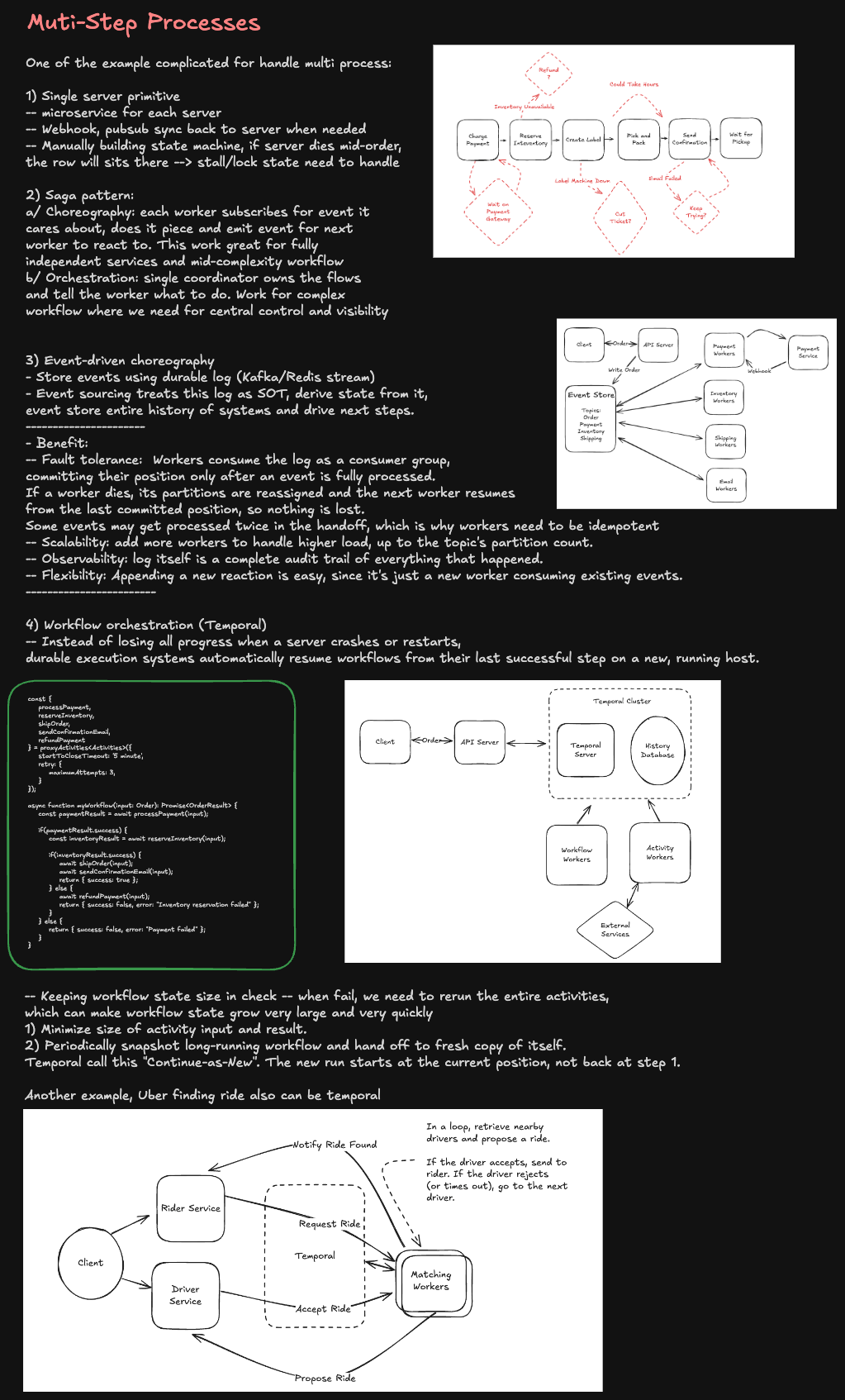
The Problem Space
Any business process spanning more than one service call is a multi-step process. Examples:
- Order fulfillment — validate → charge → reserve inventory → ship → notify
- User onboarding — create account → send welcome email → provision workspace → assign trial plan
- Video processing — upload → transcode → generate thumbnails → index → notify
- Loan approval — submit → credit check → fraud check → underwriter review → decision → disburse
These processes share failure modes that don't exist in single-step calls:
- Any step can fail independently
- The system can crash between steps, leaving partial state
- Steps may need to be retried, skipped, or compensated (undone)
- Steps may take seconds, minutes, or days (human approval)
- Concurrent instances of the same process must not interfere
Staff-level framing: The question is never "should I handle this differently?" It's "which consistency model, failure boundary, and operational surface area is acceptable for this problem?"
Technique 1: Synchronous Chain (Naive — Know When to Reject It)
The simplest approach: call each step in sequence in a single request handler.
POST /checkout
  → validateCart()
  → chargeCard()         // Stripe API call
  → reserveInventory()   // DB write
  → sendConfirmEmail()   // SendGrid API call
  → return 200
When it works: Workflows that complete in <2s, non-critical side effects, low volume.
Why it breaks at scale:
- A crash after
chargeCard()but beforereserveInventory()leaves the customer charged with no order - HTTP timeout (30s) is shorter than some workflow steps
- No retry without re-running already-completed steps (double charge risk)
- Long workflows block a thread/connection for their entire duration
Verdict: Never use for workflows with external side effects in production systems at scale.
Technique 2: Saga Pattern
Sagas decompose a long transaction into a sequence of local transactions, each with a compensating transaction that undoes its effect if a later step fails.
T1: Reserve inventory    ←  C1: Release reservation
T2: Charge credit card   ←  C2: Issue refund
T3: Ship order           ←  C3: Cancel shipment
T4: Send confirmation    ←  (no compensation — email already sent, log it)
On step N failure: execute C(N-1), C(N-2), ... C(1) in reverse order.
Choreography-based Saga
Each service listens for domain events and reacts independently. No central coordinator.
OrderService emits: OrderCreated
  → InventoryService listens: reserves stock → emits InventoryReserved
  → PaymentService listens: charges card → emits PaymentProcessed
  → ShippingService listens: schedules shipment → emits ShipmentScheduled
  → NotificationService listens: sends email → emits EmailSent

On failure:
PaymentService fails → emits PaymentFailed
  → InventoryService listens: releases reservation → emits InventoryReleased
  → OrderService listens: marks order as failed
Pros: Loose coupling, each service owns its domain, no single point of failure.
Cons: Workflow logic is distributed across services — hard to trace end-to-end. Hard to answer "what is the current state of order 123?" Cyclic dependencies can emerge. Testing is complex.
When to use: Bounded services with clear domain events, teams that own their services independently, eventual consistency is acceptable.
Orchestration-based Saga
A central orchestrator (a dedicated service or workflow engine) directs each step and handles compensation.
OrderOrchestrator:
  1. call InventoryService.reserve(orderId)
  2. call PaymentService.charge(orderId, amount)
     on failure → call InventoryService.release(orderId)
  3. call ShippingService.schedule(orderId)
     on failure → call PaymentService.refund(orderId)
                  call InventoryService.release(orderId)
  4. call NotificationService.sendConfirmation(orderId)
Pros: Workflow logic in one place. Easy to trace, debug, and modify. Clear state ownership.
Cons: Orchestrator is a coordination bottleneck. Becomes a "God service" if not carefully bounded.
When to use: Complex workflows with many steps, cross-team coordination, when you need a clear audit trail.
Technique 3: Outbox Pattern (Reliable Event Emission)
The root cause of many saga failures: writing to your DB succeeds but publishing the event to the message broker fails (or vice versa). The outbox pattern makes event emission atomic with the DB write.
Within the same DB transaction:
  INSERT INTO orders (id, status) VALUES (?, 'pending');
  INSERT INTO outbox (event_type, payload) VALUES ('OrderCreated', ?);
COMMIT;

Separate relay process:
  SELECT * FROM outbox WHERE processed = false ORDER BY created_at LIMIT 100;
  FOR each event:
    publish to Kafka/SQS
    UPDATE outbox SET processed = true WHERE id = ?
Guarantees: At-least-once delivery. The event is always published if the DB transaction commits — the relay retries until the broker acknowledges.
Idempotency requirement: Consumers must handle duplicate events (idempotency key on every step).
Implementation: Debezium CDC (reads Postgres WAL, publishes to Kafka) is the production-grade version — zero polling overhead, sub-second latency.
Technique 4: Queue-Based Step Processing (State Machine + Queue)
Model the workflow as a state machine. Each step transition is a message in a queue.
DB: orders.status = 'pending' | 'inventory_reserved' | 'paid' | 'shipped' | 'failed'

Queue messages:
  { orderId, step: 'RESERVE_INVENTORY' }
  { orderId, step: 'CHARGE_PAYMENT' }
  { orderId, step: 'SCHEDULE_SHIPMENT' }

Worker:
  consume message
  check orders.status to ensure correct sequence
  execute step
  update orders.status
  enqueue next step message
  ack message
Pros: Durable (messages survive crashes), horizontally scalable workers, natural backpressure via queue depth, simple mental model.
Cons: No built-in retry backoff logic beyond what SQS/Kafka provides. Long workflows require many queue round-trips. State reconstruction requires querying DB. Hard to implement timeouts and human-in-the-loop steps.
When to use: High-volume workflows, each step is fast (<1s), steps are independent services, you want minimal infrastructure.
Technique 5: Temporal (Workflow-as-Code)
Temporal is a durable execution platform. You write workflow logic as ordinary code; Temporal ensures it runs to completion even across crashes, restarts, and network failures.
// This looks like regular sequential code
// but Temporal persists every step's result to durable storage
export async function orderFulfillmentWorkflow(order: Order): Promise<void> {
  await reserveInventory(order.id, order.items); // Activity

  try {
    await chargePayment(order.id, order.totalAmount); // Activity
  } catch (e) {
    await releaseInventory(order.id); // Compensation
    throw e;
  }

  try {
    await scheduleShipment(order.id); // Activity
  } catch (e) {
    await refundPayment(order.id); // Compensation
    await releaseInventory(order.id);
    throw e;
  }

  await sendConfirmationEmail(order.customerId, order.id); // Activity
}
How Temporal Works Internally
Workflow Worker  ←──── Temporal Server (event history) ────► Activity Worker
     │                         │                                    │
     │   replay event history  │  records every event               │
     │◄────────────────────────│  (scheduled, started, completed)   │
     │                         │                                     │
     └── deterministic code ───┴── durable state ─────────────────►┘
The workflow code is replayed from event history on every restart. Non-deterministic operations (API calls, DB writes, time) are wrapped in Activities, which are the unit of retry/failure isolation.
Temporal Key Concepts
| Concept | Description |
|---|---|
| Workflow | Durable, long-running business process; written as code; survives crashes |
| Activity | A single step (API call, DB write); has retry policy, timeout, heartbeat |
| Signal | External event sent to a running workflow (e.g., "payment approved") |
| Query | Read current state of a running workflow without side effects |
| Timer | await sleep(days(30)) — persisted, survives server restarts |
| Child Workflow | Spawn sub-workflows; compose complex processes |
Retry and Timeout Configuration
const chargePayment = proxyActivities<PaymentActivities>({
  startToCloseTimeout: '30s', // individual attempt timeout
  scheduleToCloseTimeout: '5m', // total time including all retries
  retry: {
    initialInterval: '1s',
    backoffCoefficient: 2,
    maximumInterval: '30s',
    maximumAttempts: 5,
    nonRetryableErrorTypes: ['InvalidCardError', 'InsufficientFundsError'],
  },
});
Human-in-the-Loop with Signals
// Workflow waits indefinitely for a signal
export async function loanApprovalWorkflow(applicationId: string) {
  await submitToUnderwriter(applicationId);

  // Wait up to 72 hours for human decision
  const decision = await condition(() => receivedDecision !== undefined, '72h');

  if (decision === 'approved') {
    await disburseFunds(applicationId);
  } else {
    await notifyRejection(applicationId);
  }
}

// External system (underwriter UI) sends signal
temporalClient.signal(workflowId, 'approvalDecision', { decision: 'approved' });
When to use Temporal:
- Workflows lasting seconds to months
- Human approval steps
- Complex compensation logic
- You need full audit history of every step
- Multi-step workflows across many services
Trade-offs: Additional infrastructure (Temporal cluster). Workers must be deterministic. Learning curve. Not suited for sub-millisecond workflows.
Technique 6: Step Functions (AWS-Managed Orchestration)
AWS Step Functions is a fully managed state machine service. You define workflow as JSON (Amazon States Language); AWS manages durability, retries, and parallel execution.
{
  "Comment": "Order fulfillment",
  "StartAt": "ReserveInventory",
  "States": {
    "ReserveInventory": {
      "Type": "Task",
      "Resource": "arn:aws:lambda:us-east-1:123:function:ReserveInventory",
      "Retry": [{ "ErrorEquals": ["States.ALL"], "MaxAttempts": 3 }],
      "Catch": [{ "ErrorEquals": ["States.ALL"], "Next": "HandleFailure" }],
      "Next": "ChargePayment"
    },
    "ChargePayment": { ... },
    "ScheduleShipment": { ... },
    "HandleFailure": { "Type": "Task", "Resource": "..." }
  }
}
Pros: Zero infrastructure management, native AWS integrations (Lambda, SQS, DynamoDB, ECS), visual workflow editor, built-in audit history.
Cons: Workflow logic in JSON (not code) — harder to test and version. AWS lock-in. Price per state transition at high volume. Workflow definition separate from application code.
When to use: AWS-native shops, workflows with many Lambda steps, teams that prefer managed infrastructure over operational complexity.
Technique 7: Process Manager Pattern (DB-Driven)
For simpler workflows without dedicated orchestration infrastructure — store workflow state in the DB, use a scheduler to drive progress.
CREATE TABLE workflow_instances (
  id            UUID PRIMARY KEY,
  type          TEXT NOT NULL,          -- 'order_fulfillment'
  current_step  TEXT NOT NULL,          -- 'reserve_inventory'
  status        TEXT NOT NULL,          -- 'running' | 'failed' | 'complete'
  context       JSONB NOT NULL,         -- order data, intermediate results
  next_run_at   TIMESTAMPTZ,            -- for scheduled retries
  attempts      INT DEFAULT 0,
  created_at    TIMESTAMPTZ DEFAULT now(),
  updated_at    TIMESTAMPTZ DEFAULT now()
);
Worker loop (runs every few seconds):
SELECT * FROM workflow_instances
  WHERE status = 'running' AND next_run_at <= now()
  FOR UPDATE SKIP LOCKED
  LIMIT 10;

FOR each instance:
  execute current_step handler
  on success: advance current_step, reset attempts
  on failure: increment attempts, set next_run_at = now() + backoff(attempts)
              if attempts > max: set status = 'failed'
Pros: No external dependencies, full control, works on any DB, easy to inspect/debug state, natural idempotency via FOR UPDATE SKIP LOCKED.
Cons: You're building your own retry/backoff/timeout/scheduling logic. Polling adds DB load. Limited to workflows that fit in a DB row.
When to use: Low-to-medium volume, teams that want to avoid Temporal/Step Functions, existing Postgres infrastructure.
Comparison Matrix
| Technique | Durability | Complexity | Human Steps | Long-Running | Volume |
|---|---|---|---|---|---|
| Synchronous chain | ❌ None | Low | ❌ | ❌ | Low |
| Saga (choreography) | ✅ Via broker | Medium | ❌ | Limited | High |
| Saga (orchestration) | ✅ Via broker | Medium-High | Limited | Limited | High |
| Outbox + Queue | ✅ DB + broker | Medium | ❌ | Limited | Very High |
| Temporal | ✅ Event history | High | ✅ | ✅ Days/months | High |
| Step Functions | ✅ AWS-managed | Low-Medium | ✅ (wait task) | ✅ | Medium |
| Process Manager | ✅ DB | Medium | ✅ | ✅ | Low-Medium |
Decision Framework
Staff Interview Follow-ups
"How do you handle idempotency across retried steps?"
Every activity/step must be idempotent. Use an idempotency key (workflow ID + step name + attempt number) in every external call. Check if the operation was already applied before executing. For payment APIs, pass idempotency_key in the request header. For DB writes, use INSERT ... ON CONFLICT DO NOTHING or upsert patterns.
"What's the difference between choreography and orchestration?" Choreography: services react to events — no central brain, high coupling through event contracts. Orchestration: a coordinator directs each step — single source of truth for workflow logic, single point of change. Choreography scales better; orchestration debugs better. Use choreography for loosely coupled domains, orchestration when you need workflow visibility.
"How do you handle a step that cannot be compensated?" Emails sent, SMS delivered, external webhooks fired — these can't be undone. Design compensating actions that are logically equivalent: send a "cancellation" email rather than "unsending." Move non-compensatable side effects to the last step so compensation never needs to undo them. If you can't, mark the saga as "partially failed" and trigger a manual remediation workflow.
"How does Temporal guarantee exactly-once execution?" It doesn't — Temporal guarantees at-least-once activity execution. Activities must be idempotent. What Temporal does guarantee is that the workflow makes progress and its recorded history is consistent. The workflow code is replayed deterministically from history, so the same logical path is always followed.
"When would you NOT use Temporal?" Sub-millisecond workflows (Temporal adds latency per step), very high-volume simple tasks (bulk data processing is better served by Spark/Flink), teams without Go/Java/TypeScript expertise (SDK requirement), or when the operational overhead of running a Temporal cluster exceeds the problem complexity (use Step Functions or DB process manager instead).