Editable diagram: Open in Excalidraw
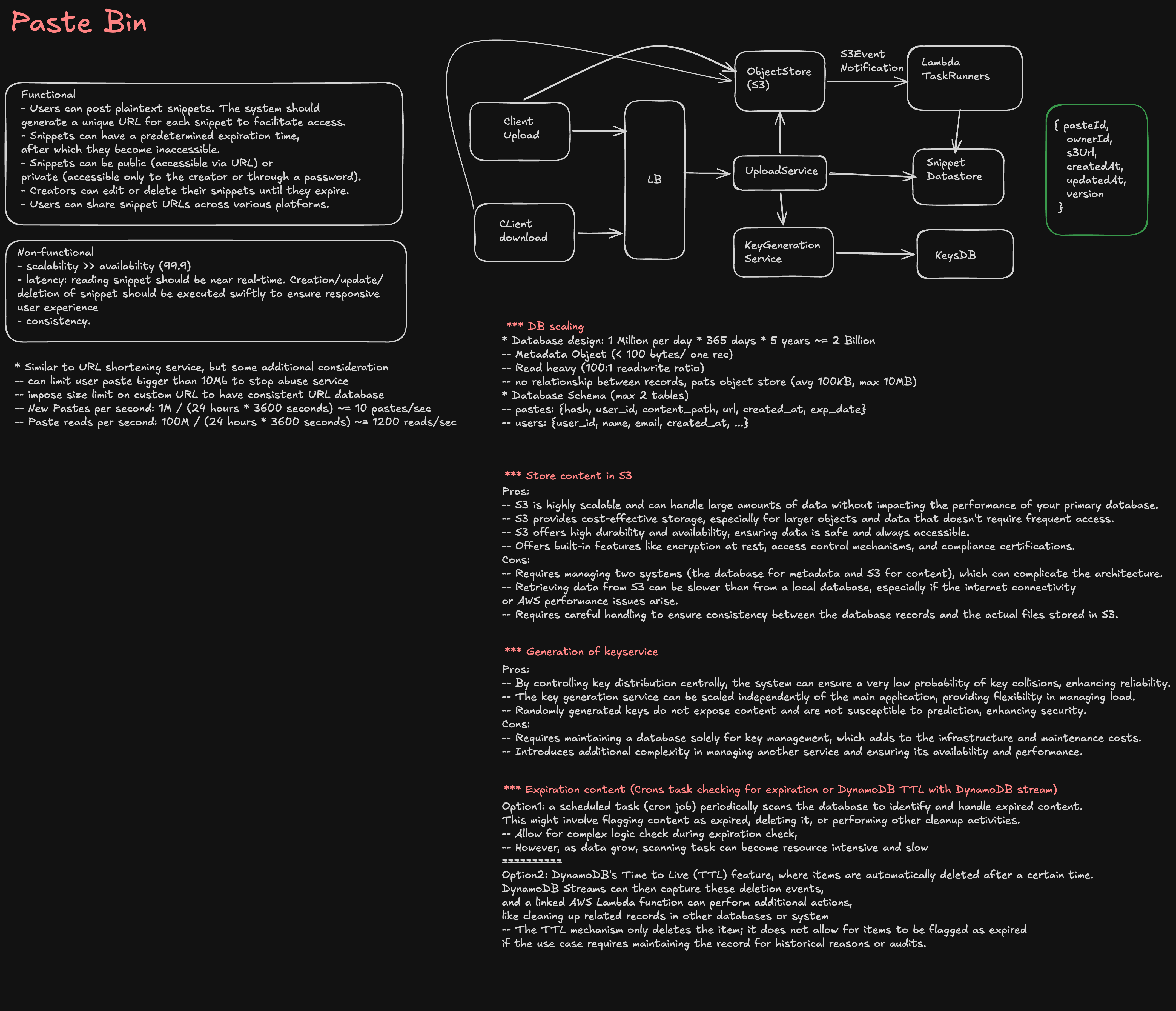
PasteBin System Design
A distributed system for storing and sharing code snippets, text, and documents with short URLs.
System Diagram
Functional Requirements
Core Features
| Feature | Details |
|---|---|
| Create Paste | User submits text/code, system generates unique short URL, returns immediately |
| Read Paste | Retrieve paste by short URL; display content and metadata |
| Delete Paste | User can delete their own paste; purge from storage |
| Expiration | Pastes can expire after TTL (hours/days) or time-based scheduled deletion |
| Access Control | Public (anyone with URL), private (requires auth token), or password-protected |
| Syntax Highlighting | Language detection and optional client-side rendering |
| Sharing | Generate share links with custom expiration, view counts, analytics |
Secondary Features
- Paste History — authenticated users can see their paste timeline
- Clone/Fork — allow users to clone a paste and create a new one
- Trending — show recently created or most-viewed pastes
- Search — find pastes by tags or content (optional; privacy-sensitive)
- APIs — programmatic paste creation/retrieval for CI/CD, tools, scripts
Non-Functional Requirements
Scale
| Metric | Target |
|---|---|
| Pastes Created/Day | 10M |
| QPS (Read) | 100K |
| QPS (Write) | 5K |
| Avg Paste Size | 10 KB |
| Data Stored (1 year) | ~50 TB (with 3x replication) |
Performance
- Write Latency — P99 < 200ms (short URL generation + storage)
- Read Latency — P99 < 50ms (cache hit); P99 < 500ms (cold read from DB)
- Availability — 99.9% uptime (SLA 3 nines minimum)
Durability & Safety
- Data Durability — 99.999999% (11 nines) across replicas
- Replication — 3x across zones or regions
- Backup — daily snapshots, 30-day retention
- PITR (Point-In-Time Recovery) — 7 days minimum
Compliance & Security
- Encryption — TLS in transit; at-rest encryption for sensitive content
- GDPR — right to be forgotten; comply with EU data residency
- Rate Limiting — prevent abuse (spam pastes, scraping)
- DDoS Protection — geo-distributed, CDN integration
- Content Moderation — detect and flag illegal/abusive content
Capacity Planning
Storage
Daily write: 10M pastes × 10 KB = 100 GB/day
Annual: 100 GB × 365 = 36.5 TB
With 3x replication: ~110 TB/year
DB Strategy:
- Hot data (< 30 days): SSD, fast access
- Warm data (30 days – 1 year): HDD, archival tier
- Cold data (> 1 year): blob storage (S3/GCS)
Bandwidth
Peak read: 100K QPS × 10 KB avg = 1 TB/sec
Requires: multi-region CDN + edge caching
High-Level Architecture
Key Design Decisions
1. URL Shortening Strategy
Option A: Sequential IDs
Pros: Simple, predictable, cache-friendly
Cons: Enumerable (security risk — can guess URLs)
Option B: Cryptographic Hash (MD5/SHA-256 prefix)
Pros: Difficult to guess, privacy-preserving
Cons: Collision handling needed; can't reverse lookup
Option C: Random Base62/Base64 String
Pros: Non-enumerable, good entropy
Cons: Collision checks needed; no inherent meaning
Recommended: 6-character Base62 = 62^6 = 56 trillion unique IDs
Chosen: Option C (6-char Base62)
- Generate candidate ID
- Check collision in Redis (fast check)
- On collision, retry (expected <1% collision rate at scale)
2. Database Schema
-- Pastes table
CREATE TABLE pastes (
  id BIGINT PRIMARY KEY AUTO_INCREMENT,
  short_url VARCHAR(10) UNIQUE NOT NULL,
  user_id BIGINT NULLABLE,
  title VARCHAR(255),
  content LONGBLOB,           -- binary or text
  language VARCHAR(50),        -- "python", "javascript", etc.
  is_public BOOLEAN DEFAULT true,
  password_hash VARCHAR(255) NULLABLE,
  view_count INT DEFAULT 0,
  created_at TIMESTAMP DEFAULT CURRENT_TIMESTAMP,
  expires_at TIMESTAMP NULLABLE,  -- TTL for auto-delete
  updated_at TIMESTAMP DEFAULT CURRENT_TIMESTAMP ON UPDATE CURRENT_TIMESTAMP,
  INDEX idx_user_id (user_id, created_at),
  INDEX idx_expires_at (expires_at)  -- for batch cleanup
) ENGINE=InnoDB;

-- Paste access log (optional, for analytics)
CREATE TABLE paste_views (
  paste_id BIGINT,
  viewer_ip VARCHAR(45),
  accessed_at TIMESTAMP DEFAULT CURRENT_TIMESTAMP,
  INDEX idx_paste_time (paste_id, accessed_at)
) ENGINE=InnoDB;
3. Caching Strategy
Cache Layers (read-through):
-
CDN (Geo-distributed, 24h TTL)
- Serves public pastes directly
- Reduces load on origin
-
Redis Hot Cache (In-memory, 1h TTL)
- Top 1% of pastes (by view count)
- Handles 80% of reads
- Automatic eviction via LRU
-
Replica Database (Read Pool)
- Scales horizontal read replicas
- Warm reads for non-cached pastes
-
Blob Storage (S3, Archive)
- Old pastes (>90 days) stored as-is
- Accessed via 302 redirect or background fetch
4. Expiration & Cleanup
Strategy: Lazy + Active Deletion
Lazy Delete (on read):
  - Check expires_at timestamp
  - If expired, return 404 (don't fetch content)
  - Mark for async cleanup

Active Delete (background):
  - Kafka topic: paste.expired
  - Worker consumes, deletes from DB and cache
  - Runs daily via cron (off-peak hours)
Rationale: Lazy prevents serving expired content; active cleanup frees storage.
5. Consistency & Replication
Choice: Eventual Consistency
Write Path:
  1. Client POSTs paste to API
  2. API writes to Primary DB
  3. API writes short_url to Redis (optimistic)
  4. Returns short_url immediately to client
  5. Primary replicates to Replicas (async, <1s)

Read Path:
  1. Check Redis (cache hit → P99 <50ms)
  2. Check Replica DB (cache miss → P99 <500ms)
  3. Stale read risk: <1 second during primary failure

Trade-off: Prioritize availability & low latency over strict consistency
(Paste data is immutable; no updates after creation)
API Endpoints
Write
POST /api/v1/pastes
Content-Type: application/json

{
  "content": "print('hello')",
  "language": "python",
  "title": "Quick test",
  "is_public": true,
  "expires_in_hours": 24,
  "password": "optional-password"
}

Response:
{
  "short_url": "abc123",
  "url": "https://pastebin.local/abc123",
  "created_at": "2026-08-01T12:00:00Z",
  "expires_at": "2026-08-02T12:00:00Z"
}
Read
GET /api/v1/pastes/{short_url}

Response (if public):
{
  "short_url": "abc123",
  "content": "print('hello')",
  "language": "python",
  "title": "Quick test",
  "created_at": "2026-08-01T12:00:00Z",
  "view_count": 42
}

Response (if password protected):
{
  "status": "password_required"
}

POST /api/v1/pastes/{short_url}/unlock
{
  "password": "user-password"
}
Delete
DELETE /api/v1/pastes/{short_url}
Authorization: Bearer {user_token}

Response: 204 No Content
Scaling Challenges & Solutions
| Challenge | Solution |
|---|---|
| Write bottleneck | Shard by user_id or paste ID prefix; distribute across DB clusters |
| Cache invalidation | TTL + active deletion via Kafka; no manual cache purge |
| Hot pasta spike | Auto-scale API tier via K8s HPA; burst capacity via CDN |
| Storage growth | Tiered storage: SSD (hot) → HDD (warm) → archival (cold) |
| Replication lag | Async replication < 1s acceptable; SLA allows eventual consistency |
| Regional outage | Multi-region deployment; failover via DNS (Route53/Cloud DNS) |
Monitoring & Observability
Key Metrics
P99 latency (write, read, delete)
Cache hit ratio (target: >90%)
Database replication lag
Paste expiration rate
View count distribution (for trending)
QPS breakdown by endpoint
Error rates (4xx, 5xx)
Alerting
Thresholds:
  - P99 write latency > 500ms
  - Cache hit ratio < 80%
  - Replication lag > 5s
  - 5XX error rate > 0.1%
  - Disk usage > 80%
Trade-offs & Decisions
| Decision | Rationale |
|---|---|
| Eventual consistency | Lower latency & higher availability; paste data immutable after creation |
| Random Base62 URLs | Non-enumerable; better privacy; simpler than cryptographic hash |
| Redis hot cache | Sub-50ms reads for top 1% pastes; 80/20 rule pays off |
| Lazy + active expiration | Avoids serving stale data; background cleanup for storage efficiency |
| Async replication | Faster writes; acceptable <1s lag given immutable pastes |
| CDN + origin | Geo-distribution reduces latency & DDoS surface |
Follow-up Questions
- How do you handle abuse? — Rate limiting per IP/user, content moderation via ML, DMCA compliance
- How do you scale to 100M pastes/day? — Sharding, multi-region, tiered storage, CDN
- How do you ensure privacy? — Encryption at rest, GDPR deletion, audit logs
- How do you prevent enumeration attacks? — Rate limiting, CAPTCHA after N failed requests, randomized URLs
- How do you handle large pastes (>1GB)? — Stream to blob storage directly; impose size limits (256 MB)