Online Auction System Design
Editable diagram: Open in Excalidraw
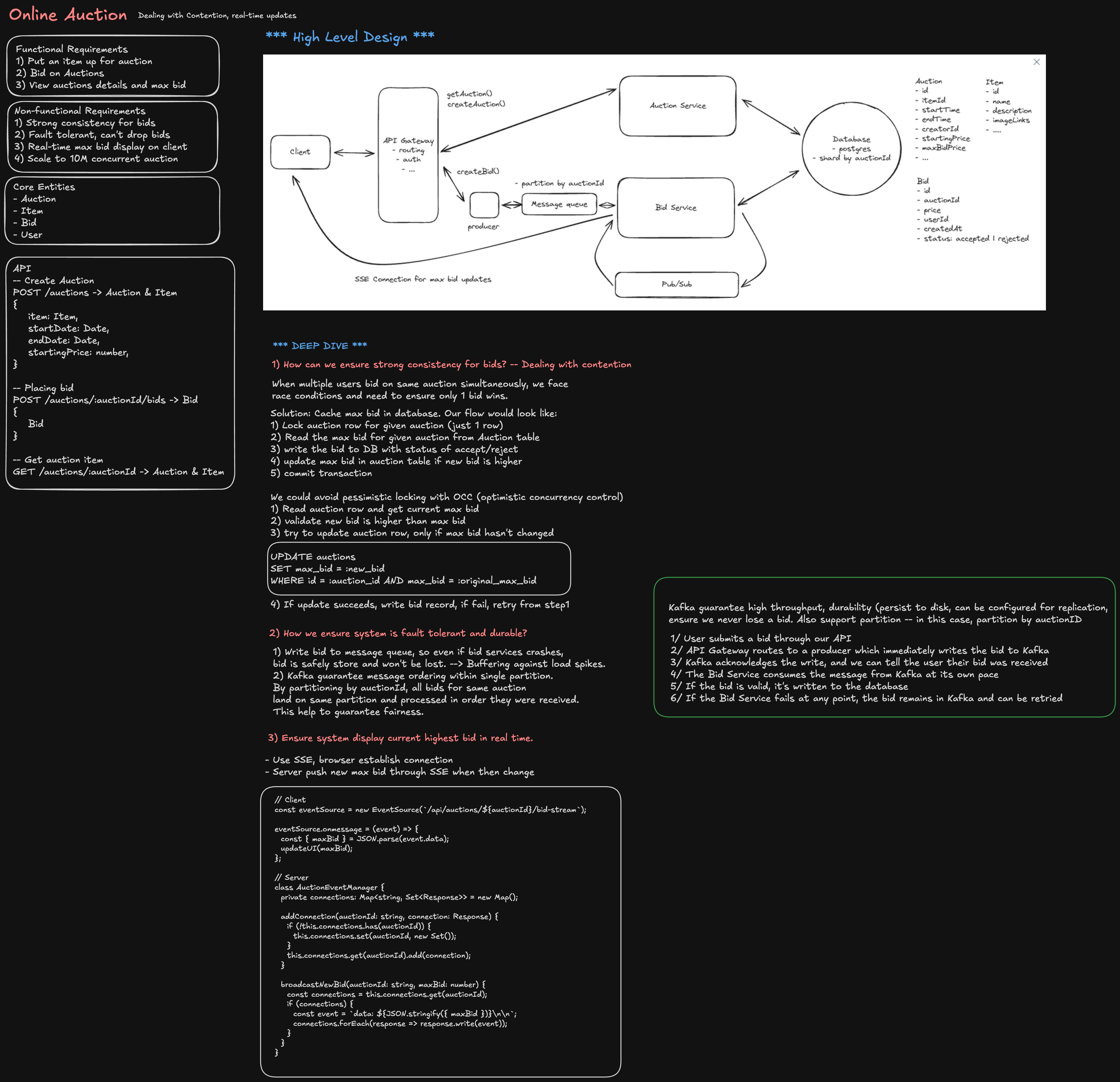
Interview Summary
| Component | Challenge | Solution |
|---|---|---|
| Bidding Engine | Multiple concurrent bids on same item; race conditions | Optimistic locking + consensus algorithm; centralized ordering |
| Real-time Updates | Clients need instant bid notifications | WebSocket/Server-Sent Events to broadcast state changes |
| Fraud Detection | Shill bidding, price manipulation, user collusion | Behavioral analysis, velocity checks, bid pattern anomalies |
| Consistency Guarantee | Final price must be unambiguous across all replicas | Single source of truth (primary DB); read replicas for scale |
| High-throughput Bidding | Peak load during final minutes of auctions | Event sourcing + in-memory cache; async persistence |
| Auction Clock Skew | Clients disagree on when auction ends | Server-side timers; ignore client timestamp claims |
| Settlement & Escrow | Winner payment, seller trust, dispute resolution | Payment holds, escrow service, appeal period |
The core challenge: A bid that arrives first to a replicated system must win deterministically, even under network partition. OT / CRDT approaches work poorly here because auction ordering is causal and irreversible.
High-Level Architecture
┌─────────────────────────────────────────────────────────────┐
│                   Client (Web/Mobile)                       │
│         Bid Form + Real-time Bid Updates (WebSocket)       │
└──────────────────────┬──────────────────────────────────────┘
                       │
                       ↓ POST /api/bid
        ┌──────────────────────────────────────────────────┐
        │   API Gateway (Auth, Rate Limit, Tenant)         │
        └──────────────┬───────────────────────────────────┘
                       │
              ┌────────┴─────────┐
              ↓                  ↓
     ┌─────────────────┐  ┌──────────────────┐
     │  Bid Service    │  │  Auction Service │
     │  (Validation)   │  │  (State Machine) │
     └────────┬────────┘  └──────┬───────────┘
              │                  │
              └────────┬─────────┘
                       ↓
        ┌──────────────────────────────────────────────────┐
        │  Consensus Layer (Primary Write, Replicate)     │
        │  - Primary DB (write lock on auction)           │
        │  - Event Log (immutable bid history)            │
        │  - Read Replicas (serve bid status)             │
        └──────────────┬───────────────────────────────────┘
                       │
        ┌──────────────┴──────────────────────────────────┐
        │                                                  │
        ↓                                                  ↓
    ┌────────────────┐                          ┌──────────────────┐
    │  PostgreSQL    │                          │  Fraud Detection │
    │  (Auctions,    │                          │  (Real-time)     │
    │   Bids, Users) │                          │  (ML Pipeline)   │
    └────────────────┘                          └──────────────────┘
        │
        ├─→ Cache (Redis): Active auction state, bid count, top bidder
        │
        └─→ Event Stream (Kafka): Bid events for analytics, settlement
The Five Critical Decisions
1. Consensus for the Final Bid
The problem: User A and User B both submit bids at the same time. Network is partitioned. Which bid wins?
Solution:
- Single primary database — all bids route through one master for ordering
- Atomic compare-and-swap — check current highest bid, update if lower, fail if higher
- Write-ahead log — bid is durable before response sent to client
Code pattern:
-- Check-and-set for auction bidding
BEGIN TRANSACTION;
SELECT highest_bid, highest_bidder_id FROM auctions WHERE id = ? FOR UPDATE;

IF new_bid_amount > highest_bid THEN
  UPDATE auctions
  SET highest_bid = new_bid_amount,
      highest_bidder_id = ?,
      bid_timestamp = NOW()
  WHERE id = ?;

  INSERT INTO bid_history (auction_id, user_id, amount, timestamp)
  VALUES (?, ?, new_bid_amount, NOW());

  COMMIT;
  RETURN SUCCESS;
ELSE
  ROLLBACK;
  RETURN FAILURE (bid too low);
END IF;
Why not CRDT or OT?
- CRDT uses eventual consistency; bids are not commutative (higher bid always wins)
- OT assumes operations can be reordered; auction order is causal and final
- Auction semantics require total ordering, not causal ordering
2. Real-time Bid Broadcasting
The problem: Bidder A is winning at $500. Bidder B places a bid at $600. Bidder A's client must update instantly to show they're losing.
Solution:
- WebSocket connection per client — persistent, low-latency
- Pub/Sub channel per auction — server publishes bid updates to all subscribers
- Bid history served from read replica (eventual consistency acceptable here)
Code pattern:
// Server publishes bid update
const broadcastBidUpdate = async (auctionId, bidData) => {
  const update = {
    type: 'bid_update',
    auctionId,
    highestBid: bidData.amount,
    highestBidderId: bidData.userId,
    timestamp: Date.now(),
    bidCount: bidData.totalBids,
  };

  // Publish to Redis pub/sub
  await redis.publish(`auction:${auctionId}`, JSON.stringify(update));

  // Connected clients receive via WebSocket
  // io.to(`auction:${auctionId}`).emit('bid_update', update);
};

// Client receives
socket.on('bid_update', (update) => {
  if (update.highestBidderId !== myUserId) {
    setStatus('You are outbid');
  } else {
    setStatus('You are winning');
  }
});
Latency targets:
- Bid placed → server processes: < 100ms
- Server → all clients notified: < 500ms
- Total perceived latency: ~1 second (acceptable for auctions)
3. Handling Auction End (Race to the Finish)
The problem: Auction ends at 5:00:00 PM. Bids received at 4:59:59.5, 4:59:59.8, 5:00:00.2 all claim to be valid. How do you handle the last-second bids?
Solution:
- Server controls time — auction.endTime is absolute; ignore client clock
- Snipe detection — bids within last N seconds trigger auto-extension
- Shill protection — suspicious late-auction bidding patterns flagged
- Settlement period — delay final winner declaration by 1-5 minutes for dispute
Time handling code:
const validateBidTiming = (auctionEndTime, bidTimestamp, serverTime) => {
  const timeUntilEnd = auctionEndTime - serverTime;
  const secondsToEnd = timeUntilEnd / 1000;

  if (secondsToEnd < 0) {
    return { valid: false, reason: 'auction_ended' };
  }

  if (secondsToEnd < 60 && bidTimestamp > auctionEndTime - 60000) {
    // Sniping attempt (bid within last minute)
    return { valid: true, reason: 'snipe_detected', extend: true };
  }

  return { valid: true, reason: 'normal' };
};

// If snipe detected, extend auction
if (shouldExtend) {
  auction.endTime = Math.max(auction.endTime, serverTime + 5 * 60 * 1000);
  // Re-broadcast new end time to all clients
  broadcastAuctionUpdate(auctionId, { endTime: auction.endTime });
}
4. Fraud Detection
The problem: Seller and accomplice bid up the price artificially. Or one user runs thousands of bot accounts to manipulate prices.
Solution:
- Behavioral profiling — flag accounts that always bid immediately after each other
- Velocity checks — reject bids from same account at inhuman speed
- Bid pattern analysis — similar IPs, devices, payment methods
- Deposit requirements — serious bidders must prove creditworthiness
Fraud detection pipeline:
const checkFraudSignals = async (bid, userProfile) => {
  const signals = {
    sameUserInAuction: null,
    velocityAnomaly: null,
    deviceChangeSuspicious: null,
    withdrawalPattern: null,
  };

  // 1. Check if same user bidding twice in succession
  const recentBids = await db.query(
    'SELECT user_id FROM bids WHERE auction_id = ? ORDER BY timestamp DESC LIMIT 2'
  );
  if (recentBids[0]?.user_id === bid.userId && recentBids[1]?.user_id === bid.userId) {
    signals.sameUserInAuction = true;
  }

  // 2. Check if user is bidding suspiciously fast
  const previousBid = await db.query(
    'SELECT timestamp FROM bids WHERE user_id = ? ORDER BY timestamp DESC LIMIT 1'
  );
  if (previousBid && Date.now() - previousBid.timestamp < 1000) {
    signals.velocityAnomaly = true; // Two bids within 1 second
  }

  // 3. Check if device changed (fingerprinting)
  if (userProfile.lastKnownDeviceId && userProfile.lastKnownDeviceId !== bid.deviceId) {
    signals.deviceChangeSuspicious = true;
  }

  // 4. Check withdrawal pattern (wins bid then cancels payment)
  const winHistory = await db.query(
    'SELECT count(*) as wins, count(CASE WHEN cancelled = true THEN 1 END) as cancellations FROM bids WHERE user_id = ? AND highest_bid = true'
  );
  if (winHistory.cancellations / winHistory.wins > 0.3) {
    signals.withdrawalPattern = true;
  }

  // Score fraud risk
  const riskScore = Object.values(signals).filter((s) => s).length / Object.keys(signals).length;
  return { riskScore, signals };
};
5. Payment & Settlement
The problem: Auction ends. Winner claims they can't pay. Or seller claims they never received payment. How do you handle disputes?
Solution:
- Hold payment in escrow immediately after auction ends
- Settlement grace period (24-48 hours) for disputes
- Automated payout to seller if no dispute raised
- Chargeback protection via payment processor
Settlement state machine:
AUCTION_ENDED
    ↓
SETTLEMENT_PENDING (24h window for disputes)
    ├─ BUYER_CLAIMS_FRAUD
    ├─ SELLER_CLAIMS_NO_PAYMENT
    └─ [No dispute] → PAYMENT_RELEASED
        ↓
SELLER_PAID
    ↓
BUYER_RECEIVES_ITEM (tracking)
    ↓
CLOSED
Deep Dive: Handling Concurrent Bids
Scenario: Three bids arrive within 100ms
| Time | User | Bid | Placed at | Server Processes at |
|---|---|---|---|---|
| 0ms | Alice | $1000 | 4:59:45 | 4:59:45.050 |
| 50ms | Bob | $1100 | 4:59:45 | 4:59:45.100 |
| 80ms | Carol | $900 | 4:59:45 | 4:59:45.200 |
Server processing order:
- Alice: $1000 accepted (highest so far)
- Bob: $1100 accepted (> $1000)
- Carol: $900 rejected (< $1100, Bob wins)
Guarantee: No matter how network reorders packets, Bob always wins because server enforces single-threaded ordering via write lock.
Code for Optimistic Locking
-- Auction table with version
CREATE TABLE auctions (
  id BIGINT PRIMARY KEY,
  highest_bid DECIMAL,
  highest_bidder_id BIGINT,
  bid_version INT,  -- Incremented on each successful bid
  version INT       -- For optimistic lock
);

-- Bid submission with compare-and-swap
UPDATE auctions
SET
  highest_bid = ?,
  highest_bidder_id = ?,
  bid_version = bid_version + 1,
  version = version + 1
WHERE id = ?
  AND highest_bid < ?  -- Only accept if new bid is higher
  AND version = ?;     -- Optimistic lock

-- If 0 rows updated: conflict! Bid was beaten by another bid
IF UPDATE count = 0 THEN
  RETURN { status: 'outbid', currentHighestBid, reason: 'another user bid higher' };
END IF;
Anti-Patterns & How to Avoid
| Anti-pattern | Problem | Solution |
|---|---|---|
| Client controls auction end time | Clients lie about time; bids after deadline claimed as valid | Server-side timer; server decides what is valid |
| No sniping protection | Last-second automated bids ruin auction legitimacy | Extend auction on late bids (e.g., +5 min per bid in final 60s) |
| Trusting user device for bids | User falsifies bid timestamp, claim to be earlier | Ignore client timestamp; use server-side clock |
| No idempotency | Bid submitted twice due to retry; double-charge | Idempotency key = (user_id, auction_id, bid_amount, nonce); cache result |
| Broadcasting old state | Clients see $1000 max bid, but it was already $1200 | Always broadcast server's view of state, not client's |
| No bid history | User claims they bid $5000 but lost; no proof | Immutable bid log; each bid gets cryptographic signature |
| Silent failure on payment | Seller never knows if payment succeeded | Synchronous payment authorization; fail auction if payment fails |
Interview Follow-ups
-
"What if the primary database goes down during an active auction?"
- Answer: Failover to standby (seconds). Active auctions are held in Redis cache; bids queue in Kafka. On recovery, replay Kafka to restore state. For auctions that end during outage, use "last seen bid" as tie-breaker and manually review.
-
"How do you prevent a user from withdrawing their bid after placing it?"
- Answer: Bids are immutable once accepted. User can place a counter-bid to "cancel" by overbidding, but cannot retract. Escrow holds their money until auction ends. Repeated cancellations flag for fraud.
-
"How do you handle the case where two bids claim the same timestamp?"
- Answer: Order by (timestamp, bid_id). Bid_id is unique (UUID or sequential). Whichever bid_id is lower wins the tie.
-
"What's the difference between a Dutch auction and an English auction? How does the system handle both?"
- Answer:
- English auction (ascending): Highest bid wins. Our design above.
- Dutch auction (descending): Price starts high, drops over time; first bid wins.
- Same core engine, different settlement logic. Dutch just needs descending price logic; bid validation flips from "must be higher" to "accept first bid at current price."
- Answer:
-
"How would you scale bidding to 100k concurrent users on one auction?"
- Answer:
- Write path: Single-threaded queue + consensus (no change).
- Read path: Read replicas + caching by geography (regional read replicas).
- Broadcast: Pub/Sub sharding (partition auction subscribers by region/client pool).
- Bid validation: Pre-check against cache before hitting DB (early rejection).
- Answer:
-
"What happens if the seller goes offline after winning and never transfers the item?"
- Answer: Dispute escalation. After grace period, system auto-refunds buyer (payment processor reverses hold). Seller's account flagged for enforcement. Repeated offenses → suspension.
-
"How do you prevent collusion between seller and bidder (shell accounts)?"
- Answer:
- Same IP address + similar device fingerprints + correlated bid patterns → automatic account linking
- If linked accounts detected in same auction, higher bid from the linked account is voided
- Repeated collusion → account ban + legal action
- Requires ML model to detect subtle patterns (different IP but same payment method, etc.)
- Answer:
-
"How do you handle time zones? User in NYC bids at 11:59:59 PM, user in Tokyo bids at 12:00:01 AM (next day). Who bid first?"
- Answer: Server uses UTC everywhere. Client sends all timestamps in UTC. Auction.endTime is always UTC. Display to user in their local timezone, but server logic is timezone-agnostic.