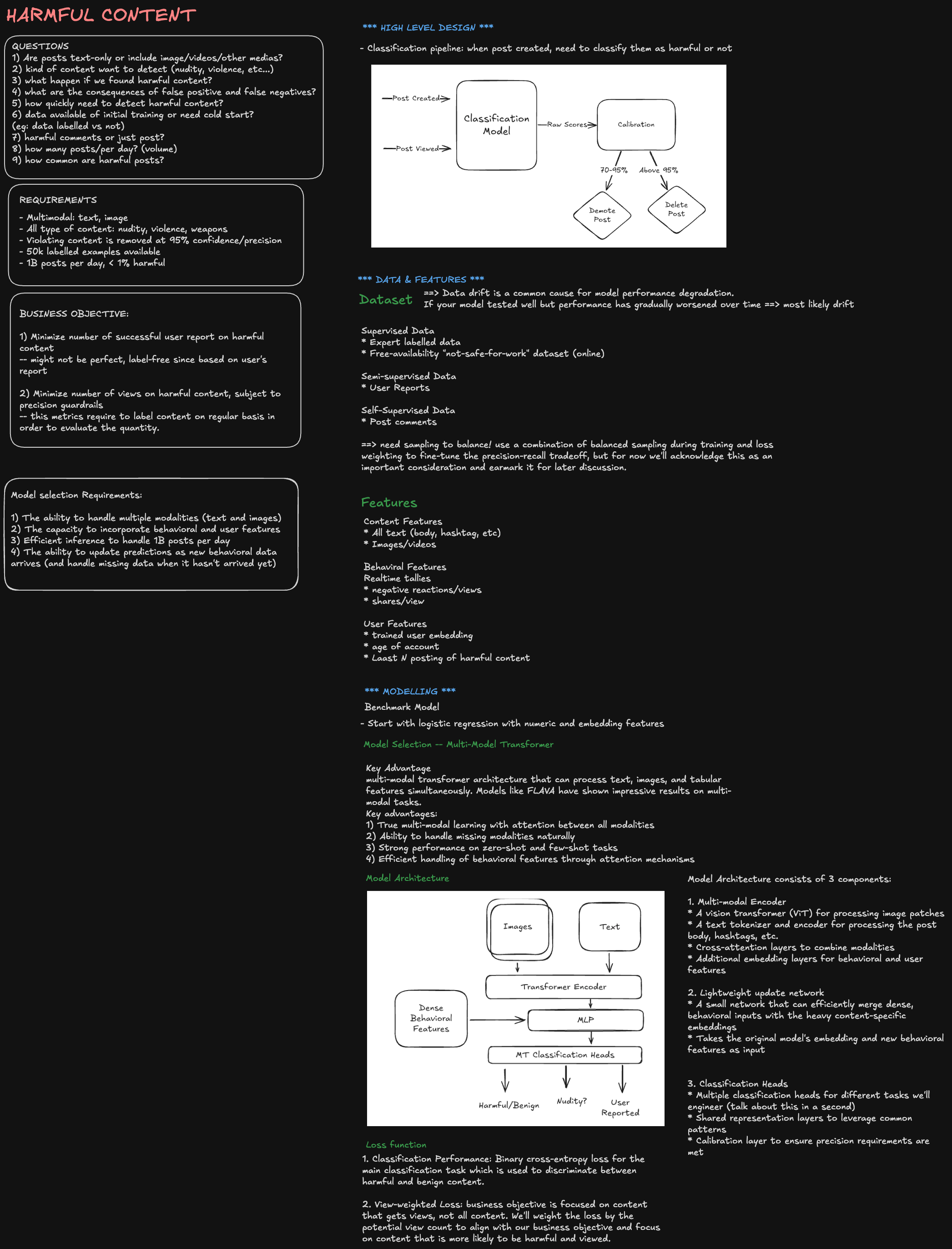
ML System Design: Detect Harmful Content
Design a system that detects harmful content in near real time and applies policy actions such as block, warn, quarantine, age-gate, or escalate to human review.
At staff level, this is not only a classification task. It is a policy, ML, and operations system where false negatives and false positives have user-safety and trust implications.
Interview framing
Clarify scope and policy before architecture:
- Which content modalities: text, image, audio, video, links, metadata?
- Which harms: hate, harassment, sexual content, self-harm, violence, scams, misinformation?
- What surfaces: upload-time, feed ranking, comments, direct messages, search?
- Is decision latency strict (sub-second) or asynchronous acceptable?
- What actions are supported: allow, downrank, soft block, hard block, account strike?
- What jurisdictions and legal obligations apply?
Core invariant: no content is actioned without a policy-grounded decision and auditable evidence.
Requirements
Functional requirements
- Ingest content and context (author, language, region, age signals, conversation context).
- Detect harmful categories and severity with confidence scores.
- Apply policy rules and return deterministic moderation actions.
- Support real-time and asynchronous moderation paths.
- Route uncertain/high-risk cases to human review.
- Track appeals, overrides, and model feedback loops.
- Publish moderation events for ranking, search, and notifications.
Non-functional requirements
| Requirement | Target |
|---|---|
| Decision latency | 50-300 ms for synchronous text path; async for heavy media scans |
| Availability | Moderation must degrade safely; never fail silently |
| Scale | Millions of content events per hour with bursty traffic |
| Quality | High recall on critical harms; controlled false-positive rate |
| Auditability | Explainable decision trail and policy versioning |
| Privacy | Minimize PII exposure and enforce retention controls |
High-level architecture
Separate concerns:
- ML inference predicts probabilities and risk signals.
- Policy engine converts model output plus rules into product actions.
- Human review resolves ambiguous/high-impact cases.
- Offline loop retrains, evaluates, and calibrates models.
Detection strategy (multi-stage)
Use a cascaded design to balance latency and cost:
- Fast filter: cheap lexical/rule-based checks, URL/domain reputation, exact hash matches.
- Primary ML classifiers: modality-specific models (text toxicity, image nudity/violence, OCR + text classifier, audio transcript classifier).
- Contextual model: conversation/user-history-aware risk model for nuanced harms.
- Policy layer: thresholds, jurisdiction rules, and user-tier rules.
- Human-in-the-loop: uncertain/high-severity cases.
Critical safety categories should favor recall, with downstream review to control precision impact.
Feature and model design
Inputs
- Content features: tokens, embeddings, image frames, OCR text, audio transcripts.
- Context features: language, geography, thread context, account age, prior strikes.
- Integrity features: link reputation, device/network patterns, abuse velocity.
Outputs
Per category:
category_score: [0, 1]
severity: low | medium | high | critical
confidence
explanations/reason_codes
Recommended output format:
{
  "content_id": "abc123",
  "policy_version": "v27",
  "scores": {
    "hate": 0.04,
    "harassment": 0.72,
    "sexual": 0.01,
    "violence": 0.15,
    "self_harm": 0.02
  },
  "severity": "medium",
  "route": "auto_action"
}
Policy engine and actions
Do not bind product behavior directly to raw model score. Use a versioned policy layer:
- score thresholds by category and region,
- user-age and legal constraints,
- recidivism and account trust multipliers,
- exception allowlists for known safe entities,
- emergency policy toggles.
Typical actions:
ALLOWALLOW_WITH_WARNINGDOWNRANKQUARANTINE_PENDING_REVIEWBLOCKACCOUNT_STRIKE
All decisions should include policy_version, reason codes, and action source (auto, human, appeal_override).
Real-time vs async moderation
Real-time path
Use for comments, captions, and short text where user feedback must be immediate.
- low-latency feature extraction,
- lightweight model ensemble,
- strict time budget and fallback behavior.
Async path
Use for heavy media (video, long audio, large images).
- process in background workers,
- perform frame/segment sampling,
- progressively update moderation status,
- prevent broad distribution before high-risk scan completes.
Human review and appeals
Human moderation is part of the core design, not an afterthought.
Review queue prioritization signals:
- high severity,
- low confidence near threshold,
- high-reach content,
- creator trust level,
- legal escalation category.
Appeals flow:
- User appeals action.
- Case enters reviewer queue with full evidence bundle.
- Reviewer decision can uphold/revert.
- Outcome updates policy/model feedback datasets.
Track inter-rater agreement and reviewer drift.
Data quality, drift, and evaluation
Monitor both model and policy quality:
- Precision/recall per category and language.
- False negative rate for critical harm classes.
- Calibration error (score vs actual risk probability).
- Drift in embedding distributions and category prevalence.
- Human override rate by model version.
Evaluate by slices:
- language,
- region,
- content type,
- creator cohort,
- vulnerable population proxies where ethically/legally valid.
Abuse and adversarial robustness
Attackers evade filters with obfuscation and multimodal tricks.
Defenses:
- text normalization (leet, unicode confusables, spacing tricks),
- OCR on images and video frames,
- URL expansion and redirect analysis,
- ensemble diversity and randomized secondary checks,
- delayed publish for suspicious high-risk patterns,
- adaptive thresholds during attack spikes.
Keep a rapid-response policy channel so Trust & Safety can ship rule updates without full model redeploy.
Reliability and failure handling
| Failure | Safe behavior |
|---|---|
| Inference service timeout | Route to conservative fallback policy or quarantine based on risk class |
| Feature extraction error | Mark as unknown-risk and route for async review |
| Policy service outage | Use last known good version with strict TTL |
| Queue backlog surge | Prioritize severe categories and high-reach content |
| Model rollout regression | Automated rollback by guardrail metrics |
Fail-safe choices must be category-aware. For critical harms, prefer block-or-review; for low-risk categories, prefer allow-with-monitoring.
Security, privacy, and governance
- Enforce least-privilege access to content and labels.
- Encrypt sensitive data at rest and in transit.
- Redact PII in logs and reviewer tooling where possible.
- Maintain immutable audit trails for enforcement actions.
- Define retention/deletion policy for content, features, and labels.
- Conduct fairness and bias reviews before broad rollouts.
Observability and alerts
Track:
- p50/p95/p99 moderation latency,
- action-rate distribution by category,
- review queue depth and SLA breaches,
- model timeout/error rates,
- block/reversal/appeal rates,
- false-negative incident counts,
- per-language quality regressions.
Alert on:
- sudden drop in critical-harm detection recall,
- spike in high-severity content pass-through,
- queue backlog growth beyond SLA,
- model or policy version mismatch,
- sustained human override spike after deployment.
Staff-level trade-offs
- Recall vs precision: critical safety categories prioritize recall; precision is improved with review and calibrated thresholds.
- Latency vs model complexity: real-time paths need fast models; deeper multimodal checks run async.
- Automation vs human review cost: more automation scales cheaply but needs robust guardrails; human review improves edge-case handling but is expensive.
- Global policy consistency vs local legal constraints: one model with policy overlays is common, but regional legal differences require policy partitioning.
- Strict blocking vs user trust: aggressive blocking reduces harm but can over-censor; transparent appeals and reason codes improve trust.
Practical interview summary
A strong staff-level answer should emphasize:
- multi-stage moderation pipeline,
- separation of ML scoring and policy action,
- human review and appeals as first-class workflows,
- robust observability and rollback controls,
- and explicit trade-offs between safety, latency, and false positives.
Detecting harmful content at scale is a continuous socio-technical system, not a one-time model deployment.