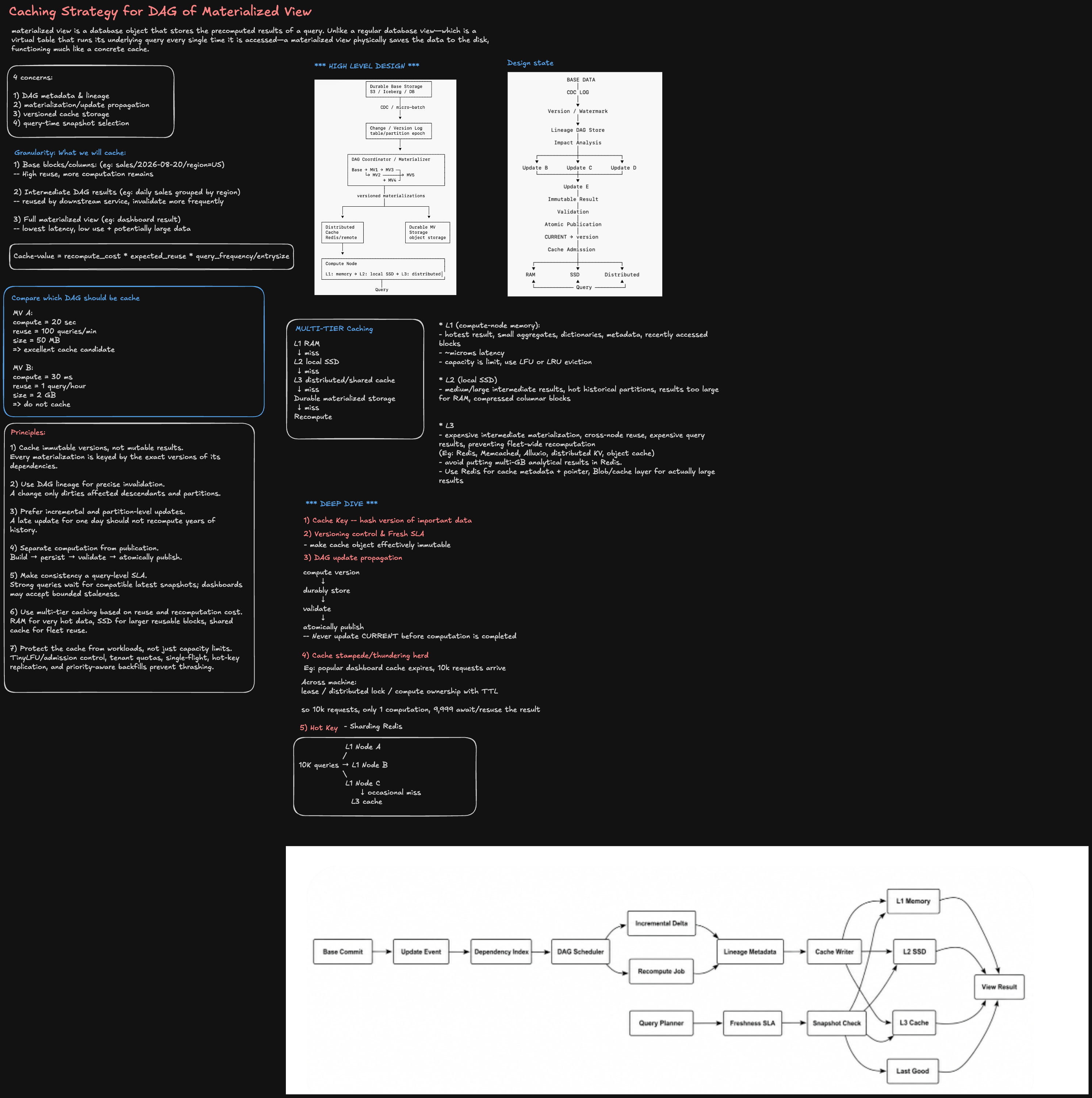
Caching Strategy for DAG of Materialized Views
0. Interview Framing
A materialized view (MV) is a database object that stores the precomputed results of a query. Unlike a regular database view — a virtual table that re-runs its underlying query every time it is accessed — a materialized view physically saves the data to disk, functioning much like a concrete cache.
In a real analytics platform, materialized views are not standalone: they form a DAG. MV3 may depend on MV1, which depends on base tables; MV5 may depend on both MV3 and MV4. Caching one node's result without understanding the DAG risks serving stale data whenever an upstream dependency changes.
Four concerns drive this design:
- DAG metadata & lineage — which views depend on which, so we know what to recompute and what to invalidate.
- Materialization / update propagation — how a base-data change flows through the DAG to produce new, correct results.
- Versioned cache storage — caching immutable versions, never mutable in-place results.
- Query-time snapshot selection — choosing which version of a result a given query is allowed to read.
1. What We Cache — Granularity
| Granularity | Reuse | Trade-off |
|---|---|---|
Base blocks / columns (e.g. sales/2026-08-20/region=US) | High reuse across many MVs | More downstream computation still remains after a cache hit. |
| Intermediate DAG results (e.g. daily sales grouped by region) | Reused by downstream services | Must be invalidated more frequently as it sits closer to raw data. |
| Full materialized view (e.g. a dashboard's final result) | Lowest latency on a cache hit | Lowest reuse rate, and can be large. |
None of these is universally correct — the right mix is a cost/benefit decision per DAG node, not a single global policy.
Cache-value scoring
cache_value = recompute_cost * expected_reuse * query_frequency / entry_size
Worked comparison
MV A:
  compute  = 20 sec
  reuse    = 100 queries/min
  size     = 50 MB
  => excellent cache candidate (expensive to compute, reused constantly, small)

MV B:
  compute  = 30 ms
  reuse    = 1 query/hour
  size     = 2 GB
  => do not cache (cheap to recompute, rarely reused, large footprint)
This scoring function should run per DAG node, not per dataset, since two nodes on the same base data can have wildly different cache value.
2. High-Level Architecture
Materialization pipeline
Durable Base Storage
  S3 / Iceberg / DB
        |
        v
CDC / micro-batch
        |
        v
Change / Version Log
  table / partition epoch
        |
        v
DAG Coordinator / Materializer
  Base -> MV1 -> MV3 -\
       \-> MV2 -> MV4 -+-> MV5
        |
        v
versioned materializations
        |
   +----+----+
   |         |
   v         v
Distributed   Durable MV Storage
Cache          object storage
Redis/remote
   |
   v
Compute Node
  L1: memory -> L2: local SSD -> L3: distributed
        |
        v
      Query
Update-to-publish state machine
BASE DATA
    |
    v
 CDC LOG
    |
    v
Version / Watermark
    |
    v
Lineage DAG Store
    |
    v
Impact Analysis
    |
    +--------+--------+
    v        v        v
 Update B  Update C  Update D
    |        |        |
    +--------+--------+
             v
         Update E
             |
             v
     Immutable Result
             |
             v
        Validation
             |
             v
    Atomic Publication
             |
             v
     CURRENT -> version
             |
             v
      Cache Admission
             |
    +--------+--------+
    v        v        v
   RAM      SSD   Distributed
    +--------+--------+
             |
             v
           Query
Impact analysis is what makes this scale: a single base-data change fans out only to the descendants that actually depend on it (B, C, D), and those results merge back into a single downstream node (E) before anything is published.
3. Core Entities
type DagNode = {
  viewId: string;
  dependsOn: string[]; // upstream node ids
  granularity: 'base_block' | 'intermediate' | 'full_view';
  currentVersion: string;
  cacheValueScore: number; // recompute_cost * expected_reuse * query_frequency / entry_size
};

type VersionWatermark = {
  tableOrPartition: string;
  epoch: number; // monotonically increasing version / commit id
  committedAtMs: number;
};

type MaterializationJob = {
  jobId: string;
  viewId: string;
  inputVersions: Record<string, string>; // dependency -> exact version consumed
  outputVersion: string;
  status: 'building' | 'validating' | 'ready_to_publish' | 'published' | 'failed';
};

type CacheEntry = {
  cacheKey: string; // hash of viewId + inputVersions
  viewId: string;
  version: string;
  tier: 'L1_ram' | 'L2_ssd' | 'L3_distributed';
  sizeBytes: number;
  lastAccessedAtMs: number;
  accessCount: number;
};

type FreshnessSLA = {
  queryClass: 'strong' | 'bounded_staleness';
  maxStalenessMs?: number; // required when queryClass = 'bounded_staleness'
};
Keying every job and cache entry by exact input versions, not by "latest," is what makes results immutable and safely cacheable.
4. Multi-Tier Caching
L1 RAM
  | miss
  v
L2 local SSD
  | miss
  v
L3 distributed / shared cache
  | miss
  v
Durable materialized storage
  | miss
  v
Recompute
| Tier | What lives here | Latency | Notes |
|---|---|---|---|
| L1 — compute-node memory | Hottest results: small aggregates, dictionaries, metadata, recently accessed blocks | ~microseconds | Capacity-limited; use LFU or LRU eviction. |
| L2 — local SSD | Medium/large intermediate results, hot historical partitions, compressed columnar blocks that are too large for RAM | Low ms | Bridges the gap between RAM capacity and network-hop cost. |
| L3 — distributed / shared cache | Expensive intermediate materializations, cross-node reuse, expensive query results — prevents fleet-wide recomputation. Backed by Redis, Memcached, Alluxio, a distributed KV store, or an object cache. | Network hop | Avoid putting multi-GB analytical results directly in Redis. Use Redis for cache metadata + pointer, and a blob/object store for the actual large payload. |
5. Deep Dive
5.1 Cache key design
The cache key is a hash of the DAG node plus the exact versions of every input it depended on:
cacheKey = hash(viewId, inputVersions)
This guarantees two important properties:
- Two computations of the same view over the same input versions produce the same key and can safely share a cache entry.
- Any change to a single upstream input produces a different key, so stale results are structurally unreachable — there is nothing to "invalidate" in place.
5.2 Versioning control & freshness SLA
Make the cache object effectively immutable.
Because a cache entry is keyed by exact input versions, once written it never needs to be mutated — only superseded by a new key when inputs change. This removes an entire class of invalidation races. Freshness becomes a property of which version a query is allowed to read, not of mutating a cached object:
- Strong-consistency queries wait for a version that is fully compatible with the latest committed inputs.
- Dashboards and other bounded-staleness consumers can read the latest published version even if a newer one is mid-build.
5.3 DAG update propagation
compute version
      |
      v
durably store
      |
      v
validate
      |
      v
atomically publish
The critical rule:
Never update
CURRENTbefore computation is completed.
Separating computation from publication means a half-finished or failed materialization is never visible to readers. CURRENT -> version only advances after the new result is durably stored and validated, so a reader either sees the fully-consistent old version or the fully-consistent new one — never a partial one.
Propagation should also be incremental and partition-level: a late-arriving update for a single day should dirty and recompute only that day's downstream partitions, not replay years of history.
5.4 Cache stampede / thundering herd
Scenario: a popular dashboard's cache entry expires, and 10,000 requests arrive for it simultaneously.
Fix: across machines, use a lease / distributed lock / compute-ownership record with a TTL.
10,000 requests arrive
        |
        v
1 request acquires the compute lease and recomputes
        |
        v
9,999 requests await and reuse that single result
Only one computation runs; everyone else attaches to it instead of independently recomputing the same expensive DAG node.
5.5 Hot key — sharding
A single popular cache key can still overload one cache node even with stampede protection solved. Shard L1 across nodes so the hot key's traffic fans out:
                  L1 Node A
                 /
10K queries -> L1 Node B
                 \
                  L1 Node C
                       |
                       v occasional miss
                    L3 cache
Each L1 node independently holds a replica of the hot entry; only the occasional miss falls through to the shared L3 tier, instead of every one of the 10K queries hitting a single node.
6. Principles
- Cache immutable versions, not mutable results. Every materialization is keyed by the exact versions of its dependencies.
- Use DAG lineage for precise invalidation. A change only dirties affected descendants and partitions.
- Prefer incremental and partition-level updates. A late update for one day should not recompute years of history.
- Separate computation from publication. Build → persist → validate → atomically publish.
- Make consistency a query-level SLA. Strong queries wait for compatible latest snapshots; dashboards may accept bounded staleness.
- Use multi-tier caching based on reuse and recomputation cost. RAM for very hot data, SSD for larger reusable blocks, shared cache for fleet-wide reuse.
- Protect the cache from workloads, not just capacity limits. TinyLFU/admission control, tenant quotas, single-flight, hot-key replication, and priority-aware backfills prevent thrashing.
7. Request Flows
Update / materialization flow
Base Commit
    |
    v
Update Event
    |
    v
Dependency Index
    |
    v
DAG Scheduler
    |
    +-------------------+
    v                    v
Incremental Delta    Recompute Job
    |                    |
    +---------+----------+
              v
       Lineage Metadata
              |
              v
         Cache Writer
              |
    +---------+---------+
    v         v          v
L1 Memory  L2 SSD    L3 Cache
    +---------+---------+
              |
              v
          View Result
Query flow
Query Planner
      |
      v
Freshness SLA
      |
      v
Snapshot Check
      |
  +---+---+---+-------+
  v   v   v            v
L1  L2  L3       Last Good (fallback)
  +---+---+---+-------+
              |
              v
          View Result
The query path always has a fallback to the last good published version if the freshest snapshot is not yet available at the requested consistency level — this is what lets bounded-staleness consumers stay fast even mid-recompute.
8. Example Verbal Answer
I'd start by separating "what to cache" from "how to keep it correct." For what to cache, I'd score each DAG node by
recompute_cost * expected_reuse * query_frequency / entry_size— an expensive, frequently-reused, small result is an excellent candidate, while a cheap, rarely-reused, large result is not, regardless of granularity.For correctness, the key idea is that every cached materialization is keyed by the exact versions of its dependencies, which makes cache entries effectively immutable — I never mutate a cached object, I only supersede its key when inputs change. Updates propagate through the DAG via impact analysis, so a base-data change only recomputes the affected descendants and partitions, not the whole graph. Computation is fully separated from publication: build, persist, validate, and only then atomically flip
CURRENTto the new version, so readers never see a half-finished result.For storage, I'd use a multi-tier cache — RAM for the hottest small results, local SSD for larger intermediate results, and a distributed/shared cache for cross-node reuse, keeping large analytical payloads out of Redis directly and instead storing pointers there to blob storage. For operational safety, I'd add stampede protection via a compute lease so 10,000 simultaneous requests for an expired hot entry trigger exactly one recomputation, plus L1 sharding so a hot key's read traffic fans out across nodes instead of overloading one.
Finally, freshness is a per-query SLA rather than a cache property: strong-consistency queries wait for a compatible latest snapshot, while dashboards can read the latest published version, or fall back to the last good version, and stay fast even while a newer materialization is still building.
9. Diagram
The accompanying whiteboard (dag-caching.png) captures:
- The four core concerns and the caching-granularity trade-offs.
- The cache-value formula and a worked MV-A/MV-B comparison.
- The high-level materialization pipeline and the update-to-publish state machine.
- The L1/L2/L3 multi-tier cache fallback chain.
- Deep dives on cache-key design, versioning, DAG update propagation, cache stampede handling, and hot-key sharding.
- The end-to-end update and query request flows.