Ad-Click Aggregator
Editable diagram: Open in Excalidraw
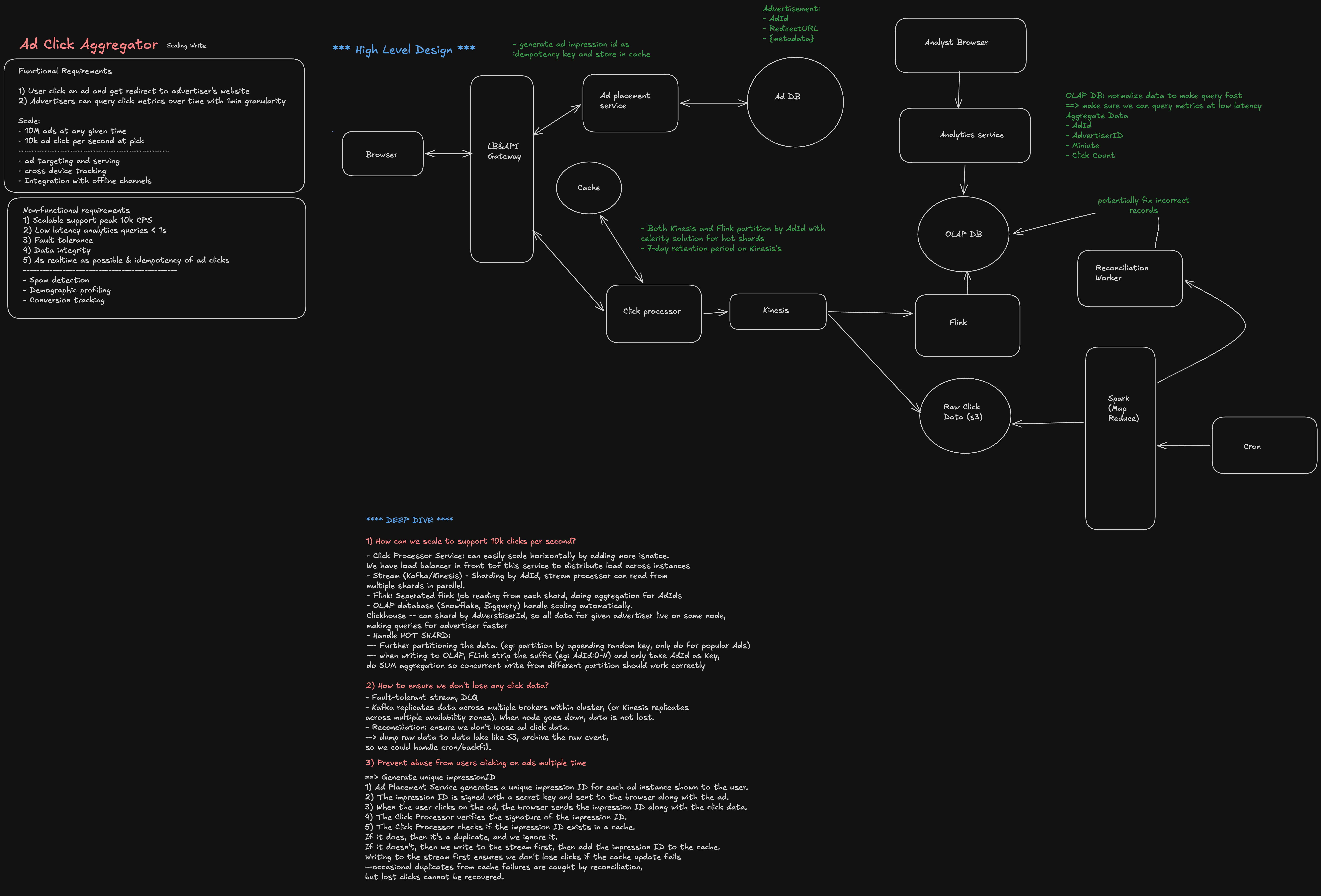
Interview Summary
| Component | Challenge | Solution |
|---|---|---|
| Click Collection | Billions of clicks/day from distributed SDKs across the web | Lightweight SDK → edge collectors → batching → Kafka |
| Deduplication | Network retries cause duplicate clicks; SDK caches may fail | Idempotency key (user_id, ad_id, timestamp, nonce); deduplicate at scale |
| Late Arrivals | Mobile data, offline browsers, network delays cause data to arrive hours late | Watermarking; trigger reports early, allow late corrections |
| Accuracy Guarantee | Marketers need exact click counts for billing; no undercounting or overcounting | At-least-once delivery + deterministic deduplication = exactly-once semantics |
| Real-time Reporting | Campaign managers need dashboard updates within seconds | Streaming aggregation (time windows) + in-memory caches |
| Attribution | Which campaign gets credit for a conversion? | First-click, last-click, or multi-touch; configurable per advertiser |
| Hot-path Latency | SDK cannot block on network; clicks must not be lost | Async collection with local queue; batch flush on timeout or size |
| Storage & Retention | Store years of data; queries must be fast | Tiered: hot (Redis/in-memory), warm (SSD), cold (S3 archive) |
The core challenge: Deliver exactly-once semantics for billions of events under network unreliability and at-least-once frameworks.
High-Level Architecture
┌─────────────────────────────────────────────────────────────────┐
│                    Client (Web/Mobile/App)                      │
│              Ad-Click SDK (batching, local queue)                │
└─────────┬───────────────────────────────────────────────────────┘
          │
          │ POST /v1/clicks (batch of 50 events, 10s or 100ms timeout)
          │
  ┌───────┴────────────────────────────────────────────────────────┐
  │                  Edge Click Collectors                          │
  │  - Regional (CDN close to users)                               │
  │  - Receives batches, validates, adds server timestamp          │
  │  - Forwards to message queue                                   │
  └───────┬────────────────────────────────────────────────────────┘
          │
          ↓
   ┌─────────────────┐
   │  Kafka Topics   │
   │  - raw-clicks   │
   │  - deduplicated │
   └────────┬────────┘
            │
   ┌────────┴────────────────────────────────────────────────────┐
   │  Stream Processing Layer (Flink / Kafka Streams)            │
   │  Stage 1: Deduplicate (idempotency key lookup)              │
   │  Stage 2: Enrich (campaign, advertiser, country)            │
   │  Stage 3: Aggregate (time windows: 1m, 5m, 1h)              │
   │  Stage 4: Output to caches + data warehouse                 │
   └────────┬────────────────────────────────────────────────────┘
            │
     ┌──────┼──────┐
     ↓      ↓      ↓
  ┌──────┐ ┌─────┐ ┌──────────┐
  │Redis │ │Druid│ │PostgreSQL│
  │Cache │ │OLAP │ │ (Raw)    │
  └──────┘ └─────┘ └──────────┘
     ↑
     │
  ┌──────────────────────┐
  │ Reporting Dashboard  │
  │ (Real-time metrics)  │
  └──────────────────────┘
The Five Critical Decisions
1. Collection Strategy: SDK Batching + Edge Collectors
The problem: If each click triggers an HTTP request, we overwhelm the network and kill battery on mobile. If we batch, how do we handle offline mode?
Solution:
- Client SDK batches — collect 50 clicks or 10 seconds, whichever comes first
- Local queue (SQLite on mobile) — if offline, persist to disk
- Edge collectors — regional servers that receive batches and validate
- Idempotency tokens — each click gets a nonce (UUID); server deduplicates
Code pattern (SDK):
class ClickCollector {
  constructor(batchSize = 50, flushIntervalMs = 10000) {
    this.queue = [];
    this.batchSize = batchSize;
    this.flushIntervalMs = flushIntervalMs;
    this.timerId = null;
  }

  recordClick(adId, campaignId, userId, metadata) {
    const click = {
      adId,
      campaignId,
      userId,
      metadata,
      timestamp: Date.now(),
      nonce: generateUUID(), // For deduplication
    };

    this.queue.push(click);

    // Flush if batch is full
    if (this.queue.length >= this.batchSize) {
      this.flush();
    } else if (!this.timerId) {
      // Set timer for next flush
      this.timerId = setTimeout(() => this.flush(), this.flushIntervalMs);
    }
  }

  async flush() {
    if (this.queue.length === 0) return;

    const batch = this.queue.splice(0, this.batchSize);
    clearTimeout(this.timerId);
    this.timerId = null;

    try {
      await fetch('/api/v1/clicks', {
        method: 'POST',
        body: JSON.stringify({ clicks: batch }),
        timeout: 5000, // Don't block forever
      });
    } catch (err) {
      // Persist to local storage / SQLite for retry
      localStorage.setItem('pending-clicks', JSON.stringify(batch));
    }
  }
}
2. Deduplication at Scale
The problem: Network retries, SDK crashes, and browser reloads all cause duplicate clicks. We need to eliminate duplicates without losing data.
Solution:
- Idempotency key = SHA256(user_id, ad_id, timestamp_bucket, nonce)
- Bloom filter for fast negative lookups (no duplicate)
- Redis set for recent hours (< 24h ago), backed by database for older data
- Watermark tracking — track maximum timestamp processed; ignore older duplicates
Deduplication logic:
const deduplicateClicks = async (batch, deduplicationStore) => {
  const dedupKeys = batch.map((click) =>
    hashIdempotencyKey(click.userId, click.adId, click.timestamp, click.nonce)
  );

  // Check Bloom filter (fast, false-positives ok)
  const possibleDuplicates = await bloomFilter.mightContain(dedupKeys);

  // For possible duplicates, check Redis
  const duplicateSet = await redis.mget(possibleDuplicates.map((key) => `click:${key}`));

  // Keep only unique clicks
  const uniqueClicks = batch.filter((click, i) => {
    const key = dedupKeys[i];
    if (!possibleDuplicates[i]) {
      // Not in Bloom filter, definitely new
      return true;
    }
    if (!duplicateSet[i]) {
      // Might be in Bloom, but not in Redis, so new
      return true;
    }
    // Duplicate, discard
    return false;
  });

  // Store new keys in Redis (with TTL = 24h) and Bloom filter
  for (const click of uniqueClicks) {
    const key = hashIdempotencyKey(click.userId, click.adId, click.timestamp, click.nonce);
    await redis.setex(`click:${key}`, 86400, '1');
    await bloomFilter.add(key);
  }

  return uniqueClicks;
};
3. Stream Processing: Windowed Aggregation
The problem: Aggregate billions of clicks into per-campaign, per-hour metrics. Real-time = within seconds. Late data must update old windows.
Solution:
- Event time windows (not processing time) — window by click timestamp
- Allowed lateness — accept data up to 24 hours late; emit updates
- Watermark — track which events are "complete"
- Aggregation state — in-memory for hot windows, RocksDB for older
Stream aggregation (Kafka Streams / Flink):
const aggregateClicks = () => {
  return stream
    .filter((click) => click.timestamp) // Must have timestamp
    .map((click) => ({
      ...click,
      hour: Math.floor(click.timestamp / 3600000) * 3600000, // Bucket to hour
    }))
    .groupByKey((click) => `${click.campaignId}:${click.hour}`)
    .windowedBy(TimeWindows.of(Duration.ofHours(1)).grace(Duration.ofHours(24))) // Allow 24h late
    .aggregate(
      () => ({ clicks: 0, uniqueUsers: new Set(), revenue: 0 }),
      (key, click, agg) => ({
        clicks: agg.clicks + 1,
        uniqueUsers: agg.uniqueUsers.add(click.userId),
        revenue: agg.revenue + (click.revenue || 0),
      })
    )
    .toStream()
    .foreach((key, agg) => {
      // Emit to Redis, OLAP store, etc.
      const [campaignId, hour] = key.key.split(':');
      redis.hset(
        `campaign:${campaignId}:${hour}`,
        'clicks',
        agg.clicks,
        'unique_users',
        agg.uniqueUsers.size,
        'revenue',
        agg.revenue
      );
    });
};
4. Late Arrivals & Watermarking
The problem: A mobile user goes offline, their clicks queue. 6 hours later, they reconnect and send a batch of 100 old clicks. Should they update yesterday's metrics?
Solution:
- Watermark tracks minimum event time across all partitions
- Allowed lateness window (typically 24h) — older data is ignored
- Grace period — after watermark passes window end + grace, window is finalized
- Re-computation flag — late data triggers recomputation and emits delta update
Watermark logic:
const watermarkTracker = {
  minEventTime: Date.now(),

  updateWatermark(eventTime) {
    // Watermark = max time we know all earlier data has arrived
    // Typically: max(eventTime - buffer)
    this.minEventTime = Math.max(this.minEventTime, eventTime - 60000); // 60s buffer
  },

  isLate(eventTime, windowEnd, gracePeriod) {
    return eventTime < windowEnd && windowEnd + gracePeriod < this.minEventTime;
  },
};

const processClick = (click) => {
  watermarkTracker.updateWatermark(click.timestamp);
  const windowEnd = Math.ceil(click.timestamp / 3600000) * 3600000;
  const gracePeriod = 24 * 3600000; // 24 hours

  if (watermarkTracker.isLate(click.timestamp, windowEnd, gracePeriod)) {
    // Too late, ignore
    return { action: 'drop', reason: 'after_grace_period' };
  }

  if (
    click.timestamp < windowEnd &&
    click.timestamp + gracePeriod >= watermarkTracker.minEventTime
  ) {
    // Late but within grace, update window
    return { action: 'late_update', window: windowEnd };
  }

  return { action: 'process', window: windowEnd };
};
5. Attribution & Multi-Touch
The problem: User sees Ad A, clicks it. Later sees Ad B, clicks it. Clicks on product. Which ad gets credit for the conversion?
Solution:
- First-click: Ad A gets 100% credit
- Last-click: Ad B gets 100% credit
- Multi-touch: Linear (50-50), time-decay, etc.
- Configurable per advertiser — store attribution model in database
Attribution code:
const attributeConversion = (userJourney, attributionModel) => {
  const clickEvents = userJourney.filter((e) => e.type === 'click');

  switch (attributionModel) {
    case 'first-click':
      return { campaignId: clickEvents[0].campaignId, credit: 1.0 };

    case 'last-click':
      return { campaignId: clickEvents[clickEvents.length - 1].campaignId, credit: 1.0 };

    case 'linear':
      return clickEvents.map((click) => ({
        campaignId: click.campaignId,
        credit: 1.0 / clickEvents.length,
      }));

    case 'time-decay':
      const weights = clickEvents.map((_, i) => 2 ** i); // Exponential: recent = higher
      const totalWeight = weights.reduce((a, b) => a + b, 0);
      return clickEvents.map((click, i) => ({
        campaignId: click.campaignId,
        credit: weights[i] / totalWeight,
      }));

    default:
      return { campaignId: null, credit: 0 };
  }
};
Deep Dive: Handling 100B Clicks/Day
Back-of-the-envelope:
- 100 billion clicks/day = ~1.15 million clicks/second
- Peak (4x average) = ~4.6 million clicks/second
Infrastructure:
- Edge collectors: 100+ regional servers, ~50k clicks/sec each
- Kafka: 10-20 brokers, 100+ partitions for parallelism
- Stream processors: 50+ Flink tasks, each processing ~1M events/sec
- Storage: Redis (hot), Druid (OLAP), S3 (archive)
Deduplication at scale:
- Bloom filter size: 1TB (for 100B entries, false-positive rate ~1%)
- Redis storage: ~10TB (24-hour window of deduplicated keys)
- Replication: 3x, across regions
Latency breakdown:
- SDK batching + network: 100ms
- Edge collection: 50ms
- Kafka: 100ms
- Stream processing: 200ms
- Redis write: 10ms
- Total: ~500ms from click to dashboard
Anti-Patterns & Solutions
| Anti-pattern | Problem | Solution |
|---|---|---|
| No deduplication | Overcount clicks; billing disputes | Idempotency key + Bloom filter + Redis |
| Processing time windows | Late data doesn't update old metrics | Use event time + allowed lateness |
| Trusting client timestamp | Attacker manipulates clock; skewed metrics | Server-side timestamping at collection point |
| Synchronous writes to database | Database becomes bottleneck; 1M clicks/sec fails | Async + Kafka; batch writes to OLAP |
| No retention policy | Storage grows unbounded | TTL on Redis, archive to S3 after 30 days |
| Single collection endpoint | Regional outage = data loss | Redundant collectors, multi-region failover |
| No fraud detection | Click farms inflate metrics; wasted spend | Velocity checks, IP reputation, user behavior patterns |
| Exact pixel tracking only | Mobile/privacy browsers don't send pixels | Conversion API (server-to-server) + SDK |
Interview Follow-ups
-
"How would you detect click fraud?"
- Answer: Multi-layer approach:
- Velocity checks: Same IP clicking 1000 times/min = suspicious
- Bot detection: Headless browser patterns, unusual user agents
- Behavioral anomalies: Click-to-conversion ratio (1000 clicks, 0 conversions = fraud)
- IP reputation: Use third-party services (MaxMind) to flag VPNs, datacenters
- Device fingerprinting: Same device, different IPs, correlated clicks = bot ring
- Answer: Multi-layer approach:
-
"What if Kafka partition gets behind? How do you handle backpressure?"
- Answer:
- Monitor lag (Kafka consumer group lag)
- Scale up: Add more consumers/partitions
- Backpressure: Edge collectors buffer to disk if Kafka is slow
- Dead-letter queue: Drop clicks after N retry attempts (rare, acceptable for at-least-once)
- Answer:
-
"How do you handle time zones for hourly aggregation?"
- Answer: All timestamps in UTC in the system. Conversion to campaign's time zone happens at reporting layer:
- Store campaign.timeZone in database
- Dashboard converts Unix timestamp to campaign's local time
- Hourly window = UTC hour (not local hour)
- Answer: All timestamps in UTC in the system. Conversion to campaign's time zone happens at reporting layer:
-
"Can you handle clicks arriving out of order?"
- Answer: Yes, stream processor doesn't care about order:
- Each click has timestamp; window determined by timestamp
- Watermark tracks completeness; late data updates old windows
- Within grace period, out-of-order is handled; after grace, late data dropped
- Answer: Yes, stream processor doesn't care about order:
-
"What's the difference between exactly-once and at-least-once semantics?"
- Answer:
- At-least-once: Kafka guarantees each message reaches consumer ≥1 times
- Exactly-once: With deduplication key, we ensure each logical click counted once
- Achieved by: idempotency key + external state (Redis/database) tracking processed keys
- When consumer rebalances or crashes, it re-processes; dedup store prevents double-count
- Answer:
-
"How would you migrate from counting clicks in-app to server-side?"
- Answer: Parallel collection for N days:
- Emit clicks to both old system and new system
- Compare counts per campaign per day
- Once within acceptable threshold (0.1% difference), cutover to new system
- Keep old system as fallback for 1 week
- Answer: Parallel collection for N days:
-
"What if you need to retroactively correct old metrics (e.g., found click fraud)?"
- Answer: Replay events with fraud filter:
- Re-run stream processor on historical Kafka topics
- Apply new fraud detection rules
- Output corrected metrics to separate tables
- Backup old metrics; switch dashboards to corrected version
- Audit log tracks which corrections were applied
- Answer: Replay events with fraud filter:
-
"How do you handle missing data due to regional outage?"
- Answer: Multi-region redundancy:
- Replicate edge collectors across regions
- If US East fails, US West collectors automatically take traffic
- Kafka replicated across regions (3+ brokers in different AZs)
- Missing data is unavoidable; report as "partial" to stakeholders
- No way to recover clicks that were never sent to any collector
- Answer: Multi-region redundancy: