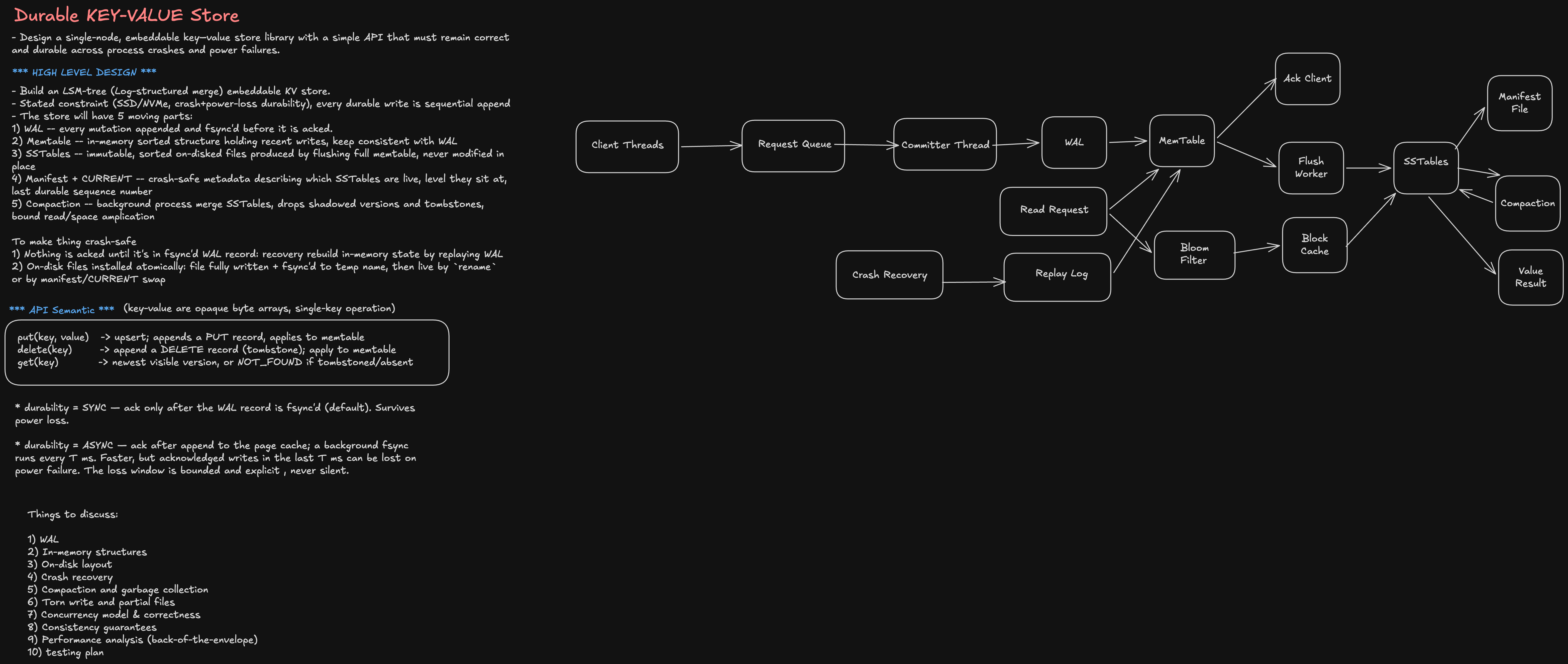
Durable Key-Value Store
0. Interview framing
Goal: design an embeddable
get / put / deletekey-value store optimized for SSD/NVMe with strong crash and power-loss durability.
The key architectural choice is an LSM-tree:
write
  ↓
WAL append + fdatasync
  ↓
mutable memtable
  ↓
immutable memtable
  ↓
flush
  ↓
L0 SSTables
  ↓
leveled compaction
  ↓
L1 ... Ln SSTables
Why LSM here:
- Durable writes are sequential appends.
- Recent data is served from memory.
- Disk files are immutable and easy to recover safely.
- Compaction moves random update cost out of the foreground write path.
- Bloom filters + block indexes keep point reads efficient.
1. Requirements
Functional
interface KVStore {
  put(key: Uint8Array, value: Uint8Array, durability?: 'SYNC' | 'ASYNC'): Promise<void>;
  get(key: Uint8Array): Promise<Uint8Array | null>;
  delete(key: Uint8Array, durability?: 'SYNC' | 'ASYNC'): Promise<void>;
}
Semantics:
put(k, v)     = upsert
delete(k)     = append tombstone
get(k)        = newest visible PUT unless newest visible record is DELETE
Out of scope:
- multi-key transactions
- distributed consensus
- range scans
- secondary indexes
Non-functional
Durability:
  SYNC writes acknowledged only after WAL fsync.

Crash safety:
  restart must recover all acknowledged writes.

Power-loss safety:
  no half-installed SSTables or metadata versions.

Concurrency:
  high write throughput, lock-free reads.

Performance:
  point reads optimized by block cache + Bloom filters.

Storage:
  bounded read amplification, write amplification, and space amplification.
2. Reference architecture
                 ┌───────────────────────────────┐
                 │           KV API              │
                 │ put / delete / get            │
                 └───────────────┬───────────────┘
                                 │
             writes              │               reads
                │                │                  │
                ▼                │                  ▼
      ┌──────────────────┐       │        ┌─────────────────┐
      │ MPSC Write Queue │       │        │ stable_seq snap │
      └────────┬─────────┘       │        └────────┬────────┘
               ▼                 │                 ▼
      ┌──────────────────┐       │        ┌─────────────────┐
      │ Group Committer  │       │        │ Mutable Memtable│
      │ seqno assignment │       │        └────────┬────────┘
      └──────┬─────┬─────┘       │                 ▼
             │     │             │        ┌─────────────────┐
             │     └─────────────┼───────▶│ Immutable Mems  │
             │                   │        └────────┬────────┘
             ▼                   │                 ▼
      ┌──────────────────┐       │        ┌─────────────────┐
      │ WAL append       │       │        │ Block Cache     │
      │ + fdatasync      │       │        └────────┬────────┘
      └────────┬─────────┘       │                 ▼
               │ durable          │        ┌─────────────────┐
               ▼                 │        │ SSTables L0..Ln │
      ┌──────────────────┐       │        │ Bloom + index   │
      │ Memtable apply   │◀──────┘        └────────┬────────┘
      └────────┬─────────┘                          │
               ▼                                    │
      ┌──────────────────┐                          │
      │ publish stable   │                          │
      │ sequence number  │                          │
      └──────────────────┘                          │
                                                   ▼
                                        ┌─────────────────────┐
                                        │ Background          │
                                        │ compaction          │
                                        └──────────┬──────────┘
                                                   ▼
                                        ┌─────────────────────┐
                                        │ MANIFEST + CURRENT  │
                                        │ live version set    │
                                        └─────────────────────┘
3. Five core components
3.1 WAL
The Write-Ahead Log is the source of durability.
Invariant:
ACK(write) ⇒ WAL record has passed the requested durability barrier
For SYNC:
append WAL
→ fdatasync
→ apply to memtable
→ publish stable_seq
→ ACK client
For ASYNC:
append WAL
→ apply to memtable
→ ACK client
→ background fsync every T ms
Trade-off:
SYNC:
  survives power failure
  higher latency

ASYNC:
  lower latency
  acknowledged writes within last T ms can be lost after power loss
3.2 Memtable
Use a sorted in-memory structure, typically a concurrent skiplist.
Internal key:
(user_key, seqno DESC)
Example:
apple @ 105 = PUT("red")
apple @ 101 = DELETE
apple @  97 = PUT("green")
A reader at snapshot S = 103 sees:
apple @ 101 = DELETE
→ NOT_FOUND
This gives simple MVCC visibility.
3.3 SSTables
Immutable sorted disk files.
[data block]
[data block]
...
[filter block]
[index block]
[meta-index]
[footer]
Typical block size:
16–32 KiB
Each block has:
CRC32C
Point lookup:
Bloom filter says "definitely absent"
    → skip file

Bloom says "maybe"
    → binary search index block
    → read one data block
    → verify CRC
    → search internal keys
3.4 Manifest + CURRENT
The manifest defines the one authoritative live version.
CURRENT
  └── MANIFEST-000042

MANIFEST edit examples:
  + add SSTable 31 to L0
  + delete SSTable 24 from L0
  + add SSTable 40 to L1
  + set last_seqno = 102931
  + set wal_checkpoint = 100000
Rule:
A disk file is live iff referenced by the current version.
Everything else is garbage.
3.5 Compaction
Compaction:
- merges sorted files
- removes overwritten versions
- reclaims tombstones safely
- keeps read amplification bounded
- keeps space amplification bounded
Default policy: leveled compaction.
L0: overlapping key ranges
L1: non-overlapping
L2: non-overlapping
...
each level ≈ 10× previous level
4. Write path
SYNC write
Client
  │
  │ put(k,v)
  ▼
Write Queue
  │
  ▼
Committer assigns seqno = 1001
  │
  ▼
WAL append
  │
  ▼
fdatasync()
  │
  ├── crash after here? WAL replay restores write
  ▼
Memtable apply
  │
  ▼
stable_seq = 1001
  │
  ▼
ACK
Pseudocode:
def commit_batch(batch):
    for req in batch:
        req.seqno = next_seqno()
        wal.append(encode(req))

    wal.fdatasync()

    for req in batch:
        memtable.apply(req)

    atomic_store(stable_seq, batch[-1].seqno)

    for req in batch:
        req.ack()
5. Group commit
This is the main throughput optimization.
Instead of:
write 1 → fsync
write 2 → fsync
write 3 → fsync
...
do:
[w1 w2 w3 ... wN]
      ↓
one WAL append batch
      ↓
one fdatasync
      ↓
ACK all writes in batch
Example batching policy:
batch = queue.drain(
    max_bytes = 512 * KiB,
    max_wait  = 1 * ms
)
Trade-off:
larger batch window:
  + higher throughput
  - higher latency

smaller batch window:
  + lower latency
  - more fsyncs
Staff-level interview point:
The single committer is not necessarily the scalability bottleneck. The real foreground bottleneck is usually the durability barrier, so group commit often gives excellent throughput with much simpler correctness than fully concurrent WAL writers.
6. WAL record format
┌──────────┬───────┬───────┬──────┬─────────┬─────────┬─────┬───────┐
│ length   │ crc   │ seqno │ type │ key_len │ val_len │ key │ value │
│ 4 bytes  │ 4 B   │ 8 B   │ 1 B  │ varint  │ varint  │ ... │ ...   │
└──────────┴───────┴───────┴──────┴─────────┴─────────┴─────┴───────┘
CRC covers:
seqno ... value
Purpose:
detect:
- torn tail writes
- partial records
- corruption
7. WAL segmentation
Directory:
db/
├── CURRENT
├── MANIFEST-000042
├── wal/
│   ├── 000016.log
│   └── 000017.log
└── sst/
    ├── 000030.sst
    └── 000031.sst
Rotate WAL when:
- segment reaches 64–256 MiB
- corresponding memtable has been flushed
A WAL segment can be deleted only when:
all records in it are represented by durable live SSTables
AND
manifest checkpoint has advanced past the segment
8. Memtable lifecycle
Mutable Memtable
      │
      │ reaches size threshold
      ▼
Freeze
      │
      ├── new mutable memtable immediately starts accepting writes
      ▼
Immutable Memtable
      │
      ▼
Background flush
      │
      ▼
SSTable.tmp
      │
      ▼
fsync file
      │
      ▼
rename → .sst
      │
      ▼
manifest version edit + fsync
      │
      ▼
advance WAL checkpoint
Typical memtable:
64–256 MiB
9. Crash-safe file installation
For any newly generated SSTable:
1. write 000123.sst.tmp
2. fsync(000123.sst.tmp)
3. rename(000123.sst.tmp, 000123.sst)
4. fsync(parent_directory)
5. append manifest version edit
6. fsync(manifest)
7. only now may old input files eventually be deleted
Important:
atomic rename ≠ durable rename
After power loss, the directory entry may disappear unless the parent directory itself was fsynced.
This is a classic storage-engine durability bug.
10. Crash recovery
Startup:
1. Read CURRENT
2. Replay MANIFEST
3. Reconstruct live SSTable set
4. Find WAL segments newer than wal_checkpoint
5. Replay valid WAL records in seqno order
6. Stop at truncated / CRC-invalid tail
7. Rebuild memtable
8. Remove orphan *.tmp files
9. Remove unreferenced SSTables
10. Delete obsolete WAL segments
11. publish stable_seq
12. begin serving
Pseudocode:
def recover():
    version = replay_manifest(read_current())

    next_seqno = version.last_seqno + 1

    for seg in wal_segments_after(version.wal_checkpoint):
        for record in seg:
            if record.truncated or not record.crc_ok:
                seg.truncate_at(record.offset)
                break

            memtable.apply(record)
            next_seqno = max(next_seqno, record.seqno + 1)

    gc_orphans(version)
    stable_seq.store(next_seqno - 1)
11. Crash matrix
| Crash point | State on disk | Recovery |
|---|---|---|
| WAL append before fsync | record may disappear | no SYNC ACK was issued |
| after fsync before memtable | durable WAL | replay rebuilds memtable |
| mid SST flush | temp file only | delete orphan, replay WAL |
| SST fsynced before manifest | file exists but not live | delete orphan |
| mid compaction | inputs still live | discard new outputs |
| mid manifest append | torn last edit | stop at last valid edit |
| after rename before dir fsync | name may not survive | directory fsync required |
| crash after durable manifest | new version authoritative | recover from new version |
Core invariant:
Never delete the old durable version before the new durable version is committed.
12. Read path
Reader snapshots:
snapshot = atomic_load(stable_seq)
Search order:
1. mutable memtable
2. immutable memtables, newest → oldest
3. L0 SSTables, newest → oldest
4. one candidate SSTable per level L1...Ln
Pseudocode:
def get(key):
    snap = atomic_load(stable_seq)

    for source in read_sources_newest_first():
        entry = source.find(key, max_seqno=snap)

        if entry is None:
            continue

        if entry.type == DELETE:
            return None

        return entry.value

    return None
13. Why stable_seq matters
Suppose a group commit contains:
seq 100
seq 101
seq 102
Bad publication:
apply 100
stable_seq = 100

apply 101
stable_seq = 101

reader starts here

apply 102
stable_seq = 102
The reader can observe a partial durability batch.
Better:
fdatasync batch
apply 100
apply 101
apply 102
stable_seq = 102   ← one atomic publication
ACK writers
Reader sees either:
before batch
or
whole batch
14. Consistency guarantee
For SYNC mode, the target is:
linearizable single-key operations
Reasoning:
A write is acknowledged only after:
  1. WAL record is durable
  2. memtable contains the write
  3. stable_seq includes its seqno
Therefore:
get() starting after ACK
  snapshots stable_seq >= write.seqno
  ⇒ sees the write or a newer write
15. Compaction
Leveled compaction
L0
 ├── SST A [a..z]
 ├── SST B [b..m]
 └── SST C [d..x]
       │
       │ compact overlapping files
       ▼
L1
 ├── SST D [a..f]
 ├── SST E [g..p]
 └── SST F [q..z]
At L1+:
key ranges do not overlap
This means a point lookup generally checks:
multiple files in L0
+
at most one file per lower level
16. Tombstone correctness
A delete is:
k @ seq=200 => TOMBSTONE
Do not immediately remove the tombstone during compaction.
Why:
L2 contains old PUT(k, "value") @ seq=100
If we drop the tombstone before proving all older versions are gone:
get(k)
→ falls through
→ finds old L2 value
→ deleted key resurrects
Safe tombstone removal requires:
1. no older version can exist in any lower level
2. no live snapshot requires the older history
Use:
min_snapshot_seq
to gate version/tombstone deletion.
17. Background compaction algorithm
pick level L
  ↓
pick candidate SSTable(s)
  ↓
find overlapping files in L+1
  ↓
k-way merge by internal key
  ↓
keep newest version needed by snapshots
  ↓
drop obsolete versions
  ↓
conditionally drop tombstones
  ↓
write output *.tmp
  ↓
fsync outputs
  ↓
rename + dir fsync
  ↓
single manifest edit:
  add outputs
  remove inputs
  ↓
fsync manifest
  ↓
retire old inputs
Manifest edit must be atomic from the version-set perspective.
18. Backpressure
Without write throttling:
write ingest > compaction throughput
          ↓
L0 file count grows
          ↓
read amplification grows
          ↓
p99 get latency explodes
          ↓
eventually disk fills
Use thresholds:
L0 > soft_limit
  → slow writes

L0 > hard_limit
  → temporarily stall writes
Expose:
- L0 file count
- compaction debt bytes
- pending compaction bytes
- flush queue depth
- write stall duration
19. Torn writes and corruption
WAL
Detect:
length prefix
+
CRC32C
Recovery behavior:
valid record
valid record
valid record
partial record   ← crash
───────────────
truncate here
SSTable block
Every block:
payload + CRC
On corruption:
return explicit corruption error
do not silently return wrong value
Optional hardening
- 4 KiB alignment
- checksummed manifests
- duplicate metadata footer
- periodic background scrub
- backup / replication above the embedded engine
20. Lock-based write path
Simple default:
many app threads
      │
      ▼
lock-free MPSC queue
      │
      ▼
single committer thread
Benefits:
- total mutation order
- trivial seqno assignment
- easy group commit
- no WAL holes
- simple ACK ordering
Pseudo-interface:
def put(k, v):
    future = Future()
    queue.push(Request("PUT", k, v, future))
    return future.wait()
21. Lock-free / optimistic WAL reservation
Possible advanced design:
def reserve(n_bytes):
    while True:
        cur = atomic_load(tail)

        nxt = Cursor(
            seqno = cur.seqno + 1,
            offset = cur.offset + n_bytes
        )

        if cas(tail, cur, nxt):
            return cur
Writers:
1. CAS-reserve [seqno, offset]
2. write bytes into reserved region
3. mark reservation complete
4. committer fsyncs contiguous completed prefix
5. advance stable_seq only with no gaps
Problem:
writer for seq=100 stalls
writer for seq=101 finishes

cannot publish 101
because stable durable prefix has a hole at 100
Trade-off:
+ more CPU parallelism
- CAS contention
- reservation bookkeeping
- stable prefix complexity
- harder recovery reasoning
Interview recommendation:
Start with single committer + group commit. Only introduce concurrent WAL writers if profiling proves the committer itself is CPU-bound.
22. Safe memory / file reclamation
Compaction may remove an SSTable from the manifest while a reader still has a pointer to it.
Use:
epoch-based reclamation
or
reference counting
Example:
guard = epoch.enter()
try:
    result = get_from_version(version)
finally:
    epoch.leave(guard)
A retired SSTable can be physically deleted only after:
global_min_reader_epoch > retire_epoch
23. Snapshot tracking
Maintain active reader snapshots:
reader A → seq 100
reader B → seq 115
reader C → seq 121
Then:
min_snapshot_seq = 100
Compaction may drop versions older than a newer shadowing version only if:
no active snapshot can still observe them
24. Sharding for scale-out
For a larger node:
shard = hash(key) % N
Each shard owns independent:
WAL
memtable
immutable memtables
SSTables
compaction queue
stable_seq
Architecture:
                 Router
             hash(key) % N
          /       |       \
         v        v        v
      Shard 0  Shard 1  Shard 2
        │        │        │
       WAL      WAL      WAL
        │        │        │
       LSM      LSM      LSM
Benefits:
- parallel writers
- parallel compactions
- no cross-shard point-operation locking
- preserves per-key ordering
Trade-off:
range scans become more complex
hot keys still hot
resharding requires data migration
25. Performance estimates
Assume:
key       = 16 B
value     = 1 KiB
WAL meta  ≈ 40 B

record ≈ 1.06 KiB
At:
50,000 puts/sec
WAL bandwidth:
50,000 × 1.06 KiB
≈ 53 MiB/sec
This is usually not the main problem.
Steady-state leveled compaction may produce roughly:
~10× write amplification
Then total device traffic can approach:
~530 MiB/sec
So the long-run capacity bottleneck is usually:
compaction write amplification
not the WAL itself.
26. Read amplification
Worst case:
mutable memtable
+ immutable memtables
+ several overlapping L0 files
+ one file per lower level
Mitigations:
- Bloom filters
- partitioned indexes
- block cache
- bounded L0 file count
- non-overlapping L1+
- compaction prioritization
27. Space amplification
Leveled compaction typically gives better space amplification than tiered compaction.
Trade-off:
Leveled:
  + low read amplification
  + low space amplification
  - higher write amplification

Tiered:
  + lower write amplification
  + better ingest throughput
  - higher read amplification
  - higher temporary space use
28. Cache strategy
Block cache
Cache:
- decompressed data blocks
- index blocks
- filter blocks
Policy:
LRU / CLOCK / TinyLFU-style admission
Do not blindly cache:
large compaction scans
or compaction will evict hot foreground-read blocks.
Use cache admission hints:
foreground point read  → cache
compaction sequential read → bypass / low priority
29. Manifest rollover
An append-only manifest grows forever.
Periodically:
1. write new MANIFEST-N.tmp containing full current version snapshot
2. fsync
3. rename to MANIFEST-N
4. fsync directory
5. write CURRENT.tmp = MANIFEST-N
6. fsync
7. rename CURRENT.tmp → CURRENT
8. fsync directory
9. delete old manifest later
Recovery reads only the current manifest.
30. Failure handling
fdatasync fails
- do not ACK affected SYNC writes
- transition store to write-error state
- surface disk error
Disk full during flush
- keep immutable memtable + WAL
- do not advance checkpoint
- stop / throttle new writes before memory exhaustion
Disk full during compaction
- inputs remain live
- discard partial outputs
- retry after space is freed
Corrupt SSTable
single-node embedded store:
  explicit corruption error

replicated system above it:
  repair from healthy replica / backup
31. Observability
Critical metrics:
Write path:
  put_qps
  WAL_bytes_sec
  fsync_latency_p50/p95/p99
  group_commit_batch_size
  group_commit_wait_ms

Memtable:
  mutable_memtable_bytes
  immutable_memtable_count
  flush_latency

Compaction:
  L0_file_count
  compaction_pending_bytes
  compaction_bytes_read
  compaction_bytes_written
  write_amplification
  compaction_stall_ms

Read:
  get_qps
  block_cache_hit_rate
  bloom_positive_rate
  bloom_false_positive_rate
  blocks_read_per_get

Storage:
  live_bytes
  obsolete_bytes
  WAL_bytes
  space_amplification

Recovery:
  recovery_time
  WAL_records_replayed
  orphan_files_deleted
32. Testing strategy
Unit tests
WAL:
  encode/decode
  CRC mismatch
  truncated record
  sequence ordering

SSTable:
  block lookup
  index lookup
  Bloom behavior
  CRC errors

Manifest:
  version edit replay
  checkpoint replay
  CURRENT swap
Property tests
Generate random:
PUT
DELETE
GET
RESTART
Compare against a reference in-memory map.
Invariant:
recovered state == all acknowledged SYNC operations
33. Crash fault-injection matrix
Inject process death at:
WAL append
WAL fsync
memtable apply
memtable freeze
mid flush
SSTable fsync
rename
directory fsync
manifest append
manifest fsync
CURRENT rename
compaction merge
input deletion
After every restart verify:
1. no acknowledged SYNC write is lost
2. no unacknowledged partial mutation becomes visible incorrectly
3. deleted keys do not resurrect
4. manifest references only valid files
34. Power-failure test
Process crash testing is not sufficient.
Use:
- actual power cut
- filesystem fault injector
- dm-flakey / equivalent
- forced write reordering
Workload:
continuous SYNC writes
record ACKed seqnos externally
cut power
restart
assert recovered stable_seq >= last ACKed seqno
assert all ACKed keys are correct
35. Alternatives
B+ tree + WAL
Better when:
- read-heavy workload
- ordered scans are common
- low read amplification is critical
Trade-off:
+ fewer files to search
+ strong range scans
- more random updates
- page split complexity
- copy-on-write / page WAL complexity
LSM tree
Better when:
- write-heavy
- SSD/NVMe
- point reads
- large ingest rate
36. Staff-level trade-off discussion
Why not fsync every individual write?
fsync latency dominates
→ throughput collapses
Group commit amortizes the barrier.
Why immutable SSTables?
- no in-place corruption window
- safe concurrent readers
- simple compaction
- atomic version swap
Why keep WAL after flush starts?
Because:
flush output is not durable/live until manifest commit
Why manifest rather than scanning all SSTables at startup?
Scanning filenames cannot tell:
- which files belong to the latest logical version
- whether a compaction output was fully committed
- which old files are obsolete
The manifest is the source of truth.
Why not delete old SSTables immediately after compaction?
Readers may still reference them.
Use epoch/refcount-based reclamation.
37. Interview deep-dive: exact crash invariant
The system continuously preserves:
At least one complete durable representation of every acknowledged write exists.
Before flush:
WAL
After new SSTable is fsynced but before manifest commit:
WAL + old live version
After manifest commit:
new live SSTable version
Only then can:
old SSTables
old WAL
be reclaimed.
That invariant makes crash reasoning much easier.
38. Minimal class layout
class DB {
  private wal: WAL;
  private mem: MemTable;
  private immutables: MemTable[];
  private versions: VersionSet;
  private cache: BlockCache;
  private stableSeq: bigint;

  async put(key: Uint8Array, value: Uint8Array): Promise<void> {}
  async delete(key: Uint8Array): Promise<void> {}
  async get(key: Uint8Array): Promise<Uint8Array | null> {}

  private async flush(mem: MemTable): Promise<void> {}
  private async compact(level: number): Promise<void> {}
  private async recover(): Promise<void> {}
}
Subsystems:
DB
├── WAL
├── WriteCoordinator
├── MemTable
├── SSTableBuilder
├── SSTableReader
├── VersionSet
├── Manifest
├── CompactionPicker
├── CompactionJob
├── BlockCache
└── RecoveryManager
39. Recommended interview answer flow
Use this order on the whiteboard:
1. clarify durability + API
2. choose LSM
3. draw WAL → memtable → SSTable
4. explain fsync-before-ACK
5. explain group commit
6. explain manifest + atomic file install
7. walk one crash recovery
8. explain compaction + tombstones
9. explain read path + Bloom/cache
10. explain concurrency + stable_seq
11. discuss sharding
12. estimate write amplification
13. finish with failure injection
This avoids prematurely diving into every file format detail.
40. Final interview summary
Durability
  checksummed WAL
  fsync-before-ACK

Fast writes
  sequential append
  group commit

Fast reads
  memtable
  block cache
  Bloom filters
  sparse SSTable index

Crash safety
  immutable files
  temp → fsync → rename → directory fsync
  manifest defines the one live version

Space reclamation
  leveled compaction
  safe tombstone dropping

Consistency
  monotonically increasing seqno
  stable_seq snapshot
  lock-free readers

Concurrency
  single committer by default
  sharding for parallel write scaling
  CAS WAL reservation only if needed

Validation
  deterministic crash injection
  power-failure testing
  model-based verification
One-line staff answer:
Build an LSM-tree whose durability boundary is a checksummed, group-committed WAL; whose disk state is immutable SSTables installed through an fsync + atomic-manifest protocol; whose readers use MVCC snapshots overstable_seq; and whose compaction, tombstone GC, backpressure, and sharding keep performance bounded without weakening crash correctness.