Chess Board System — Low Level Design
Problem Statement
Design a low-level system for a chess game that models the board, pieces, and players, enforces move legality (including special moves like castling, en passant, and promotion), and detects check, checkmate, stalemate, and draw conditions.
Diagram
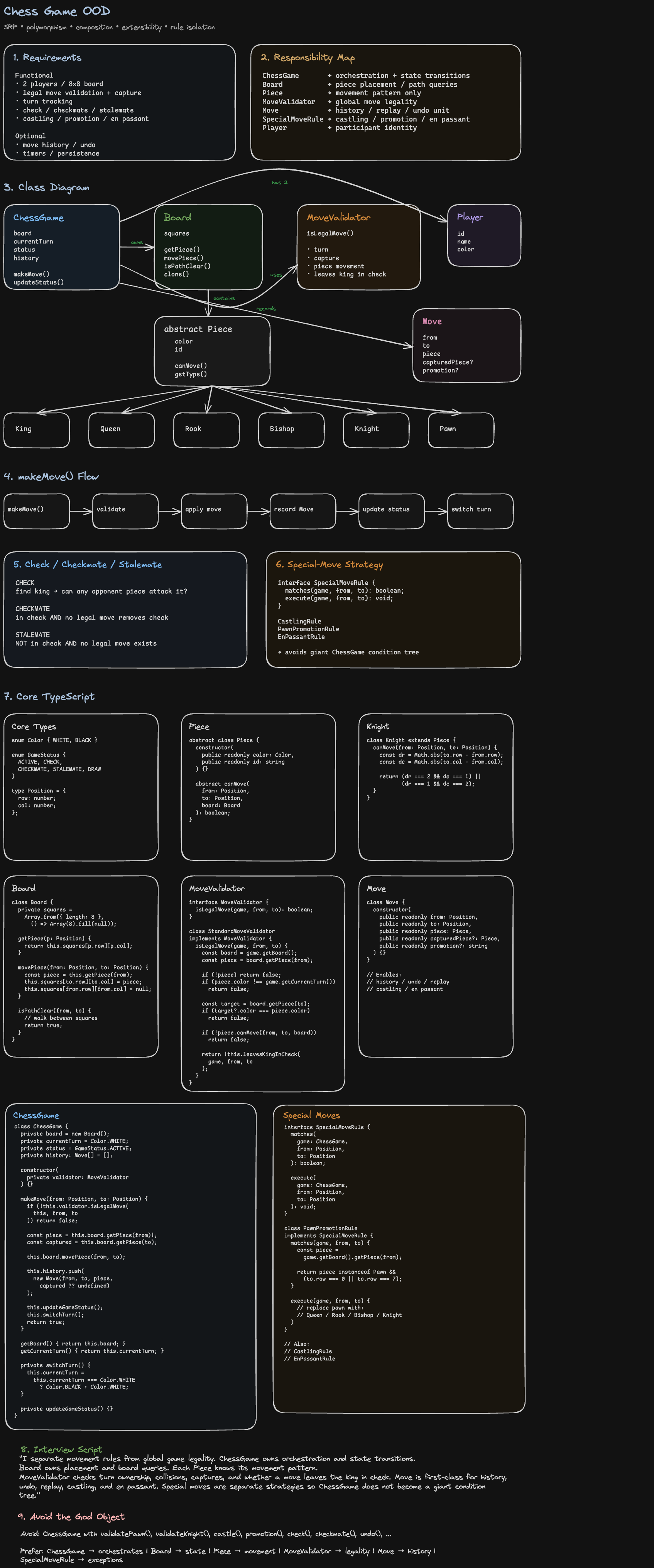
Requirements
Functional
- Board is initialized with the standard 8x8 starting position
- Players alternate turns; only the player whose turn it is may move
- Each piece type moves according to its own rules (pawn, knight, bishop, rook, queen, king)
- Illegal moves are rejected, including moves that leave the mover's own king in check
- Special moves are supported: castling (king/queenside), en passant, and pawn promotion
- Game detects check, checkmate, stalemate, and draw (insufficient material, 50-move rule, threefold repetition)
- Move history is tracked and can be replayed
Non-Functional
- Correctness: move validation must never allow an illegal or self-check-exposing move
- Extensible: new piece types or variants (e.g. Chess960) should be addable without rewriting the board
- Testable: move-generation logic isolated from I/O so it can be unit tested against known FEN positions
Core Entities
Enums
enum Color {
  WHITE,
  BLACK,
}
enum PieceType {
  KING,
  QUEEN,
  ROOK,
  BISHOP,
  KNIGHT,
  PAWN,
}
enum GameStatus {
  ACTIVE,
  CHECK,
  CHECKMATE,
  STALEMATE,
  DRAW,
}
Position
class Position {
  row: number; // 0-7
  col: number; // 0-7

  isValid(): boolean;
  equals(other: Position): boolean;
}
Piece (abstract)
abstract class Piece {
  color: Color;
  type: PieceType;
  hasMoved: boolean;

  abstract getValidMoves(pos: Position, board: Board): Position[];
}

class King extends Piece {}
class Queen extends Piece {}
class Rook extends Piece {}
class Bishop extends Piece {}
class Knight extends Piece {}
class Pawn extends Piece {}
Board
class Board {
  grid: (Piece | null)[][]; // 8x8

  getPiece(pos: Position): Piece | null;
  setPiece(pos: Position, piece: Piece | null): void;
  movePiece(from: Position, to: Position): void;
  isSquareAttacked(pos: Position, byColor: Color): boolean;
  findKing(color: Color): Position;
  clone(): Board; // for what-if move simulation
}
Move
class Move {
  from: Position;
  to: Position;
  piece: Piece;
  capturedPiece: Piece | null;
  isCastling: boolean;
  isEnPassant: boolean;
  promotionType: PieceType | null;
}
Player
class Player {
  id: string;
  color: Color;
}
Game (Controller)
class Game {
  board: Board;
  players: [Player, Player];
  currentTurn: Color;
  moveHistory: Move[];
  status: GameStatus;

  makeMove(from: Position, to: Position, promotion?: PieceType): boolean;
  isInCheck(color: Color): boolean;
  isCheckmate(color: Color): boolean;
  isStalemate(color: Color): boolean;
  undo(): void;
}
MoveValidator (Strategy)
interface MoveValidator {
  getValidMoves(pos: Position, board: Board): Position[];
}
Move Validation Strategies
Per-piece move generation
Each Piece subclass owns its own raw movement pattern:
King:   1 step in any of 8 directions, + castling
Queen:  straight/diagonal, unlimited distance
Rook:   straight, unlimited distance
Bishop: diagonal, unlimited distance
Knight: L-shape (2,1), can jump over pieces
Pawn:   1 forward (2 on first move), diagonal capture, en passant, promotion on last rank
Legality filter
Raw candidate moves are filtered through a "does this expose my own king" check:
candidateMoves = piece.getValidMoves(pos, board)
legalMoves = candidateMoves.filter(move => {
  simulatedBoard = board.clone()
  simulatedBoard.movePiece(pos, move)
  return !simulatedBoard.isSquareAttacked(
    simulatedBoard.findKing(piece.color), opponentColor
  )
})
This two-phase split (raw pattern → self-check filter) keeps each piece class simple and centralizes check-safety in one place.
Class Diagram
Move Flow
State Machine — Game
Edge Cases & Discussion Points
| Scenario | Handling |
|---|---|
| Move exposes own king to check | Filtered out during legality check, never applied to the board |
| Castling through/into check | Reject if king's start, path, or destination square is attacked |
| En passant | Only legal immediately after opponent's 2-square pawn push |
| Pawn reaches last rank | Require promotionType; default to Queen if unspecified by UI |
| King captured | Never allowed — game ends at checkmate before capture is possible |
| Threefold repetition | Track board-state hashes per move; offer/declare draw on 3rd match |
| 50-move rule | Reset counter on pawn move or capture; draw at 50 moves without one |
| Insufficient material (K vs K, K+B vs K) | Auto-declare draw when no side can force checkmate |
Trade-offs
| Decision | Option A | Option B |
|---|---|---|
| Board representation | 2D array of Piece objects | Bitboards (64-bit int per piece type) |
| Move validation | Per-piece polymorphic methods | Single MoveValidator with switch |
| Check detection | Clone board + simulate each move | Incrementally track attacked squares |
| Piece modeling | Class hierarchy (King extends Piece) | Single Piece class + type enum |
Recommended: 2D array + polymorphic pieces for interview clarity and readability; bitboards only if performance (engine-speed move generation) is explicitly required.
Follow-up Questions
- How would you support undo/redo and full game replay from move history?
- How would you add a chess clock (per-player time control, increment)?
- How would you serialize/deserialize a game using FEN or PGN notation?
- How would you extend this to support a chess engine (AI opponent) via the same
MoveValidatorinterface? - How would you support online multiplayer with move synchronization and reconnection?