Frontend System Design: Live Payment / Webhook / Alert Monitor
Editable diagram: Open in Excalidraw
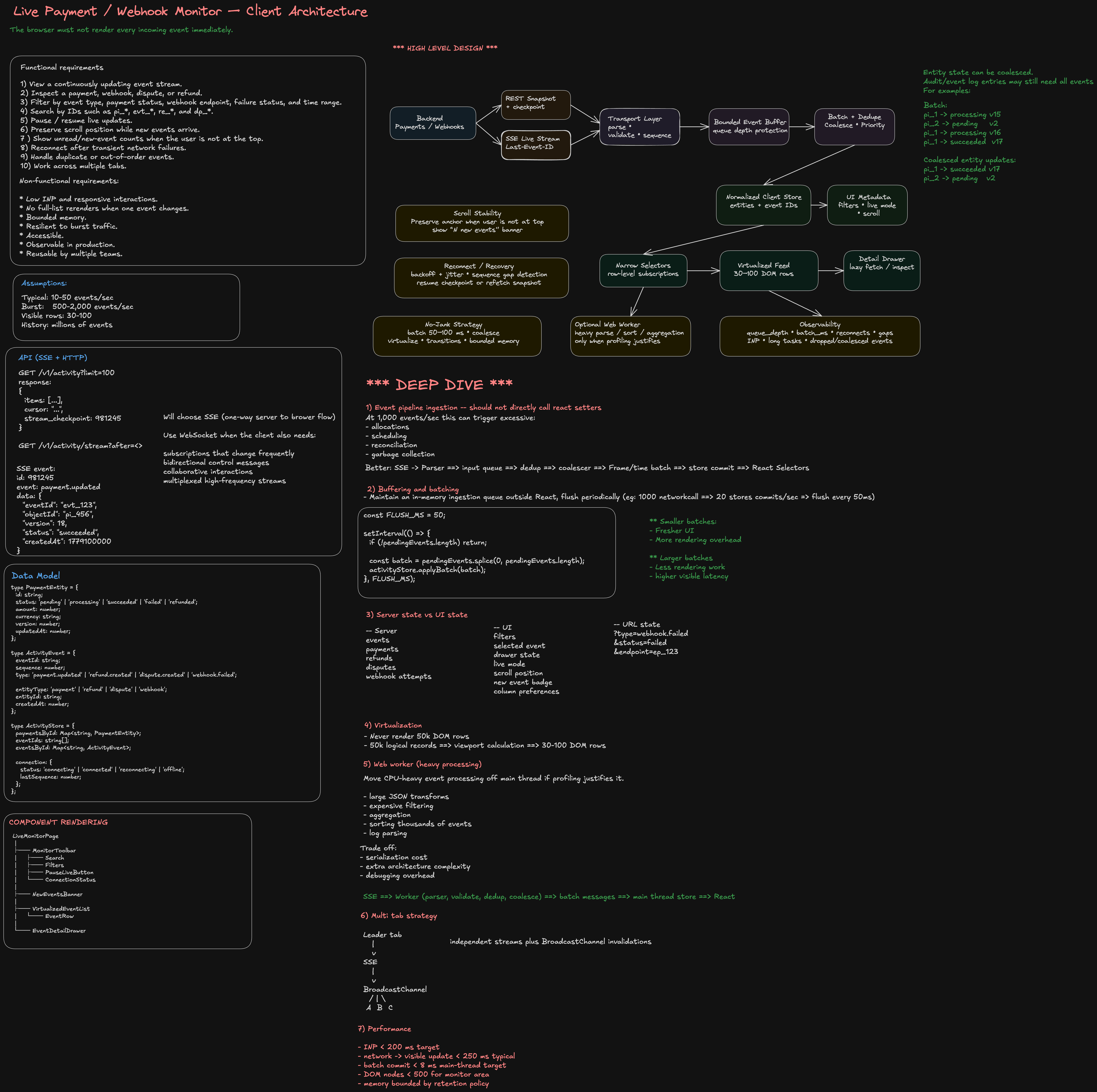
Problem
Design the client-side architecture for a Stripe-like operational dashboard that displays high-volume, near-real-time updates such as:
- Live payment status transitions
- Webhook delivery logs
- Refund events
- Dispute alerts
- Retry / failure events
- Merchant operational alerts
The frontend must remain responsive even when event volume spikes.
1. Requirements
Functional
Users should be able to:
- View a continuously updating event stream.
- Inspect a payment, webhook, dispute, or refund.
- Filter by event type, payment status, webhook endpoint, failure status, and time range.
- Search by IDs such as
pi_*,evt_*,re_*, anddp_*. - Pause / resume live updates.
- Preserve scroll position while new events arrive.
- Show unread/new-event counts when the user is not at the top.
- Reconnect after transient network failures.
- Handle duplicate or out-of-order events.
- Work across multiple tabs.
Non-functional
- Low INP and responsive interactions.
- No full-list rerenders when one event changes.
- Bounded memory.
- Resilient to burst traffic.
- Accessible.
- Observable in production.
- Reusable by multiple teams.
2. Clarify Scale
Ask early:
- Typical events/sec?
- Peak burst?
- How many rows can users inspect?
- Is ordering strict or best-effort?
- Is sub-second freshness required?
- Are events immutable logs, mutable entities, or both?
- Is history server-paginated?
Assume:
Typical: 10-50 events/sec
Burst:   500-2,000 events/sec
Visible rows: 30-100
History: millions of events
Key consequence:
The browser must not render every incoming event immediately.
3. High-Level Architecture
                        Backend
                           |
                  -------------------
                  | REST / GraphQL  |
                  | Live Stream API |
                  -------------------
                     |          |
                     |          +------------------+
                     |                             |
                     v                             v
              Initial snapshot                 SSE stream
                     |                             |
                     +-------------+---------------+
                                   |
                                   v
                         Event Transport Layer
                                   |
                      parse / validate / sequence
                                   |
                                   v
                           Event Buffer / Queue
                                   |
                 coalesce / dedupe / batch / throttle
                                   |
                                   v
                         Client Data Store / Cache
                        /          |            \
                       /           |             \
                      v            v              v
                Entity Store   Event Log      UI Metadata
                                                state
                      \            |              /
                       \           |             /
                        +----------+------------+
                                   |
                                   v
                           Selectors / Hooks
                                   |
                                   v
                          Virtualized UI
4. Transport Choice
REST + SSE
Recommended default:
- REST for initial snapshot and historical pagination.
- SSE for server -> client live events.
Why SSE fits:
- One-way server-to-browser flow.
- Native reconnect support.
- Simpler than WebSocket.
- Easy event IDs.
- HTTP-friendly.
- Good fit for operational streams.
Example:
GET /v1/activity?limit=100
GET /v1/activity/stream
SSE event:
id: 981245
event: payment.updated
data: {
  "eventId": "evt_123",
  "objectId": "pi_456",
  "version": 18,
  "status": "succeeded",
  "createdAt": 1779100000
}
When WebSocket may be justified
Use WebSocket when the client also needs:
- subscriptions that change frequently
- bidirectional control messages
- collaborative interactions
- multiplexed high-frequency streams
For a monitor feed, SSE usually keeps the system simpler.
5. Initial Snapshot + Live Handoff
Avoid this race:
T1 request snapshot
T2 event occurs
T3 snapshot returns
T4 stream starts

event at T2 is lost
Safer design:
GET /activity?limit=100

response:
{
  items: [...],
  cursor: "...",
  stream_checkpoint: 981245
}
Then:
GET /activity/stream?after=981245
Alternative:
- Open stream first.
- Buffer events.
- Fetch snapshot.
- Merge buffered events.
- Render.
Important interview phrase:
I want an explicit snapshot-to-stream consistency contract from the backend.
6. Event Data Model
Do not use one giant array of full records.
Separate entity state from event-log ordering.
type PaymentEntity = {
  id: string;
  status: 'pending' | 'processing' | 'succeeded' | 'failed' | 'refunded';
  amount: number;
  currency: string;
  version: number;
  updatedAt: number;
};

type ActivityEvent = {
  eventId: string;
  sequence: number;
  type: 'payment.updated' | 'refund.created' | 'dispute.created' | 'webhook.failed';

  entityType: 'payment' | 'refund' | 'dispute' | 'webhook';
  entityId: string;
  createdAt: number;
};

type ActivityStore = {
  paymentsById: Map<string, PaymentEntity>;
  eventIds: string[];
  eventsById: Map<string, ActivityEvent>;

  connection: {
    status: 'connecting' | 'connected' | 'reconnecting' | 'offline';
    lastSequence: number;
  };
};
Why normalize:
eventIds
  ↓
evt_9
evt_8
evt_7

eventsById
  evt_9 -> payment pi_1
  evt_8 -> webhook we_3

paymentsById
  pi_1 -> latest payment state
Benefits:
- One entity update does not replace the whole feed.
- Detail views and rows share the same entity cache.
- Easier dedupe.
- Lower render fan-out.
7. Event Ingestion Pipeline
Incoming network events should not directly call React setters.
Bad:
eventSource.onmessage = (event) => {
  setEvents((prev) => [JSON.parse(event.data), ...prev]);
};
At 1,000 events/sec this can trigger excessive:
- allocations
- scheduling
- reconciliation
- garbage collection
Better:
SSE
 |
 v
Parser
 |
 v
Input Queue
 |
 v
Dedupe
 |
 v
Coalescer
 |
 v
Frame / Time Batch
 |
 v
Store Commit
 |
 v
React selectors
8. Buffering and Batching
Maintain an in-memory ingestion queue outside React.
const pendingEvents: ActivityEvent[] = [];

eventSource.onmessage = (message) => {
  pendingEvents.push(parse(message.data));
};
Flush periodically:
const FLUSH_MS = 50;

setInterval(() => {
  if (!pendingEvents.length) return;

  const batch = pendingEvents.splice(0, pendingEvents.length);
  activityStore.applyBatch(batch);
}, FLUSH_MS);
This converts:
1000 network callbacks
into roughly:
20 store commits/sec
when flushing every 50 ms.
Staff-level tradeoff
Smaller batches:
- fresher UI
- more rendering overhead
Larger batches:
- less rendering work
- slightly higher visible latency
For an operational dashboard, 50-100 ms is often visually real-time while being much cheaper.
9. Coalescing
Suppose one payment receives:
processing
processing
processing
succeeded
during one batch.
The UI often only needs the newest entity state.
Batch:
pi_1 -> processing v15
pi_2 -> pending    v2
pi_1 -> processing v16
pi_1 -> succeeded  v17

Coalesced entity updates:
pi_1 -> succeeded v17
pi_2 -> pending   v2
Important distinction:
- Entity state can be coalesced.
- Audit/event log entries may still need all events.
Keep those as separate concepts.
10. Ordering and Versioning
Network streams may reconnect and resend events.
Events can also arrive out of order.
Require:
eventId
sequence
entity version
timestamp
Apply update only when newer:
if (incoming.version <= current.version) {
  return;
}
For event log dedupe:
if (eventsById.has(event.eventId)) {
  return;
}
Sequence gaps:
last sequence = 100
incoming = 103

missing:
101
102
Client options:
- Fetch missing range.
- Refetch recent snapshot.
- Mark connection as degraded and reconcile.
Prefer explicit recovery APIs.
11. Backpressure
The server may send events faster than the UI can consume.
Network stream
      |
      v
bounded queue
      |
      +---- normal load ----> batch processor
      |
      +---- overload -------> coalesce / drop UI-only work
Do not allow:
pendingEvents.length -> infinity
Example cap:
const MAX_PENDING = 10_000;
If queue exceeds threshold:
- aggressively coalesce entity updates
- preserve critical alert events
- stop rendering intermediate states
- optionally request a new snapshot
Principle:
Correctness comes from authoritative server state, not from rendering every transient event.
12. UI State vs Server State
Server state
events
payments
refunds
disputes
webhook attempts
UI state
filters
selected event
drawer state
live mode
scroll position
new event badge
column preferences
URL state
?type=webhook.failed
&status=failed
&endpoint=ep_123
URL state should represent shareable filters.
13. Rendering Architecture
LiveMonitorPage
│
├── MonitorToolbar
│   ├── Search
│   ├── Filters
│   ├── PauseLiveButton
│   └── ConnectionStatus
│
├── NewEventsBanner
│
├── VirtualizedEventList
│   └── EventRow
│
└── EventDetailDrawer
Rows subscribe to their own state.
const EventRow = memo(({ eventId }) => {
  const event = useEvent(eventId);
  return <Row event={event} />;
});
Avoid:
<EventList events={allEvents} />
if the entire array identity changes on every batch.
Prefer:
<EventList eventIds={visibleEventIds} />
with row-level selectors.
14. Selector Granularity
A selector should return only what the component needs.
Bad:
useStore((state) => state);
Better:
useStore((state) => state.eventsById.get(eventId));
For status badge:
useStore((state) => state.paymentsById.get(paymentId)?.status);
Result:
pi_123 status changes

PaymentStatusBadge(pi_123)
    rerenders

unrelated rows
    do not
15. Virtualization
Never render 50,000 DOM rows.
50,000 logical records
        |
        v
  viewport calculation
        |
        v
~30-100 DOM rows
Discuss:
- fixed vs variable row height
- overscan
- focus management
- keyboard navigation
- screen-reader accessibility
- preserving scroll anchor
16. Preserve Scroll Position
User is reading old events.
New events arrive.
Bad UX:
new events inserted
      ↓
scroll position jumps
Better:
if user near top:
    prepend immediately
else:
    keep current viewport stable
    increment "23 new events" banner
Pseudo-code:
if (isNearTop()) {
  exposeNewEvents();
} else {
  pendingVisibleCount += newEvents.length;
}
17. Pause / Resume Live Mode
LIVE
events continuously visible
User clicks pause:
PAUSED
network stream remains connected
events continue buffering
UI snapshot is frozen
Why keep connection open?
Avoid reconnect overhead and missing events.
On resume:
batch pending events
update store
restore live mode
18. Search and Filtering
Client-side is fine for currently loaded rows.
Server-side is required for large history.
Example:
GET /activity?type=webhook.failed&created_after=...&cursor=...
Debounce text search and abort obsolete requests.
19. Live Updates + Filters
Suppose user filters:
type = webhook.failed
Incoming:
payment.succeeded
webhook.delivered
webhook.failed
Do not rerun expensive filters over the entire dataset each time.
Incrementally evaluate each new event:
if (matchesCurrentFilter(event)) {
  visibleEventIds.prepend(event.eventId);
}
20. React Scheduling
Large batches should not block high-priority input.
Possible tool:
startTransition(() => {
  exposeNewBatch(batch);
});
But React scheduling is not the primary solution.
The bigger wins are:
- batching
- bounded data
- selectors
- virtualization
21. Web Worker
Move CPU-heavy event processing off main thread if profiling justifies it.
Candidates:
- large JSON transforms
- expensive filtering
- aggregation
- sorting thousands of events
- log parsing
Architecture:
SSE
 |
 v
Worker
 |
 +-- parse
 +-- validate
 +-- dedupe
 +-- coalesce
 |
 v
batched messages
 |
 v
Main thread store
 |
 v
React
Tradeoff:
- serialization cost
- extra architecture complexity
- debugging overhead
22. Memory Management
A live stream can grow forever.
Need explicit retention.
Example:
Keep:
latest 5,000 event summaries in memory
latest 500 rendered/searchable locally

Older history:
server pagination
Evict oldest data, but protect:
- selected row
- open drawer entity
- pinned records
23. Reconnect Strategy
Connection states:
connecting
connected
reconnecting
offline
Reconnect with exponential backoff and jitter:
1s
2s
4s
8s
...
max 30s
After long disconnect:
stream resume attempt
      |
      +-- checkpoint valid -> replay gap
      |
      +-- checkpoint expired -> fresh snapshot
24. Offline / Stale State
If connection drops, keep existing content visible.
Show:
Live updates interrupted
Last updated 17 seconds ago
Reconnecting...
Important:
network unavailable != no data
25. Multi-Tab Strategy
Simple MVP:
Tab A -> SSE
Tab B -> SSE
Tab C -> SSE
Optimization:
Leader tab
   |
   v
SSE
   |
   v
BroadcastChannel
  / | \
 A  B  C
Leader election reduces connections but increases complexity.
For MVP, independent streams plus BroadcastChannel invalidations are reasonable.
26. Webhook Monitor Special Case
type WebhookAttempt = {
  id: string;
  endpointId: string;
  eventType: string;
  responseCode: number | null;
  attemptNumber: number;
  latencyMs: number | null;
  status: 'pending' | 'succeeded' | 'failed';
  createdAt: number;
};
Useful columns:
timestamp
event
endpoint
status
HTTP code
latency
attempt
27. Alert Prioritization
Not every incoming event deserves equal rendering priority.
P0 critical merchant-impacting alert
P1 failed payment / failed webhook
P2 normal payment transition
P3 informational telemetry
During overload:
preserve P0/P1
coalesce P2
defer or sample P3
This is a strong Staff-level backpressure discussion.
28. Accessibility
Do not announce every live event to screen readers.
Avoid:
aria-live="assertive"
on the whole feed.
Prefer:
- announce only critical alerts
- polite new-event count
- pause functionality
- keyboard-accessible rows
- stable focus
- proper table/list semantics
Example announcement:
12 new events available
29. Performance Budget
Define measurable budgets.
INP < 200 ms target
network -> visible update < 250 ms typical
batch commit < 8 ms main-thread target
DOM nodes < 500 for monitor area
memory bounded by retention policy
A Staff engineer should define what “no UI jank” means.
30. Observability
Transport
stream_connect_latency
stream_disconnect_count
reconnect_count
sequence_gap_count
events_received/sec
Processing
queue_depth
batch_size
batch_processing_ms
events_deduped
events_coalesced
events_dropped
Rendering
commit_duration
long_tasks
INP
dropped_frames
virtualized_row_count
Product
alert_open_rate
time_to_inspect_event
search_success
refund_alert_acknowledged
31. Failure Scenarios
Event burst
2,000 events/sec
Response:
- queue
- batch
- coalesce
- prioritize
- bounded memory
Duplicate replay after reconnect
Use:
eventId dedupe
entity version
Out-of-order event
Ignore stale version or reconcile.
Slow client
Reduce visible update frequency and coalesce.
Stream disconnected
Show stale state, reconnect, resume from checkpoint.
Huge historical result
Server pagination + virtualization.
User reading row while update arrives
Preserve focus and scroll anchor.
32. Data Flow Walkthrough
Backend
 |
 | payment.updated
 v
SSE connection
 |
 v
Transport parser
 |
 v
pending queue
 |
 v
50 ms batch
 |
 v
dedupe + version check
 |
 +----> eventsById[eventId]
 |
 +----> paymentsById[paymentId]
 |
 v
store publishes narrow subscriptions
 |
 v
PaymentStatusBadge(paymentId)
 |
 v
only affected row rerenders
This is one of the most important flows to explain in the interview.
33. Recommended Client Modules
src/
  transport/
    ActivityStream.ts
    reconnect.ts

  store/
    activityStore.ts
    entityStore.ts
    selectors.ts

  ingestion/
    EventBuffer.ts
    dedupe.ts
    coalesce.ts

  components/
    LiveMonitor/
    EventRow/
    ConnectionStatus/
    NewEventsBanner/

  hooks/
    useActivityStream.ts
    useEvent.ts
    usePayment.ts

  workers/
    activity.worker.ts
34. Staff-Level Platform Discussion
If multiple teams need live operational views, don't make each team reinvent:
SSE reconnect
buffering
dedupe
virtualization
new event banner
scroll anchoring
connection status
Provide shared infrastructure:
createLiveResource({
  snapshot,
  subscribe,
  getId,
  getVersion,
  retention,
});
And reusable primitives:
<LiveDataProvider />
<ConnectionStatus />
<VirtualizedFeed />
<NewItemsBanner />
<PauseLiveUpdates />
Domain teams define:
schema
row renderer
filters
detail panel
Platform owns:
transport
reconnect
batching
metrics
memory policy
35. Important Tradeoffs
| Decision | Option A | Option B | Discussion |
|---|---|---|---|
| Live transport | SSE | WebSocket | SSE simpler for one-way feed |
| Rendering | immediate | batched | batching protects main thread |
| Data shape | giant array | normalized store | normalized reduces fan-out |
| History | in-memory | server paginated | server pagination bounds memory |
| Updates | every event | coalesced | preserve audit log separately |
| Processing | main thread | Worker | Worker only when profiling justifies |
| Multi-tab | one stream/tab | leader tab | complexity vs connection savings |
| Filtering | recompute all | incremental | incremental scales better |
| Overload | preserve all | prioritize/coalesce | UI must stay usable |
36. Interview Summary
I would separate initial history from live transport, use REST for snapshots and SSE for the live stream, and establish a checkpoint so the handoff is lossless. Incoming events would never directly update React. They enter a bounded ingestion queue, where I dedupe, validate versions, coalesce entity updates, and commit batches every ~50-100 ms. The UI reads from a normalized external store with row-level selectors, and the feed is virtualized so only visible rows exist in the DOM. If the user scrolls away from the top, I preserve their viewport and accumulate a "new events" count rather than forcing inserts. Under burst load, correctness is preserved through authoritative server state while intermediate UI states are coalesced or deprioritized. I would also design explicit reconnect, sequence-gap recovery, bounded memory, accessibility, and observability into the platform so the same primitives can support payments, webhook logs, refunds, and disputes across multiple teams.